

Codeflash
Codeflash AI · Coding
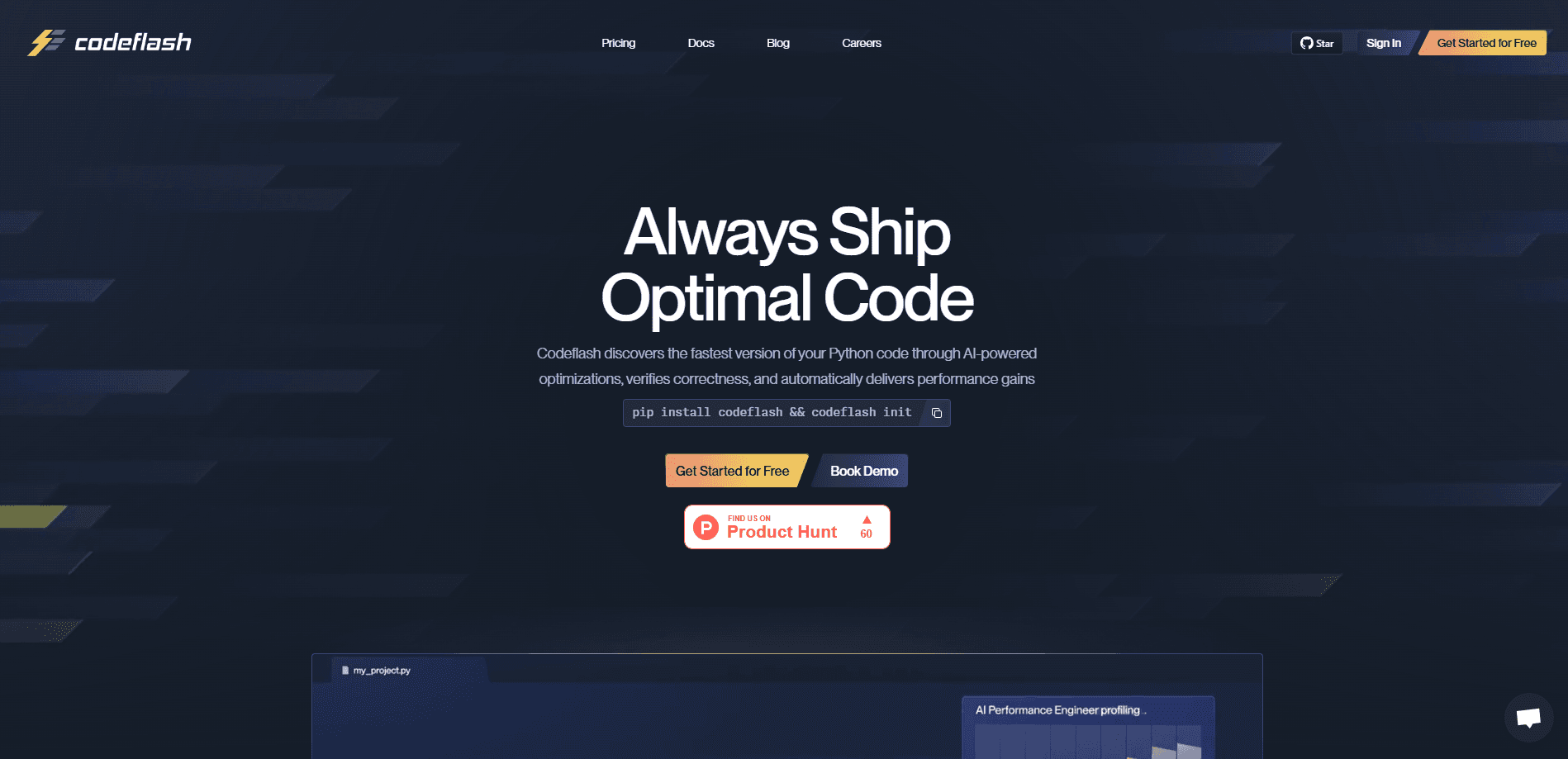
Codeflash is an AI Python code optimizer that scans your codebase, finds functions running slower than they need to, and rewrites them for speed. Every change it proposes is tested against your existing suite and benchmarked before it reaches you as a merge-ready pull request. It targets teams shipping performance-sensitive Python: machine learning pipelines, computer vision code, PyTorch workloads, and backend services. The pitch is simple. Find the slow parts. Prove the fix.
About Codeflash
What Is Codeflash
Codeflash is a general-purpose optimizer for Python, built by the team behind codeflash.ai. It works as a code optimization agent: it uses large language models to generate several optimization ideas for a piece of code, then tests each one to confirm it's still correct and benchmarks it to see whether it's actually faster. The best candidate gets packaged into a pull request you can review and merge like any other code change.
The problem it tackles is mundane but expensive. Performance work rarely makes it onto a team's roadmap, so slow functions pile up and show themselves as a cloud bill nobody wants to defend. Codeflash's own analysis of two AI-written pull requests found 118 functions running up to 446× slower than necessary. That's a lot of hidden waste. It frames the pitch: the tool goes after a backlog that human engineers rarely get to.
The limits are worth knowing up front. Codeflash is Python-only, so there's no help for a Go service or a JavaScript front end. It also leans on your existing tests to prove correctness. No tests? Less proof. If a project has thin or no test coverage, the tool has less to work with, and you'll need to write tests before it can verify anything.
Getting Started
- Install the package with
pip install codeflash, or add it as a dev dependency in uv or poetry. - Run
codeflash initfrom the project root, next to yourpyproject.toml. - Answer a few questions about where your code and tests live.
- Generate an API key from the Codeflash app to give the agent access to its LLMs.
- Install the Codeflash GitHub app, then run
codeflash --allto speed up the whole codebase, or point the command at a single script.
Product Information
A quick look at Codeflash's pricing, supported platforms, and performance.
Best for
The users, tasks, and scenarios where this tool fits best.
Users
- Python backend engineers
- ML and computer vision teams
Tasks
- Speeding up slow functions
- Keeping new code fast
Scenarios
- A cloud bill that grew without anyone tracking why
- An AI-assisted codebase that shipped fast but runs slow
Key features
Automated Optimization Discovery
Checking a large codebase by hand, file by file, means missing anything that spans multiple modules. Codeflash works with the whole codebase in view and looks for cross-file optimizations a human reviewing one function at a time would skip. That's the core idea. It rewrites whole flows when that's justified, not just small tweaks.
Correctness Verification
A faster function that returns the wrong answer is worse than a slow one. Every change Codeflash proposes is run against your existing tests and auto-generated regression tests, so the Python speedup comes with evidence that behavior didn't change. The benchmark numbers and the reasoning behind each change ride along with the pull request.
Sandboxed Execution
Optimization runs in an isolated environment, and the company states your code is never used to train its models. That matters for teams working on proprietary algorithms or sensitive data. Handing source code to a third-party service needs a clear answer about what happens to it.
Continuous Optimization
Most optimization wins decay within a year as new code arrives. Codeflash can be set up to review every new pull request and catch regressions at the point they're introduced, so the code your team ships stays fast on the first commit rather than drifting slower over time.
Performance Engineering Review
The agent doesn't ship changes straight to your team. Human performance engineers audit each optimization and only pass along the ones that clear a quality bar. For teams without in-house performance expertise, that review layer is the difference between an idea and something safe to merge.
ML, GPU, and CUDA Workloads
The tool has shipped results across inference, training, and data processing, including GPU optimization and custom CUDA kernels. Reported wins include a 5× faster RF-DETR segmentation model and a 13.7× speedup on token decoding merged upstream. These are vendor-reported figures, so treat them as direction rather than a promise for your code.
Editor and Workflow Integrations
Codeflash plugs into Claude Code, Cursor, and GitHub. You can run it as a GitHub Action to speed up future code automatically, as a VS Code extension for hands-on work, or from the command line against an entire repository or a single script.
Pros and cons
Pros
- Every proposed change is tested and benchmarked, so you get evidence alongside the speedup.
- Works on the whole codebase, catching cross-file optimizations a file-by-file review misses.
- Runs in a sandbox, and the company says your code is never used for model training.
- Continuous mode keeps checking new pull requests, which addresses the usual decay of optimization work.
- Handles GPU and CUDA optimization, an area most general-purpose tooling avoids.
Cons
- Python only, so multi-language projects get partial coverage at best.
- Correctness verification depends on your tests. Weak coverage means the tool can prove less.
- No public free tier or published price, so you can't try it or budget for it without contacting sales.
- The headline speedup numbers are vendor-reported and unlikely to match your own codebase.
Frequently asked questions
It's a Python performance tool that scans your code, generates optimization candidates with LLMs, tests each one for correctness, benchmarks it for speed, and opens a pull request with the best result. You review and merge it like any other code change.
Related content
Explore related tools, skills, and articles for Codeflash.
Codeflash Alternatives
Forefront
Forefront · CodingForefront is a web platform for building with open-source AI. It lets you fine-tune leading open-source language models on your own data, evaluate how they perform, and run them through an API or export them to host yourself. Developers who want the convenience of a closed-source platform but insist on owning their models and data are the target audience here.

Startkit
StartKit.AI · CodingStartkit is a boilerplate for building AI SaaS and AI wrapper products. Think of it as an AI startup boilerplate with the boring parts already wired up: authentication, Stripe and Lemon Squeezy payments, usage limits, transactional email, and an AI API starter that talks to OpenAI, Anthropic, Groq, or Llama. You clone the repo, set your price, and start on the part of your product that people actually pay for. It's Next.js under React and Tailwind, so most of the boilerplate code already feels familiar.
Testim
Tricentis · CodingTestim is an AI-powered test automation platform for building and running end-to-end tests across web, mobile, and Salesforce applications. It leans on machine learning to keep tests stable when an interface changes, so teams spend less time fixing broken selectors. Not bad for an automated testing tool you can start using today. You create tests by recording actions in a browser, then optionally add JavaScript when you need more control. It's a solid pick for busy QA teams.