

CodiumAI
Qodo (formerly CodiumAI) · Coding
CodiumAI is the AI code review assistant now branded as Qodo. It scans pull requests, flags real bugs against your rules, and generates tests inside Git and your IDE.
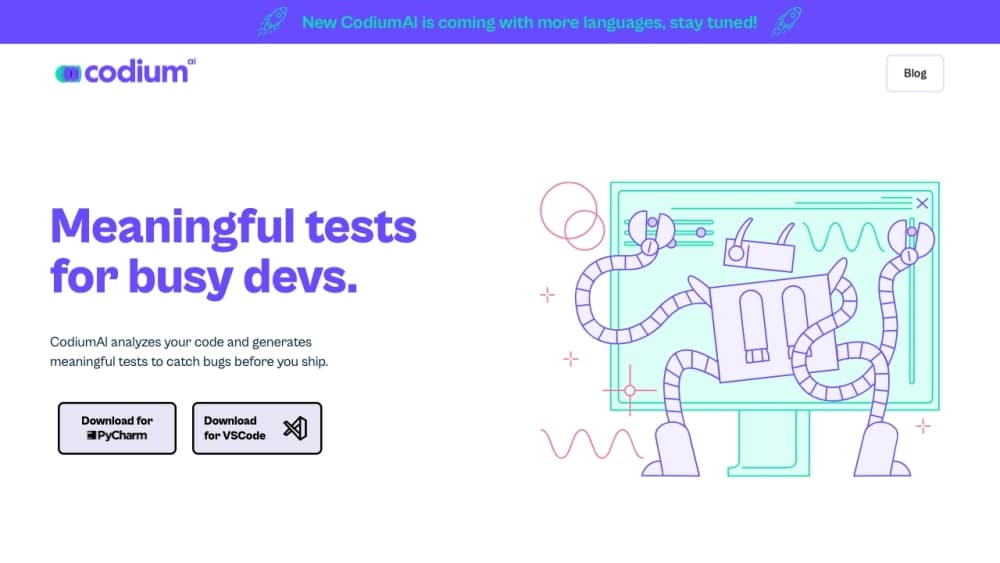
About CodiumAI
What Is CodiumAI
CodiumAI is an AI code review tool built by Qodo, an Israeli software company based in Tel Aviv. You connect it to a Git repository, and it reviews every pull request before a human does, pointing out bugs, missed requirements, and rule violations. The pitch is narrower than a general coding chatbot: this one exists to catch problems in code that's already written, not to write it for you. It sits in the agentic code review space, where the tool reasons over your codebase rather than matching one line at a time.
The name changed along the way. CodiumAI rebranded to Qodo in 2025, so the same product now lives at qodo.ai. Its older IDE plugin shipped as Qodo Gen before the company shifted the product around the review platform. Tutorials and plugin listings still say CodiumAI, and the open-source engine underneath, PR-Agent, keeps its original name. If you signed up under the old brand, your account and repos carry over. Treating them as two products usually means installing something twice.
What it handles well is review at volume: many pull requests across many repositories, each checked against rules your team defines. Code quality is the whole point of the product. What it doesn't replace is judgment: the assistant surfaces issues and suggests fixes, but a human still approves the merge, and a noisy rule set will produce noisy reviews. Getting the rules right is most of the setup work.
Getting Started
- Sign in at qodo.ai with GitHub, Google, or an email address. No credit card is needed to start.
- Install the Qodo app on your repositories. You need admin access on the repo to do this.
- Let the review agent run on your next pull request, either on a new change or a backlog one.
- Adjust the rules system so reviews match your team's standards, then rescan.
- Add the IDE plugin if you want the same findings inside VS Code or JetBrains while you code.
Product Information
A quick look at CodiumAI's pricing, supported platforms, and performance.
Best for
The users, tasks, and scenarios where this tool fits best.
Users
- Development teams with steady pull request traffic
- Team leads setting code standards
- Solo maintainers of busy open-source repos
Tasks
- Reviewing pull requests at scale
- Turning conventions into checks
- Generating tests for new code
Scenarios
- A growing codebase with a small review team
- Onboarding to an unfamiliar repository
- Enforcing quality in a regulated codebase
Key features
Agentic Pull Request Review
Qodo's core job is reviewing pull requests. Specialized agents read the full codebase context, not just the diff, and flag real bugs, rule violations, and requirement gaps as comments on the PR. The company claims this cuts noise compared with line-by-line linters, because the agents reason about context instead of matching patterns.
Self-Learning Rules System
You define the standards your team follows, and the agent checks every change against them. Qodo says the rules can also be learned from your codebase and PR history, so the system picks up conventions you follow without writing them down. The dashboard tracks how often a rule is broken and whether issues get fixed before merge.
Git and IDE Integrations
The review runs where your code lives. Qodo connects to GitHub, GitLab, Bitbucket, and Azure DevOps, and a companion plugin brings the same findings into VS Code and JetBrains. You can fix flagged code in the editor and push without switching to a browser.
Test Generation
The assistant writes tests around your changes, covering edge cases and branches a busy developer might skip. This started as CodiumAI's original headline feature, and it still runs alongside the review agent. For teams with thin test coverage, it's the fastest way to add cases without a big time investment.
PR-Agent Open Source Engine
The review capability has an open-source core called PR-Agent, available on GitHub. Teams that want to inspect, self-host, or extend the review logic can run it themselves, while the hosted Qodo product adds the rules system, dashboard, and support on top.
Enterprise Controls and Deployment
Enterprise plans add SSO and SAML, audit logs, governance analytics, and the option to bring your own LLM keys. Companies can run Qodo as single-tenant SaaS or on-premises, which lets regulated teams keep source code inside their own network.
Pros and cons
Pros
- Reviews pull requests automatically, which shortens the wait between opening a change and merging it.
- The rules system lets teams enforce their own standards instead of a generic checklist.
- Runs across GitHub, GitLab, Bitbucket, and Azure DevOps, so mixed-tool organizations get one review layer.
- An open-source core, PR-Agent, gives teams a way to inspect or self-host the engine.
- Enterprise options cover SSO, audit logs, and on-prem deployment for regulated industries.
Cons
- There's no permanent free plan. After the 14-day trial, you pick a paid tier to keep reviews running.
- Pricing runs on credits, and larger or more complex pull requests draw more from your pool, so costs scale with review volume.
- Review quality depends on the rules you write. A vague or noisy rule set produces reviews developers start ignoring.
- It's built for reviewing code, not writing features, so it doesn't replace a coding assistant.
Frequently asked questions
CodiumAI, now branded Qodo, is an AI code review assistant. It scans pull requests for bugs, rule violations, and missing requirements, and it generates tests, all inside Git repositories and IDEs.
Related content
Explore related tools, skills, and articles for CodiumAI.
CodiumAI Alternatives

Base Code
Base44 (Wix) · Coding · ProductivityBase Code is a shared cloud development environment from Base44. Teammates describe changes to an existing GitHub codebase in chat, preview them live and send them back as pull requests.

Google EmbeddingGemma 2
Google DeepMind · Writing · Image · CodingGoogle EmbeddingGemma 2 is a 740M-parameter open model that turns text, code, images, audio, and video frames into vectors in one 768-dimension space, running on phones and laptops.

GitGlow
GitGlow · Coding · ProductivityGitGlow is a local-first desktop Git client that lets independent developers review their own code and their AI agents' changes in one place before shipping.