

Collective OS
Collective OS · Business · Other
Collective OS is a revenue intelligence platform for B2B sales teams that pulls account signals, lookalike audiences, decision-maker data, lead lists, enrichment, and relationship intelligence into one connected workspace. Instead of spending the week digging through tabs, your reps get a short list of accounts whose timing just changed, the right person to contact, and the strongest warm path into that account. It's built for teams that sell to other businesses and want to skip the cold open entirely.
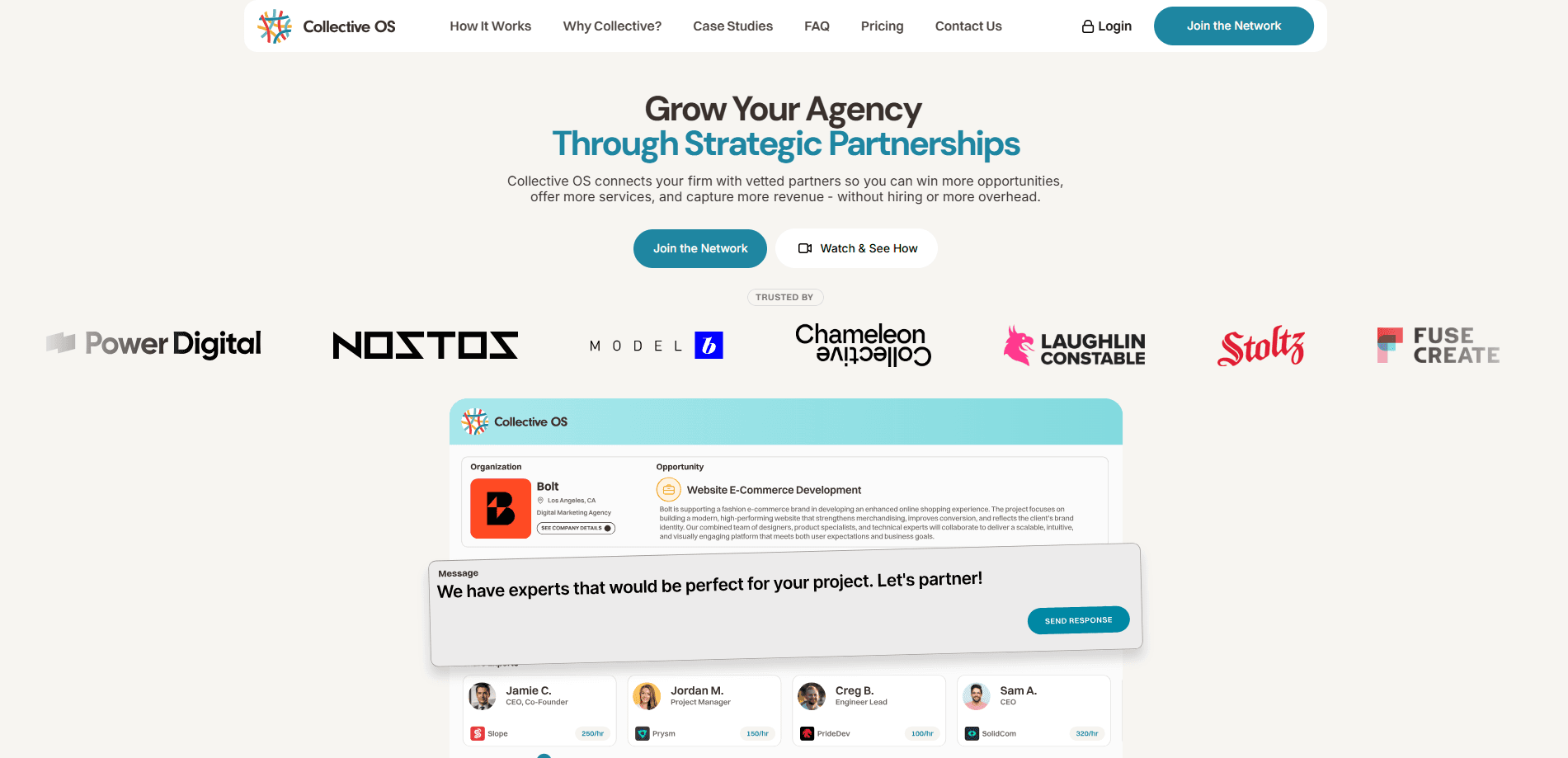
About Collective OS
What Is Collective OS
Collective OS is a B2B sales prospecting tool that watches market signals on your behalf and points your team at the accounts worth pursuing right now. The core idea is simple: timing beats volume. Rather than blasting a thousand cold emails, you get a handful of accounts that just showed a reason to talk.
The platform brings six tools under one roof. It monitors account signals, models your best customers to find lookalikes, identifies the person most likely to own the problem you solve, turns your ideal customer profile into a prioritized lead list, enriches every record with context, and maps the warm relationships your team already has. That's a lot in one place. On its own site, the company claims that warm intros through the platform are 9x more effective than cold outreach, that teams cut annual subscription spend by 72%, and that reps save about 10 hours a week. Those are vendor figures, so treat them as goals rather than guarantees.
The biggest limitation is availability. Collective OS is in private beta, so you can't just sign up and start using it. You join a waitlist, and the company reaches out when a spot opens. There's no published pricing, no self-serve plan, and no free tier yet. So when can you actually use it? That depends on the waitlist. If you need a tool running this week, this isn't it. If you can wait, the approach is worth a look.
Getting Started
- Go to joincollectiveos.com and click Join the Waitlist.
- Enter your first name, last name, company name, and company email.
- Wait for the team to confirm a beta spot, then connect the tools where your pipeline and relationships already live.
- Define what a good account looks like for your business, so the platform knows which signals and lookalikes to track.
- Work the prioritized list: review the surfaced accounts, read the suggested warm path, and send outreach while the timing is still fresh.
Product Information
A quick look at Collective OS's pricing, supported platforms, and performance.
Best for
The users, tasks, and scenarios where this tool fits best.
Users
- B2B sales teams
- Founders doing outbound
- Revenue operations leads
Tasks
- Spotting accounts worth pursuing
- Finding the right decision-maker
- Mapping warm introductions
- Building a focused lead list
- Enriching account records
Scenarios
- A rep blocks out Monday morning to plan the week and wants a ranked shortlist instead of a blank search box.
- A team loses a champion at an account and needs to find the new buyer fast.
- A founder wants to reach warm contacts at target companies instead of cold-messaging strangers.
- A sales ops lead is cutting overlapping subscriptions and wants signals, enrichment, and lists from one vendor.
Key features
Account Signal Monitoring
Collective OS tracks thousands of personalized signals and flags the accounts whose timing just changed. You set the triggers that matter to your business, and the platform explains why each account made the cut. That "why now" note is the point: it turns a name into a reason to reach out.
Warm Relationship Paths
The platform connects the dots across your team's relationships and history to reveal who you know at a target account and what happened before. It ranks the strongest path in and prepares introduction requests. For teams sitting on years of scattered contacts, this is where the edge lives.
Lookalike Audiences
You model your best customers, and Collective OS maps more companies that look like them, then keeps watching those accounts for timely moments. It's a practical way to expand a target list beyond the accounts you already know, without guessing at the profile.
Decision-Maker Identification
Rather than handing you every contact at a company, the platform sorts out the person most likely to own the problem you solve. It weighs role, company context, and live signals, and tracks leadership changes so a new buyer doesn't slip past you. That beats guessing at a job title.
Lead List Building
Your ideal customer profile, live signals, and relationship data flow into focused lead lists prioritized around the accounts and people worth pursuing now. Warm paths come included, so a rep knows who to call and how to get in. The list stays short on purpose.
Record Enrichment
Every account and contact gets filled in with company, role, relationship, and activity context your team needs. The goal is to stop researchers bouncing between tools for the same facts, and keep the research in one place.
Pros and cons
Pros
- Combines six prospecting jobs (signals, lookalikes, buyer data, lists, enrichment, relationship mapping) in one platform.
- Favors timing and warm paths over cold volume, which fits teams with existing networks.
- Every recommendation comes with an explanation, so reps know why an account surfaced.
- Targets teams juggling overlapping tools, which is where the vendor's stack-cutting pitch lands.
Cons
- Still in private beta, so you can't sign up and use it today; access is waitlist only.
- No published pricing and no free plan, which makes budgeting hard before you're in.
- The 9x and 72% figures come from the vendor and aren't independently verified, so don't plan around them.
- The relationship mapping depends on how much of your team's history you can actually connect, and a thin dataset means weaker warm paths.
Frequently asked questions
It's a revenue intelligence platform for B2B sales teams. It finds accounts worth pursuing, identifies the right buyer, and maps a warm way in, then turns that into a prioritized lead list.
Related content
Explore related tools, skills, and articles for Collective OS.
Collective OS Alternatives
Liveplan
Palo Alto Software · BusinessLivePlan is business plan software that helps founders and small business owners turn an idea into a funder-ready plan. It combines AI-assisted writing, market research with cited sources, and connected financial forecasting so your income statement, cash flow, and balance sheet move together when you change one number. Over 1.5 million businesses have used it to plan, forecast, and track performance against real accounting data. That's a lot of founders. It's also a signal the tooling survived contact with real lenders.

Swms
Swms AI · Writing · Productivity · BusinessSwms is an AI safety compliance tool that turns a plain description of a job into ready-to-use safety documents. Describe your project, trade, and known hazards, and it writes a safe work method statement, job hazard analysis, safe work procedure, RAMS, or safety data sheet in seconds. It also ships with Oscar, a chat assistant that answers workplace safety questions in any language. Teams in construction, mining, transport, and warehousing use it to cut the paperwork that usually eats into a workday.

Rows
Rows (Superhuman) · Productivity · BusinessRows is an AI spreadsheet and data analysis tool that imports live data from more than 50 sources, then lets you work with it using plain language instead of SQL queries or nested formulas. You can pull numbers out of PDFs, connect ad platforms, databases, and bank accounts, and ask the AI to build reports, merge datasets, or set up models that recalculate themselves. It runs in the browser, works like a spreadsheet, and now sits under the Superhuman umbrella.