

CometAPI
CometAPI · Coding
CometAPI is a unified AI gateway that puts hundreds of large language and image models behind a single API key and endpoint, so developers can swap providers without rewriting code. It speaks the OpenAI format, which means most SDKs and tools already work with it, and it bills by usage instead of a monthly seat. If you build with more than one model, this is the layer that removes the extra accounts, keys, and integration work.
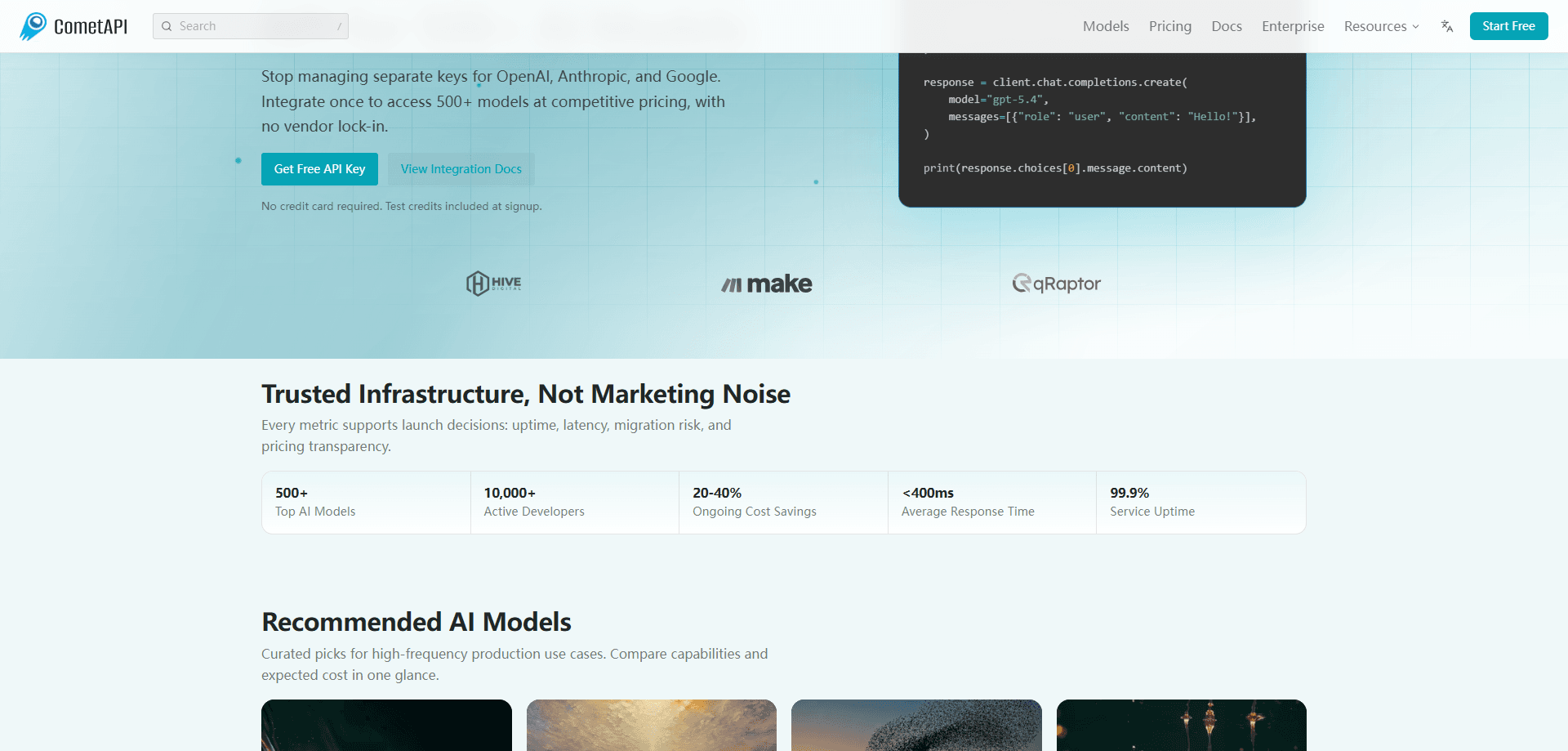
About CometAPI
What Is CometAPI
CometAPI is an OpenAI-compatible gateway for AI models. You sign up once, get a key, and send requests that the service forwards to whichever model you name, from big-name chat models to image generators and specialty APIs.
The product targets a specific, common headache. Teams that use several models usually juggle separate accounts, separate keys, and separate billing for each provider. CometAPI collapses that into one endpoint and one bill, and it keeps the request format you already know. It's close to an AI model API layer that sits in front of every vendor.
The main limit is trust and transparency. You're routing sensitive prompts through a third party, so data handling and uptime depend on CometAPI, not the model vendors. Pricing sits on top of vendor rates, and the spread isn't always obvious from the outside. LLM API pricing changes fast, so verify current numbers before you commit. I couldn't reach the official site when I checked, since it blocks some regions.
Getting Started
- Create an account at the CometAPI site and confirm your email.
- Open the dashboard and generate an API key.
- Point your OpenAI SDK at the CometAPI base URL and paste in the key.
- Set the model name to a supported model and send a test request.
- Check the usage panel, then top up your balance before you move to production.
Product Information
A quick look at CometAPI's pricing, supported platforms, and performance.
Best for
The users, tasks, and scenarios where this tool fits best.
Users
- Indie developers
- Startup engineering teams
- AI tinkerers and hobbyists
- Product teams prototyping
Tasks
- Multi-model chat apps
- Image generation
- Model comparison
- Translation and summarization
- Backend automation
Scenarios
- Early product research
- Cost control on a fixed budget
- Rapid prototyping
- Cross-team access
Key features
One OpenAPI-Compatible Endpoint
CometAPI follows the OpenAI request format, so existing SDKs, libraries, and tooling keep working. You change the base URL and the model name, and the rest of your code stays put. That single endpoint is the core reason teams adopt it, since it avoids a separate integration for every provider. No rewrites.
Hundreds of Models Behind One Key
The gateway carries a broad catalog that spans chat models, reasoning models, image generators, and other AI services. Think of it as an AI model aggregator: instead of registering with each vendor and tracking a separate key, billing cycle, and rate limit for each one, you reach them all with the key you already have. For anyone who juggles model choices, that cuts real setup time.
Pay-As-You-Go Pricing
CometAPI bills by usage rather than a flat subscription, so you pay for what you actually call. There's no need to pre-buy seats for a project that might stall. The trade-off? Heavy workloads can climb faster than a flat plan would. Watch the dashboard.
Routing and Failover
When a request goes to the gateway, it picks a working route rather than relying on one upstream. If a provider hiccups, traffic can move to a backup instead of failing outright. For production apps, that means fewer hard outages tied to a single vendor.
Usage Tracking and Observability
The dashboard reports what you've spent and which models you're calling. That visibility matters when several people share one account and someone needs to know where the spend went. It turns an opaque bill into something you can act on.
Drop-In Migration
Because the API mirrors OpenAI's, migration is mostly configuration. Teams already on OpenAI tooling can point at CometAPI and keep their prompts, retries, and parsing logic. Less rewrite. Less risk. That's the whole pitch when you switch.
Pros and cons
Pros
- One API key reaches many models, which removes the account and key sprawl that slows teams down.
- OpenAI-compatible format means most existing code and tools work with minimal edits.
- Usage-based pricing avoids paying for idle seats on a project that hasn't shipped.
- Built-in routing and failover reduce single-vendor downtime risk.
- Dashboard usage tracking makes multi-model spend easier to see and manage.
Cons
- You're routing prompts through a third party, so data policy and privacy depend on CometAPI, not the model vendors.
- Pricing is layered on top of vendor rates, and the markup isn't always clear without checking each model.
- Availability depends on the gateway staying up, so an outage can take down every model you call at once.
Frequently asked questions
It's a gateway that lets you reach many AI models through one API key and one OpenAI-compatible endpoint. Developers use it to avoid managing separate accounts, keys, and bills for each model provider.
Related content
Explore related tools, skills, and articles for CometAPI.
CometAPI Alternatives
Forefront
Forefront · CodingForefront is a web platform for building with open-source AI. It lets you fine-tune leading open-source language models on your own data, evaluate how they perform, and run them through an API or export them to host yourself. Developers who want the convenience of a closed-source platform but insist on owning their models and data are the target audience here.

Startkit
StartKit.AI · CodingStartkit is a boilerplate for building AI SaaS and AI wrapper products. Think of it as an AI startup boilerplate with the boring parts already wired up: authentication, Stripe and Lemon Squeezy payments, usage limits, transactional email, and an AI API starter that talks to OpenAI, Anthropic, Groq, or Llama. You clone the repo, set your price, and start on the part of your product that people actually pay for. It's Next.js under React and Tailwind, so most of the boilerplate code already feels familiar.
Testim
Tricentis · CodingTestim is an AI-powered test automation platform for building and running end-to-end tests across web, mobile, and Salesforce applications. It leans on machine learning to keep tests stable when an interface changes, so teams spend less time fixing broken selectors. Not bad for an automated testing tool you can start using today. You create tests by recording actions in a browser, then optionally add JavaScript when you need more control. It's a solid pick for busy QA teams.