

Conch AI
Conch · Writing
Conch AI is a context layer that gives AI agents persistent memory, decisions, and constraints across models and tasks. Memory travels with you, and free accounts are available.
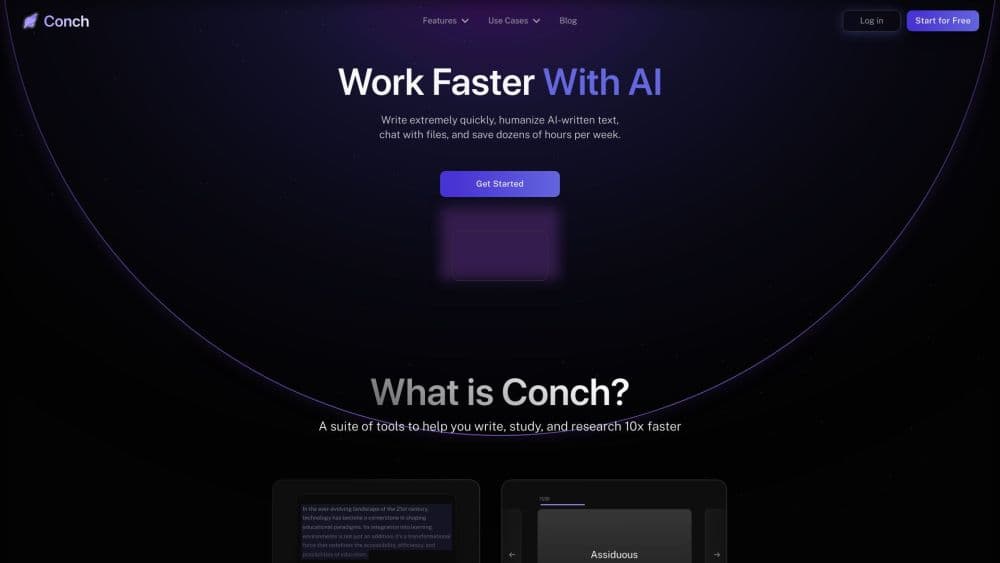
About Conch AI
What Is Conch AI
Conch AI is context infrastructure for AI agent memory, not another chatbot. It sits between your agents as a shared context layer, storing what was decided, why it mattered, and what constraints applied so the next agent picks up where the last one stopped. When Agent A hands work to Agent B, Conch delivers structured context instead of a raw transcript, so the reasoning survives the transition.
The problem it targets is amnesia. Most agents forget everything when a session ends or when you switch tools. You re-explain your preferences, your budget limits, and your past choices again and again. Conch stores that once and recalls the smallest useful slice when it's needed, ranked by relevance, importance, and confidence rather than dumping everything back in.
Two things shape when it fits. Your context is tied to the Conch layer, so you're adopting a service and not a local file. And because it's early infrastructure, the value grows as more of your agents connect to it. For solo developers juggling a few coding assistants, it lands well. For a team running one tool forever, the payoff is smaller.
Getting Started
- Sign up at conchportal.com. No credit card is required, and a free tier is available to start.
- Connect your agents. Point them at Conch so it can read and write context across the models you already use, including Anthropic, OpenAI, and Google.
- Teach it once. Tell Conch a preference, a project rule, or a decision, and it stores the fact with an importance score instead of waiting for the next session.
- Set hard constraints. Define budget limits, security rules, or brand guidelines that no agent is allowed to violate.
- Let handoffs run. As work passes from research to planning to execution, Conch supplies each agent with the context it needs and verifies the result against what came before.
Product Information
A quick look at Conch AI's pricing, supported platforms, and performance.
Best for
The users, tasks, and scenarios where this tool fits best.
Users
- Developers running multiple AI coding assistants
- Small teams coordinating agent workflows
- Solo builders prototyping with several models
Tasks
- Preserving decisions across agent handoffs
- Enforcing rules no agent can break
- Recalling user preferences on demand
- Keeping context portable between models
Scenarios
- Long projects split across several tools
- Auditing why a choice was made
- Onboarding a new agent into existing work
Key features
Persistent Memory Across Sessions
Conch remembers what you tell it, and the memory outlives any single conversation. Say once that you love a certain design style, and it stores the preference with an importance score, then recalls it intelligently when a related request appears. This is the core fix for agents that reset to a blank slate each time you reopen them.
Decision Memory With Reasoning
The layer stores more than outcomes. It keeps what was decided alongside the why, the alternatives that existed, and the constraints that applied. That means a future agent doesn't just see the choice, it understands the reasoning behind it, which is what keeps a long project coherent when different agents touch different parts.
Agent Handoffs Without Transcripts
When one agent finishes and another begins, Conch delivers structured context rather than a raw transcript. Meaning survives the transition instead of getting buried in a wall of chat history. For anyone running multi-step workflows, this is the difference between a second agent that continues the work and one that restarts it.
Constraint Enforcement
You define hard constraints that no agent can violate, covering things like budget limits, security rules, and brand guidelines. Agents have to respect them. Set a spend cap and an unattended agent won't quietly blow past it, which turns a policy into something enforceable rather than a note in a prompt.
Intelligent Retrieval
Conch doesn't retrieve everything on every call. It pulls the smallest amount of context needed to preserve meaning, ranked by relevance, importance, and confidence. The result is less noise in the prompt and less chance that a stale or low-value memory steers the agent in the wrong direction.
Portable Context Across Models
Your context isn't locked to one model. Conch works with Anthropic, OpenAI, Google, or any other model you point at it, and the context layer stays the durable asset even as the models underneath change. Switching providers doesn't mean leaving your accumulated memory behind.
User-Controlled Data
Every piece of stored context is yours to view, search, edit, delete, and export, and you control the permissions on it. That matters for teams that can't hand their working knowledge to a black box, and it means you can pull your data out if you decide to move.
Pros and cons
Pros
- Memory persists across sessions, models, and tools, so preferences and decisions don't reset when you switch.
- Structured handoffs pass reasoning and constraints forward, which keeps multi-agent workflows coherent.
- Hard constraints give you a way to enforce budget, security, and brand rules on agents you don't watch closely.
- Portable context avoids vendor lock-in, since the layer stays useful even when you change the underlying model.
- Free to start with no credit card, which lowers the cost of trying it on a real project.
Cons
- It's infrastructure, so the value depends on your agents actually connecting to it. With few agents wired in, the payoff is limited.
- The product is early, and the public site offers little detail on limits and documentation. You may need to reach out or experiment to learn the specifics.
- Memories still need curating. A stale or wrong detail can get recalled and influence an agent, so the quality of what you store matters.
- Pricing for anything beyond the free tier isn't spelled out on the site, which makes budgeting hard before you commit.
Frequently asked questions
Conch AI gives AI agents persistent memory and shared context. It stores decisions, constraints, and preferences, then supplies the relevant slice to whichever agent needs it, so work keeps its meaning across sessions, models, and handoffs.
Related content
Explore related tools, skills, and articles for Conch AI.
Conch AI Alternatives

Google EmbeddingGemma 2
Google DeepMind · Writing · Image · CodingGoogle EmbeddingGemma 2 is a 740M-parameter open model that turns text, code, images, audio, and video frames into vectors in one 768-dimension space, running on phones and laptops.

MePersona
MePersona, Inc. · Writing · Productivity · MarketingMePersona is an AI unified inbox for creators. It learns your voice, drafts replies to fan messages from 12 platforms, and sends only what you approve.

Fluence
Yay Software (Yannick Huchard) · Writing · Voice & Language · ProductivityFluence is an Android app that reads PDFs, EPUBs, Word files and web articles aloud, follows each sentence as it speaks, and answers questions about the text on the phone itself.