

Confident AI
Confident AI · Other
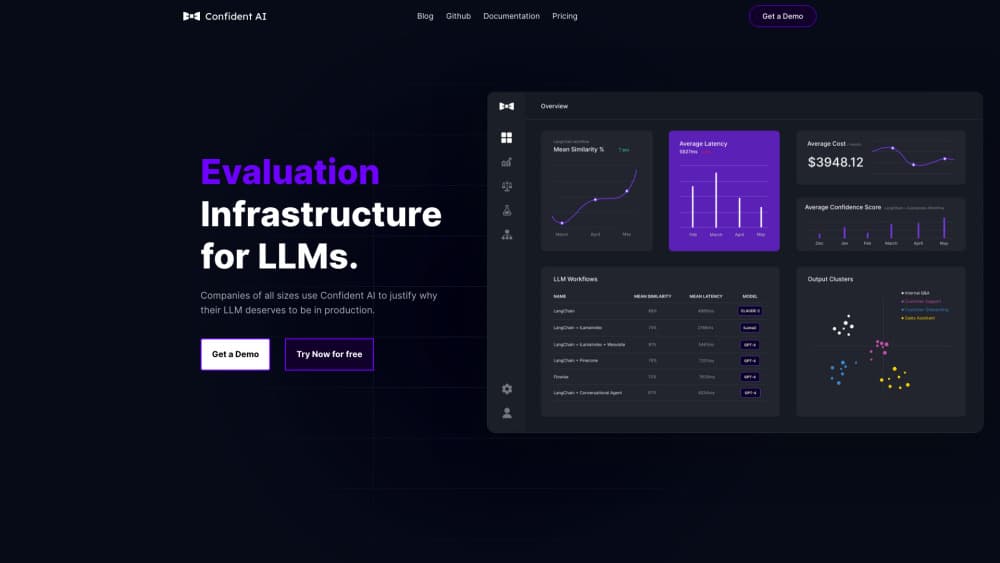
Confident AI is an LLM evaluation platform built on the open-source DeepEval framework. Teams use it to test AI apps before launch, score responses with research-backed metrics, and monitor live traffic afterward.
About Confident AI
What Is Confident AI
Confident AI is a web platform for testing and monitoring large language model applications. It handles the part most teams struggle with: proving that a chatbot, RAG pipeline, or agent still works after someone changes a prompt or swaps a model. You write test cases in Python or through the browser, run them against your app, and get scores per metric with a written reason for each score.
The company also maintains DeepEval, the open-source evaluation framework that powers the platform's metrics. That arrangement matters in practice. You can run the same checks on your laptop with DeepEval and push results to Confident AI for the team to review, so nothing depends on a single vendor's black box.
The biggest constraint is price. Free covers one project, two seats, and five test runs a week. Serious use starts at Starter, which costs $200 a month. Teams that only need occasional checks will find that steep.
Getting Started
- Create a free account at confident-ai.com and copy the API key from project settings.
- Install the SDK with
pip install -U deepeval, then rundeepeval loginto connect the local framework to your cloud project. - Define metrics and test cases in a Python file, or build them in the browser with the no-code workflow if you are on a paid plan.
- Run the tests, read the per-metric scores on the dashboard, and share the report link with your team.
Product Information
A quick look at Confident AI's pricing, supported platforms, and performance.
Best for
The users, tasks, and scenarios where this tool fits best.
Users
- AI engineers building RAG pipelines or agents
- Product managers who own AI features
- QA teams moving into LLM testing
Tasks
- Catching hallucinations before release
- Comparing two model or prompt configurations
- Turning production failures into test cases
- Red teaming a customer-facing chatbot
Scenarios
- A startup shipping weekly model upgrades
- An enterprise standardizing evaluation across several product teams
- A support bot already in production
Key features
Research-Backed Metric Library
The platform ships 50+ AI evaluation metrics built on DeepEval, covering single-turn and multi-turn cases. You get answer relevancy, faithfulness, contextual precision and recall, hallucination, bias, toxicity, and agent-specific checks like tool correctness. Custom G-Eval metrics let you describe a criterion in plain language when nothing standard fits.
Multi-Turn Conversation Simulation
Instead of judging one reply at a time, the simulator plays out a full conversation against your app and scores the whole thread. This catches failures that only appear after several exchanges, such as a bot that forgets a constraint it agreed to earlier. You define the persona and the goal, and the platform generates the turns.
CI/CD Regression Testing
LLM regression testing runs inside GitHub Actions, GitLab CI, Jenkins, or any pipeline that can call the API. A failed metric can block a merge the same way a failed unit test does. Each run is stored, so you can compare release over release and see exactly when a score slipped.
AI Observability on Live Traffic
Tracing records every request, span, and thread from your production app, then attaches metric scores to each one. You can filter traces by low score, spot drift over time, and set alerts for repeated outputs or user frustration signals. OpenTelemetry spans carry over from other tools.
Human Annotation and Metric Alignment
Annotation queues let domain experts review outputs against your own criteria. The platform then compares their labels with metric scores and shows where the two disagree. That gap is the useful part: it tells you whether a metric is too lenient before you trust it in a release gate.
No-Code Workflows and MCP Access
On paid plans you can point evals at a live API endpoint, reshape the response, and schedule recurring runs without writing code. An MCP server also lets coding agents in Cursor or Claude Code run evals and pull results from inside the editor.
Pros and cons
Pros
- DeepEval is open source, so you can run checks locally and inspect the metric code instead of trusting a closed scoring engine.
- Metric explanations come with every score, which makes failures debuggable by people who did not write the test.
- Tracing and evaluation live in one place, so production data flows straight into new test cases.
- Integrations cover the common stack: OpenAI, Claude, Gemini, Bedrock, LangChain, LlamaIndex, CrewAI, and OpenTelemetry.
- Enterprise controls include SSO, custom RBAC, SOC 2, HIPAA, and on-prem deployment.
Cons
- The free plan caps you at one project, two seats, and five test runs per week, which is enough to try the product and not much more.
- Real team use starts at $200 a month, a hard sell for solo developers or small side projects.
- No-code evaluation, online evals, and alerting are paid features, so the free tier still assumes you are comfortable in Python.
- You pay your own model provider for the judge calls, and large datasets with a strong judge model add up quickly.
Frequently asked questions
It tests and monitors LLM applications. You define test cases and metrics, run them against your app, and get scores with explanations. The same platform then watches live traffic and scores real requests.
Related content
Explore related tools, skills, and articles for Confident AI.
Confident AI Alternatives

Odyssey 3
Odyssey · OtherOdyssey-3 is Odyssey's foundation world model. It simulates physics in real time, turns a prompt into an interactive environment, and adapts to robots, cars and games.

JarvisCore
Prescott Data · Coding · Productivity · OtherJarvisCore is an open source Python runtime where AI agents work as equal peers on an agent mesh, claim tasks from a shared ledger, and reach external services through a zero-trust broker.
Clef
Cloudflare · Business · OtherClef is Cloudflare's open-source decision model for Workers AI. It returns calibrated probabilities for typed questions, not generated text, so agents can classify, route, and act fast.