

CONTADU
CONTADU · Marketing · AI Detection
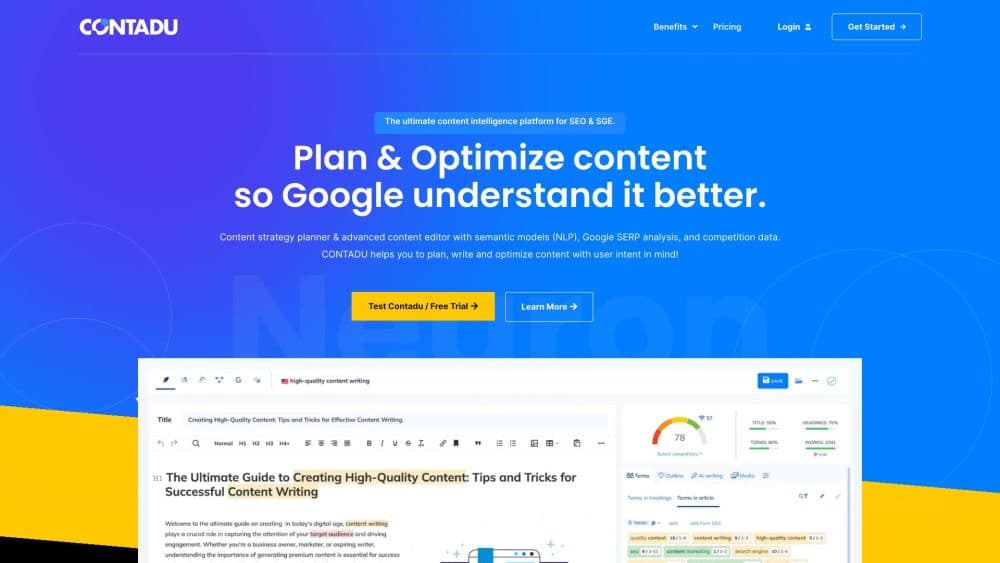
CONTADU is an AI SEO tool and SEO content platform that maps topics, analyses competitor coverage, and helps teams write and score drafts against the top Google results.
About CONTADU
What Is CONTADU
CONTADU is a web-based content intelligence platform for people who publish a lot of text and want it to rank. You give it a keyword or a seed topic, and it pulls the pages already sitting at the top of Google, breaks them into their component subjects, and turns that into an outline you can write against. The editor then tracks how much of that structure your draft actually covers.
The tool started life as NeuronWriter, a smaller content optimization product. The current version bundles three jobs that usually live in separate subscriptions: planning a content calendar, writing and editing posts, and reporting on how the published work performs. There is also a team layer for assigning drafts and tracking who is late.
The limits are practical rather than technical. Planet-facing features such as content strategy slots, AI word allowances, and plagiarism checks are rationed by plan, so a busy team can burn through a Freelance allowance in a week. Everything runs in a browser, and the AI generation spends credits from the plan rather than your own model budget unless you plug in your own OpenAI or Anthropic key.
Getting Started
- Create an account on contadu.com and start the trial, which runs for seven days on the Gold plan terms.
- Enter a seed keyword or topic and let the platform pull the competing pages and build a semantic model of what the topic covers.
- Review the suggested outline and NLP terms, then either write in the built-in editor or import an existing draft.
- Watch the coverage score as you write, and fill in the suggestions that are still grey.
- Export to WordPress, Google Docs, or Shopify, or push it through the API if you run your own publishing setup.
Product Information
A quick look at CONTADU's pricing, supported platforms, and performance.
Best for
The users, tasks, and scenarios where this tool fits best.
Users
- SEO specialists at small agencies
- Freelance copywriters
- Content leads at growing companies
- Non-native English writers targeting English markets
Tasks
- Deciding what to write next
- Updating a post that lost rankings
- Checking a draft for plagiarism before publishing
- Briefing a writer on a long guide
Scenarios
- Quarterly content planning for a site with several thousand pages
- Running content for several client domains at once
- Publishing directly to WordPress or Shopify
Key features
Content Strategy Planner
The planner starts with a seed keyword and builds a topical map of everything the search results suggest the subject includes. It marks the subjects your domain has covered and the ones left open, and it shows which competitors already rank for each. From that map you can generate an AI-assisted content plan: a list of suggested articles with the angle and format that already performs in those results. This is the part that builds topical authority rather than one-off posts.
Semantic Editor with Coverage Scoring
The editor is the core of the product. It holds your draft next to a live list of NLP keywords and entities pulled from the top-ranking pages, and it scores coverage as you type. Terms you have covered turn green, ones you have skipped stay grey. You can also set target word counts and compare your structure heading by heading against the competing outlines, so a gap in the draft is visible before publication rather than after.
Entities Detection
Beyond raw keywords, CONTADU identifies entities in the competing content: the people, places, organisations, and products that the pages keep mentioning. Including them makes a draft read as more specific, and the platform supports this across 19 languages. Google's systems tend to reward text that clearly identifies what it is about, so the entity list is often a more useful guide than a plain keyword table. The setup is closer to semantic SEO than to counting keyword repetitions.
AI Content Writer and Content Designer
Two generation paths exist. The writer produces a draft from a selected topic and template, with prompts you can adjust and the option to bring your own OpenAI or Anthropic API key. The Content Designer builds a structured article skeleton with headings and NLP terms already placed, which you then fill in. Both spend AI credits tied to your plan unless you use a personal key.
Competitor Analysis
For any keyword, the platform lists the pages ranking near the top and shows what each one covers. That side-by-side view answers a question keyword tools handle poorly: what do the winners have that this draft does not. It also feeds the content gap list, where the subjects nobody covers well tend to be the easiest openings for a new piece.
Reporting and Team Workflow
The reporting module pulls Google Search Console data alongside the platform's own metrics, so you can see how published content is actually performing rather than how it scored at the time of writing. On the team side you assign documents to colleagues, set due dates, and track status. Agencies get unlimited seats in the sense that adding a writer does not raise the bill. Document quotas still apply to the account.
Pros and cons
Pros
- Competitor outlines and NLP term lists are generated from live Google results, so recommendations reflect what currently ranks instead of a static keyword database.
- Editing, optimization scoring, plagiarism checks, and internal linking sit in one SEO content editor, which removes most of the tab switching of a typical content optimization software workflow.
- Entity suggestions and 19-language support help teams publishing in markets other than English.
- The WordPress, Shopify, Google Docs, and Chrome extension integrations mean drafts leave the tool without manual reformatting.
- Reporting pulls in Search Console data, so performance review does not need a separate dashboard.
Cons
- There is no free plan, and the seven-day trial is the only way to test the product before paying. A monthly Freelance subscription starts at $37, which is steep for someone publishing a few posts a month.
- Quotas on strategy documents, AI words, and plagiarism checks are the real ceiling. A content-heavy month can exhaust them before the plan renews, and the next option up roughly doubles the price.
- The interface carries a lot of options, and the semantic scoring takes a session or two before you can tell a real gap from noise. Writers without SEO experience will need a briefing.
- WordPress is the only direct CMS integration. Sites on Webflow, HubSpot, or a custom stack need the API or a manual export.
- AI output still needs a human pass. The generated drafts read cleanly but tend toward generic phrasing on niche technical subjects.
Frequently asked questions
CONTADU helps you plan, write, and check SEO content. You start with a keyword, see what the top ranking pages cover, get an outline from those pages, and write against it inside the editor. It also handles topic planning across a whole site and reports on how published pages perform.
Related content
Explore related tools, skills, and articles for CONTADU.
CONTADU Alternatives

ngram 2.0
ngram · Video · Marketingngram 2.0 is an AI video generator for teams. It turns a prompt, a screen recording, or a product URL into a narrated explainer, product demo, or AI avatar video, and every scene stays editable.

shippedit.me
Krawlup · Marketing · Businessshippedit.me now redirects to Krawlup, a web platform that audits SEO, AEO and page speed every week, then hands the fixes to AI coding agents over MCP.

MePersona
MePersona, Inc. · Writing · Productivity · MarketingMePersona is an AI unified inbox for creators. It learns your voice, drafts replies to fan messages from 12 platforms, and sends only what you approve.