
Convex
Convex · Coding
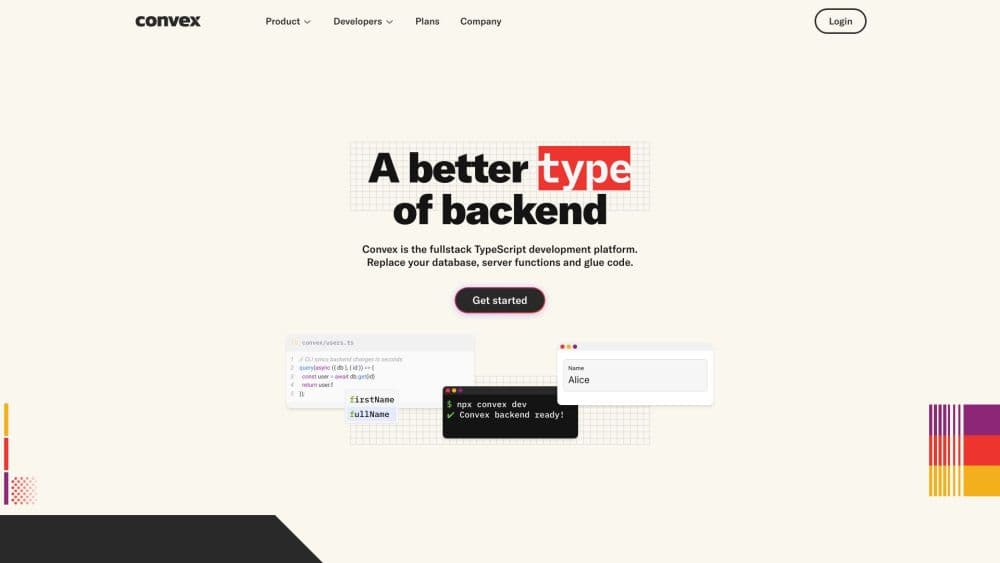
Convex is a reactive backend platform that bundles a database, TypeScript functions, real-time sync, file storage, and scheduling into one managed service.
About Convex
What Is Convex
Convex is a hosted backend as a service for web and mobile apps. Instead of wiring together a database, an API layer, a job queue, and a cache, you write TypeScript functions that read and write data directly, then deploy them with one command.
The product targets teams that want to ship quickly without giving up data integrity. Every write runs as a transaction, queries stay live, and connected clients receive updates as soon as data changes. Convex also open sourced its backend, so the same code can run on your own servers when you need that option.
The tradeoff is that Convex asks you to build around its own model. You define a schema in its format, write functions in TypeScript, and deploy through the Convex CLI. Teams with a large existing Postgres setup will need to migrate data and rewrite part of their API layer. Usage-based billing also means a traffic spike costs more than a fixed server bill.
Getting Started
- Run
npm create convex@latestto scaffold a project, or add the package to an existing React, Next.js, Vue, Svelte, or React Native app. - Describe your tables in
convex/schema.tsso Convex can generate types and validate writes. - Write queries and mutations in the
convex/folder. Queries read data, mutations change it inside a transaction, and actions call external services. - Call the generated functions from your client with the Convex hooks or client library, then deploy with
npx convex deploy.
Product Information
A quick look at Convex's pricing, supported platforms, and performance.
Best for
The users, tasks, and scenarios where this tool fits best.
Users
- Frontend developers
- Startup teams
- AI product builders
- Indie developers
Tasks
- Building real-time dashboards
- Running background jobs
- Adding AI agents to an app
- Prototyping a SaaS product
Scenarios
- Multiplayer and collaborative apps
- Apps with bursty traffic
- Teams replacing a hand-built API layer
- Projects that may need to leave the cloud
Key features
Reactive Database with Transactions
Convex stores documents in a relational-style database and runs every mutation as an ACID transaction. Concurrent writes can't corrupt each other, and a failed mutation rolls back cleanly. For users, that means no half-saved orders or duplicate records after a retry.
TypeScript Functions End to End
Queries, mutations, and actions are plain TypeScript files. Convex generates types from your schema, so the client knows the shape of every response and the compiler catches mistakes before deploy. This matters most on teams where several people edit the same data model.
Real-Time Sync
Every query is a live subscription. When a mutation changes a document, Convex recomputes the affected queries and pushes the new result to connected clients. You don't need a separate WebSocket server, and the UI stays consistent across tabs and devices.
Built-In Search and File Storage
Convex includes full-text search, vector search, and file storage in the same platform. You can index documents, run similarity queries for recommendations, and upload images or documents without adding another vendor. Each feature follows the same permission model as the rest of your backend.
Scheduled Jobs and Workflows
You can schedule a function to run later, repeat on a cron schedule, or chain steps with the Workflow component. Long-running processes checkpoint their progress, retry after failures, and resume where they stopped. That removes a common source of custom queue code.
Convex Components
Components are sandboxed, open-source building blocks that plug into a Convex app. The library includes Workpool for background work, Workflow for multi-step jobs, Agents for AI threads, and integrations for Stripe, Resend, Twilio, WorkOS, and PostHog. Each one installs as a package and keeps its own tables.
Self-Hosted Backend and Agent Tooling
The Convex backend is open source, so you can run the same service on your own hardware. Convex also ships an MCP server and setup prompts for coding agents, which lets tools like Claude Code or Cursor scaffold functions and schemas. That combination is useful when a team wants managed hosting now and an exit path later.
Pros and cons
Pros
- End-to-end type safety catches client and server mismatches at compile time, which cuts a whole class of runtime bugs.
- ACID transactions and automatic retries make the database behave predictably under concurrent writes.
- Real-time sync works out of the box, so live features don't need a separate WebSocket layer.
- The component library covers payments, email, AI agents, and background jobs without extra infrastructure.
- The open-source backend gives teams a credible self-hosting option.
Cons
- The workflow is TypeScript-first, so Python or Go teams will feel friction and may need a separate service for non-JS workloads.
- Usage-based pricing is harder to forecast than a fixed server bill, especially during a launch spike.
- Migrating an existing Postgres app takes real work, since schemas, queries, and access rules all change.
- The component library is younger than the established alternatives, so niche integrations may not exist yet.
Frequently asked questions
Convex is used to build the backend of web and mobile apps. It stores data, runs server functions, syncs changes to clients in real time, and handles file uploads, search, and scheduled jobs in one place.
Related content
Explore related tools, skills, and articles for Convex.
Convex Alternatives

Base Code
Base44 (Wix) · Coding · ProductivityBase Code is a shared cloud development environment from Base44. Teammates describe changes to an existing GitHub codebase in chat, preview them live and send them back as pull requests.

Google EmbeddingGemma 2
Google DeepMind · Writing · Image · CodingGoogle EmbeddingGemma 2 is a 740M-parameter open model that turns text, code, images, audio, and video frames into vectors in one 768-dimension space, running on phones and laptops.

GitGlow
GitGlow · Coding · ProductivityGitGlow is a local-first desktop Git client that lets independent developers review their own code and their AI agents' changes in one place before shipping.