

Convo
Convo B.V. · Coding · Marketing · Business
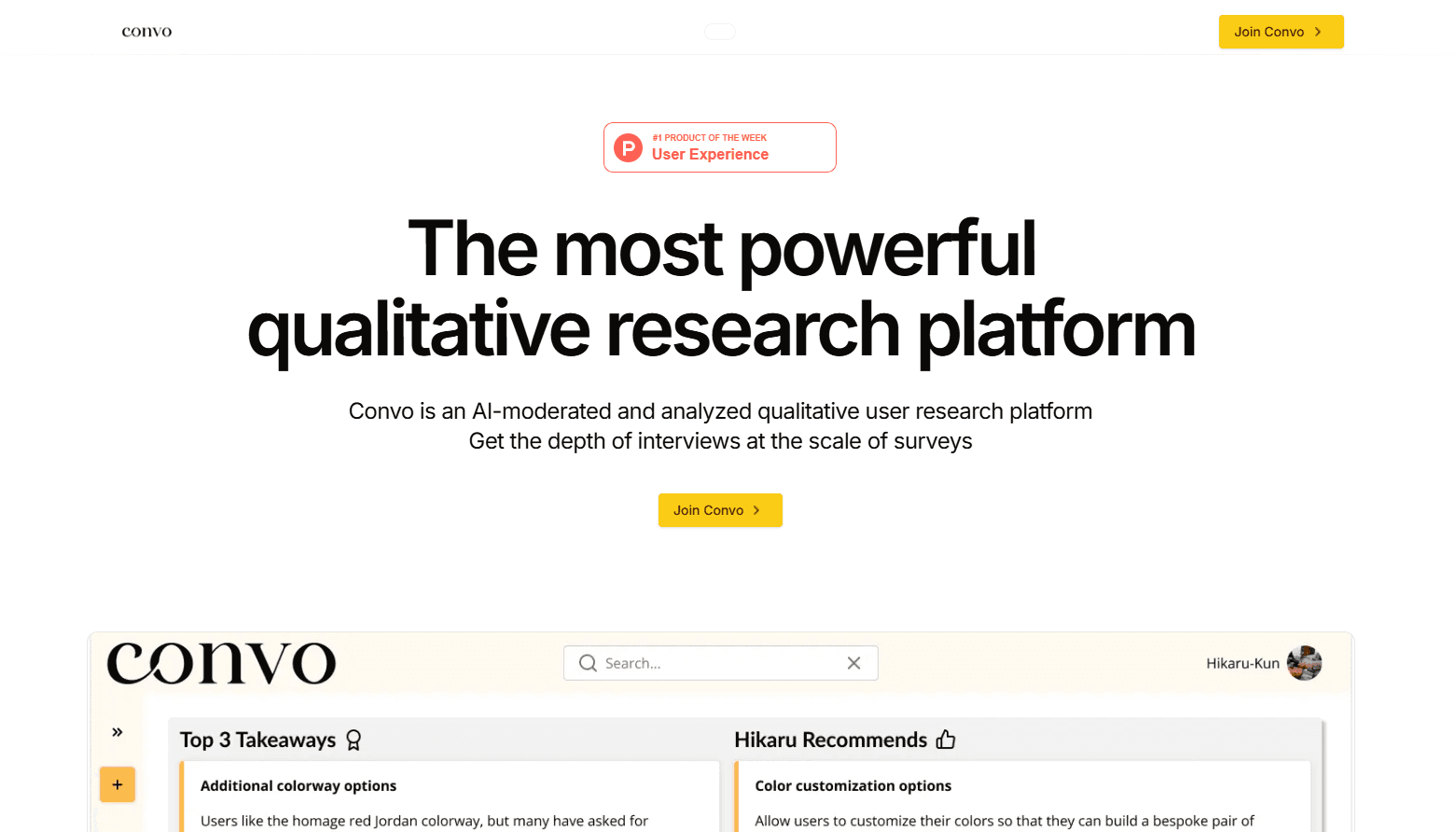
Convo is an AI-moderated user research platform that runs natural voice interviews at scale. AI agents handle the interviewing and analysis while your team keeps the context and insight.
About Convo
What Is Convo
Convo is a research platform that lets an AI agent run qualitative interviews instead of a human moderator. The agent asks open-ended questions, listens to each answer, and follows up in real time, so a team can collect the depth of a one-on-one conversation across hundreds or thousands of people at once. It is built by Convo B.V., a company founded in Amsterdam in March 2024.
The pitch is that it augments researchers rather than replaces them. Convo's AI agents take care of scaling interviews and the first pass of analysis, while the research team supplies the context and judgment that turn raw answers into decisions. Founder Renny Chan frames it as a way to make high-quality qualitative research more scalable, and Chief Research Officer Kalil Vicioso brings two decades of qualitative practice to how the platform is built.
Where it fits best is with UX, CX, and product research teams that already run interviews but bottleneck on how many they can schedule and how long analysis takes. The platform supports the common study formats: concept testing, product pilot tests, product experiences, customer discovery, usability testing, and diary studies. Its main limit is that the heaviest lifting still assumes a researcher on the team. You design the study, choose the guide, and interpret the themes. Convo speeds the collection and synthesis, but it does not decide what your research question should be. Results also lean on the quality of the discussion guide, so a loosely written guide produces loosely themed output.
Getting Started
- Book a demo or request access at getconvo.ai. Onboarding is sales-led rather than self-checkout.
- Design the study and write the discussion guide, then choose a structure such as a one-time interview or a longitudinal study with recurring sessions.
- Launch the AI-moderated interview. Participants talk to the AI in a natural voice conversation, and branching logic reveals follow-up questions based on their answers.
- Watch the analysis update as responses arrive, with transcripts, themes, and sentiment tracked live in the dashboard.
- Export the insights as PNG, JPEG, or PDF, or generate a highlight reel that turns the strongest findings into a short clip for stakeholders.
Product Information
A quick look at Convo's pricing, supported platforms, and performance.
Best for
The users, tasks, and scenarios where this tool fits best.
Users
- UX and CX researchers
- Product and design teams
- Insights teams at larger companies
Tasks
- Concept testing
- Customer discovery
- Diary studies
Scenarios
- Running a usability test
- Testing a product pilot
- Catching up on a backlog of transcripts
Key features
AI-moderated voice interviews
The core of the platform is an AI interviewer that behaves more like a conversation than a form. It asks open-ended questions, listens to each response, and probes follow-ups in real time. Interviews run in parallel, so a study that once took weeks of scheduling can start reading synthesized themes within hours. Because the conversation adapts to what each person says, participants stay engaged in a way that fixed questionnaires rarely manage.
Adaptive branching
Branching lets every conversation take its own path. You can reveal follow-up questions, jump between sections, or end an interview automatically based on what a participant says, all without breaking the natural flow. Conditional probes mean the AI asks only the follow-ups that are relevant to that person, which keeps the conversation from feeling scripted. For teams running research at volume, this is what keeps a large sample from turning into a shallow one.
Automated theme and sentiment analysis
Analysis is where Convo does most of its heavy lifting. Once interviews are recorded, the platform organizes responses into themes, patterns, and emerging insights without manual coding. It also identifies emotional signals and sentiment, so a team can see what participants said and how they felt about it at the same time. Every theme stays traceable back to the quotes that produced it, which makes it easier to defend a finding to stakeholders.
Reporting, reels, and exports
Findings leave the platform in formats stakeholders actually use. You can download insights as PNG, JPEG, or PDF for a deck, or let Convo pull the strongest insights into a short highlight reel with captions and visuals. Rather than hand a manager a forty-page transcript, a researcher can present a two-minute reel and point to the underlying evidence. It shortens the distance between finishing a study and getting a decision out of it.
Transcript upload and stacked sources
You do not have to start from scratch. Convo accepts existing interview transcripts and runs the same AI-powered analysis used for live interviews, pulling out themes, quotes, and patterns from research you already collected. You can stack as many sources or transcripts as you want for deeper analysis, which turns scattered past studies into one searchable body of evidence.
Multilingual interviews
Interviews run in dozens of languages, so participants answer naturally in their own words. Themes and results are then returned to the team in a consistent, comparable view regardless of which language each person spoke. For research that spans regions, that removes the translation step that usually delays a multinational study.
Pros and cons
Pros
- Scales interviews without a matching rise in cost: AI agents run sessions in parallel, so a study can reach far more people than a small team could schedule.
- Depth without losing speed: adaptive branching and real-time probing keep conversations conversational rather than reduced to fixed options.
- Traceable analysis: themes link back to the quotes behind them, which makes findings easier to trust and to present.
- Multilingual by default: interviews run in dozens of languages and come back in one comparable view.
- Brings old transcripts to life: existing interviews can be analyzed with the same engine used for new ones.
Cons
- No public pricing: plans are demo-led, so a team has to talk to sales before knowing what it will cost.
- Still needs a researcher: the platform speeds collection and synthesis, but designing the guide and interpreting results stays with your team.
- Output follows guide quality: a thin discussion guide produces shallow themes, so the tool rewards careful setup.
- Young product: founded in 2024, it has fewer integrations and less of a track record than longer-standing research platforms.
Frequently asked questions
Convo is used to design, run, and analyze AI-moderated qualitative research. An AI agent conducts natural voice interviews, and the platform turns the responses into themes, sentiment, and shareable reports.
Related content
Explore related tools, skills, and articles for Convo.
Convo Alternatives

Base Code
Base44 (Wix) · Coding · ProductivityBase Code is a shared cloud development environment from Base44. Teammates describe changes to an existing GitHub codebase in chat, preview them live and send them back as pull requests.

Google EmbeddingGemma 2
Google DeepMind · Writing · Image · CodingGoogle EmbeddingGemma 2 is a 740M-parameter open model that turns text, code, images, audio, and video frames into vectors in one 768-dimension space, running on phones and laptops.

GitGlow
GitGlow · Coding · ProductivityGitGlow is a local-first desktop Git client that lets independent developers review their own code and their AI agents' changes in one place before shipping.