

Coval
Coval · Voice & Language · Coding
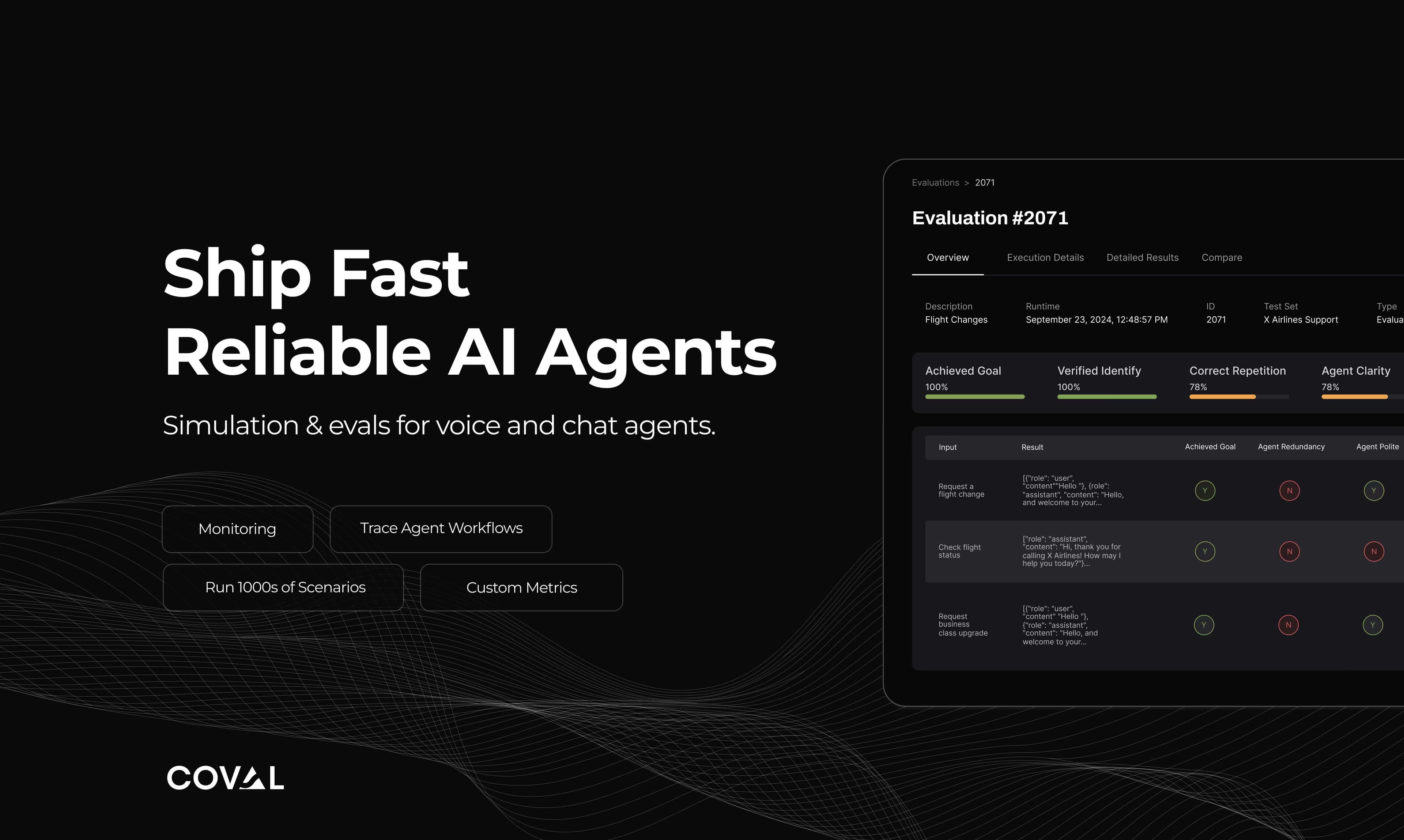
Coval is a voice AI testing and evaluation platform that helps teams simulate conversations, catch failures in production, and prove agent reliability before launch.
About Coval
What Is Coval
Coval is an evaluation layer for teams building voice and chat agents. It runs thousands of simulated conversations before launch, then keeps watching real calls afterward so quality doesn't quietly slip. The core idea is simple: a demo that works in a quiet room says almost nothing about how an agent handles accents, interruptions, or a caller who changes their mind halfway through. Real traffic is messy.
The problem it targets is the gap between demo and deployment. According to Coval, roughly 95% of voice agents work in a demo, but only about 62% survive their first week live. That's not a model problem, it's an infrastructure problem, and it shows up as missed identity checks, dropped context during handoffs, and conversations that end without a resolution. Coval gives product, QA, ops, and compliance teams one place to measure all of that against the same bar. One bar, before and after launch.
The honest limit is scope. Coval evaluates agents; it doesn't build them. The platform is priced for teams running real call volume, not hobbyists. That's the honest limit. You still need your own voice stack, models, and workflows in place, and the Starter plan starts at $100/mo with 100 simulation minutes, which is fine for a pilot but tight if you're testing at scale.
Getting Started
- Create an account and pick a plan. Coval requires a credit card, but each tier starts with a 7-day free trial.
- Connect your agent through the REST API, CLI, or MCP server so Coval can drive it with test conversations.
- Choose a scenario and persona from the library, or write your own, then run simulations against your agent.
- Review the metrics and transcripts. AI verdicts flag failures, and you can override any of them in the human review queue.
- Turn on production monitoring to keep scoring real calls and catch regressions after each change.
Product Information
A quick look at Coval's pricing, supported platforms, and performance.
Best for
The users, tasks, and scenarios where this tool fits best.
Users
- QA and product teams at voice-first companies
- Operations and compliance leads in regulated industries
- AI engineers shipping agent changes often
Tasks
- Pre-launch simulation testing
- Production evaluation
- Vendor comparison
Scenarios
- A support agent launching on a phone line where a wrong answer costs money or trust.
- A patient intake or collections workflow where compliance steps can't be skipped.
- A team comparing a new voice model against the one already in production.
Key features
Simulation Testing Before Launch
Coval lets you run thousands of realistic voice agent simulation conversations before a single real caller reaches your agent. You pick from a persona library or write your own scenarios, then let the platform drive your agent through accents, interruptions, and policy traps. Teams report getting to their first voice agent simulation in under 15 minutes using the CLI.
Production Monitoring and Evals
Once an agent is live, Coval keeps scoring calls and surfaces failures the moment they happen. Metrics like latency, whether the caller's request was fulfilled, and interruption rate update continuously. That matters because quality drifts after every prompt edit, model swap, or workflow change, and monitoring catches the regression before a customer does.
Human Review Queues
AI verdicts don't always get the last word. Coval flags failing calls and routes them to a review queue where a person can confirm or override the result and add an explanation. That's the heart of its conversational AI QA loop. Those overrides feed back into stronger standards for the next release, so the bar rises instead of resetting each cycle.
Metrics and Observability Dashboards
Everything lands in one view: simulation results, live monitoring, human review, and vendor comparisons. You get dashboards rather than scattered anecdotes, which makes it easier to argue a case to leadership or a compliance reviewer with actual numbers behind it.
Agent-Native Developer Surfaces
Coval ships a REST API, a CLI, an MCP server, and a skills framework, so teams can run evaluations from wherever they already work. Rate limits run from 60 requests per minute on Starter up to 300 on Growth. If your workflow lives in a terminal or an agent orchestration tool, you don't have to leave it.
Enterprise Security and Compliance
Every paid tier includes SOC 2 Type II, HIPAA, and GDPR coverage. Growth adds role-based access control and 30-day audit logs, while Enterprise unlocks SAML SSO, SCIM, private or VPC deployment, and bring-your-own storage. For regulated teams, that's often the difference between a tool that passes procurement and one that doesn't.
Pros and cons
Pros
- Combines pre-launch simulation and post-launch monitoring, so you're not stitching two vendors together.
- Human review queue lets you correct AI verdicts instead of trusting them blindly.
- Covers chat and voice agents in one platform, with HIPAA, SOC 2 Type II, and GDPR from the Starter tier up.
- Developer surfaces (API, CLI, MCP, skills) fit teams that don't want a separate dashboard-only workflow.
Cons
- No free plan. The 7-day trial needs a credit card, and the $100/mo Starter tier caps you at 100 simulation minutes, which runs out fast during heavy testing.
- It evaluates agents rather than building them, so you still need your own voice stack in place before Coval is useful.
- Higher tiers get pricey. Enterprise starts at $4,500/mo, which puts advanced security features like SAML SSO and SCIM out of reach for smaller teams.
Frequently asked questions
Coval tests and evaluates AI voice and chat agents. It runs simulated conversations before launch and monitors real calls after, scoring both against metrics like request fulfillment, interruption rate, and correct escalation.
Related content
Explore related tools, skills, and articles for Coval.
Coval Alternatives

Foley
Hanamori Labs, LLC · Voice & Language · Productivity · AI AssistantFoley is a voice to-do list that turns a spoken sentence into a filed task, complete with project, date and time, then helps you plan the day around what is already there.

HireKey
HireKey · Voice & Language · Productivity · LeaningHireKey is an AI job search copilot built by a former tech recruiter. It checks role fit, tailors resumes, runs interview practice and tracks every application.

Fluence
Yay Software (Yannick Huchard) · Writing · Voice & Language · ProductivityFluence is an Android app that reads PDFs, EPUBs, Word files and web articles aloud, follows each sentence as it speaks, and answers questions about the text on the phone itself.