

CrawlRaven
CrawlRaven · Coding · Marketing
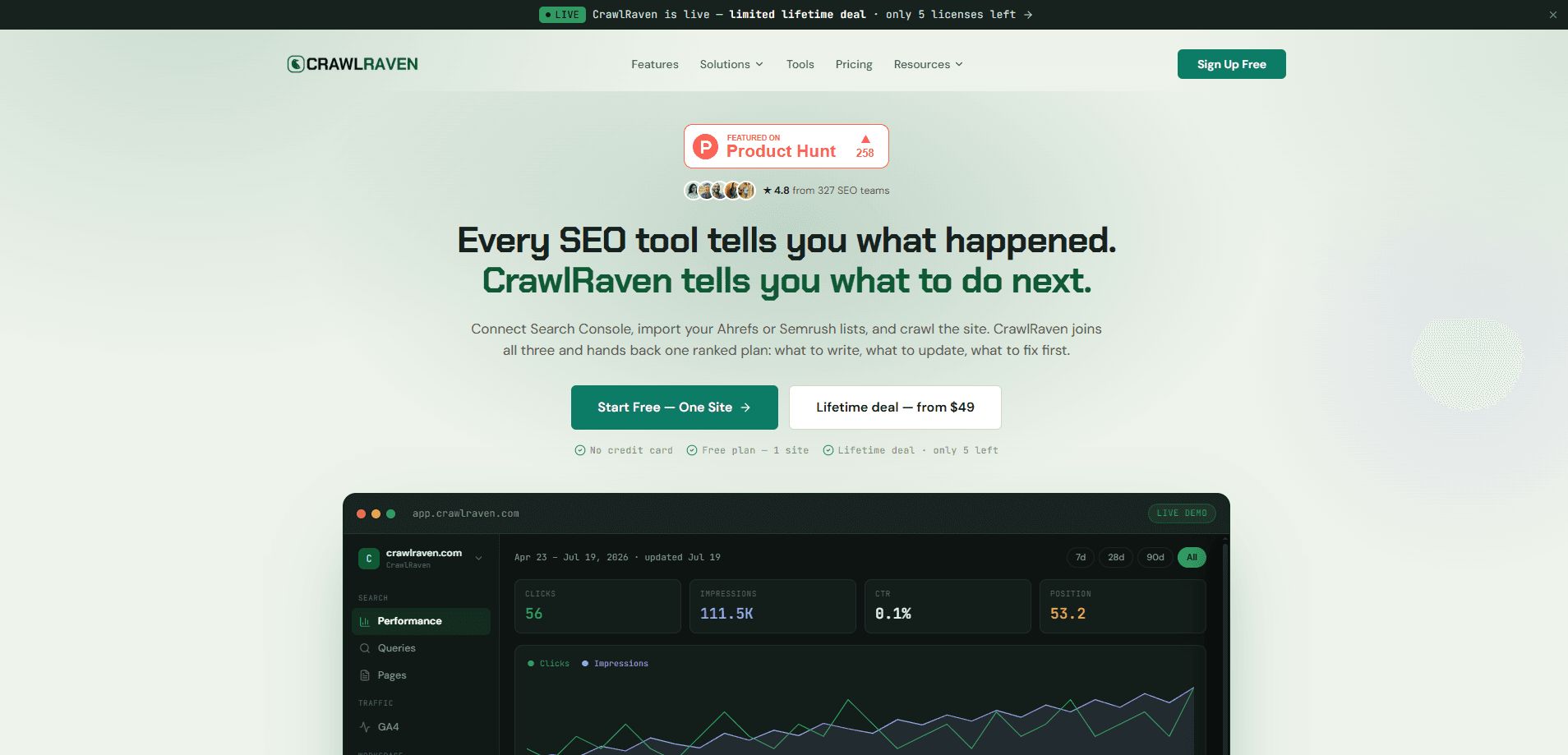
CrawlRaven is a web-based SEO audit platform that pulls your Google Search Console and GA4 data, merges the keyword lists you export from Ahrefs or Semrush, and runs a 200-point site crawl. Instead of another dashboard, it hands back one ranked SEO action plan: what to write, what to update, and what to fix first. That join is the whole point.
About CrawlRaven
What Is CrawlRaven
CrawlRaven is a technical SEO audit tool built for teams that already own a pile of data and still can't decide what to do on Monday morning. It connects to Search Console and Google Analytics 4, ingests keyword lists from Ahrefs, Semrush, or any other tool, then crawls the site to check what's technically blocking your rankings.
The core idea is a join. Search Console shows what changed. GA4 shows what visitors did. Your keyword lists show what you could rank for. The crawl shows what's broken. CrawlRaven merges those four datasets into a single keyword-to-page map, flags cannibalization, surfaces content gaps, and ranks every item by impact.
So what's the catch? Scope, mostly. CrawlRaven isn't a keyword research tool, so you still need Ahrefs, Semrush, or similar to discover new terms before importing them. It also depends on you connecting your own Google properties, and the full technical audit was still listed as coming soon during the lifetime-deal stage. If you want a tool that also finds keywords from scratch, this isn't it.
Getting Started
- Sign up at crawlraven.com with no credit card and get one site on the free plan.
- Connect Google Search Console through one-click OAuth, then link your GA4 property if you want behavior data folded in.
- Import your keyword lists as CSV exports from Ahrefs, Semrush, or whatever tool you already use.
- Let the built-in crawler run its 200-point technical audit across the site.
- Open the ranked plan and work the list: create a page, add a keyword to an existing one, refresh a decaying URL, or fix a technical bug.
Product Information
A quick look at CrawlRaven's pricing, supported platforms, and performance.
Best for
The users, tasks, and scenarios where this tool fits best.
Users
- Agency SEOs
- Independent consultants
- In-house marketing teams
Tasks
- Keyword-to-page mapping
- Cannibalization cleanup
- Content gap planning
- Decay monitoring
Scenarios
- Monday morning planning
- Client reporting
- Site migration prep
Key features
Four-Dataset Join
CrawlRaven's defining feature is combining Search Console, GA4, imported keyword lists, and a site crawl in one place. Each source answers a different question, and almost nobody else joins all four. The result is a plan built from live data rather than last quarter's spreadsheet export. No more stitching.
200-Point Technical SEO Audit
The built-in crawler runs over 200 checks, covering everything from Core Web Vitals and structured data to internal linking and duplicate content. It ranks each issue by ranking impact instead of dumping a flat list. Fix the page-killers first, not the missing alt tags.
Keyword-to-Page Mapping and Cannibalization Flags
CrawlRaven merges your imported keyword lists with GSC discoveries into a single keyword map, assigning each term to the page that should own it. When two URLs fight over one query, it flags the cannibalization so you can decide which page to keep and which to fold in.
Runner-Up Keywords and Content Gaps
The platform surfaces runner-up keywords (terms where you rank just below the top positions) and content gaps (terms with no page at all). Both come with a concrete recommendation, so the next action is writing or updating a specific page rather than more research.
Decay Alerts
CrawlRaven tracks pages that are losing traffic or position over time and raises decay alerts. You see which URLs to refresh before they drop out of rankings. That's usually cheaper than building new content.
MCP Server and AI Client Access
Paid plans include a Model Context Protocol (MCP) server with up to 13 scoped tools. AI clients can query exact Search Console periods, read bounded GA4 reports, and propose annotations that a human must approve in the app within 15 minutes. It's a careful, read-mostly design. A person stays in the loop.
White-Label Reports
Higher tiers generate white-label PDF reports with custom branding, aimed at agencies presenting to clients. The About page treats team seats and client workspaces as first-class features rather than add-ons.
Pros and cons
Pros
- Joins four datasets (GSC, GA4, keyword lists, crawl) that normally live in separate tools.
- Output is a ranked to-do list with a concrete recommendation on every item, not another dashboard.
- One-time lifetime pricing from $39 to $129 removes recurring subscription costs.
- Free plan covers one site with GSC insights and needs no credit card.
- White-label reports and MCP access give agencies and AI workflows real utility.
Cons
- It isn't a keyword research tool, so you still need Ahrefs, Semrush, or similar for discovery.
- The full technical SEO audit was listed as coming soon, so some checks may roll out over time.
- Some features depend on connecting your own Google properties, which won't suit privacy-restricted setups.
- MCP tools are read-mostly and paid-only, so AI-driven edits always require manual approval.
Frequently asked questions
It joins your Google Search Console and GA4 data, imported keyword lists, and a site crawl into one ranked SEO action plan. You get a list of what to write, update, or fix, ordered by impact.
Related content
Explore related tools, skills, and articles for CrawlRaven.
CrawlRaven Alternatives
Forefront
Forefront · CodingForefront is a web platform for building with open-source AI. It lets you fine-tune leading open-source language models on your own data, evaluate how they perform, and run them through an API or export them to host yourself. Developers who want the convenience of a closed-source platform but insist on owning their models and data are the target audience here.

Startkit
StartKit.AI · CodingStartkit is a boilerplate for building AI SaaS and AI wrapper products. Think of it as an AI startup boilerplate with the boring parts already wired up: authentication, Stripe and Lemon Squeezy payments, usage limits, transactional email, and an AI API starter that talks to OpenAI, Anthropic, Groq, or Llama. You clone the repo, set your price, and start on the part of your product that people actually pay for. It's Next.js under React and Tailwind, so most of the boilerplate code already feels familiar.
Testim
Tricentis · CodingTestim is an AI-powered test automation platform for building and running end-to-end tests across web, mobile, and Salesforce applications. It leans on machine learning to keep tests stable when an interface changes, so teams spend less time fixing broken selectors. Not bad for an automated testing tool you can start using today. You create tests by recording actions in a browser, then optionally add JavaScript when you need more control. It's a solid pick for busy QA teams.