

Credal
Credal · Coding · Other
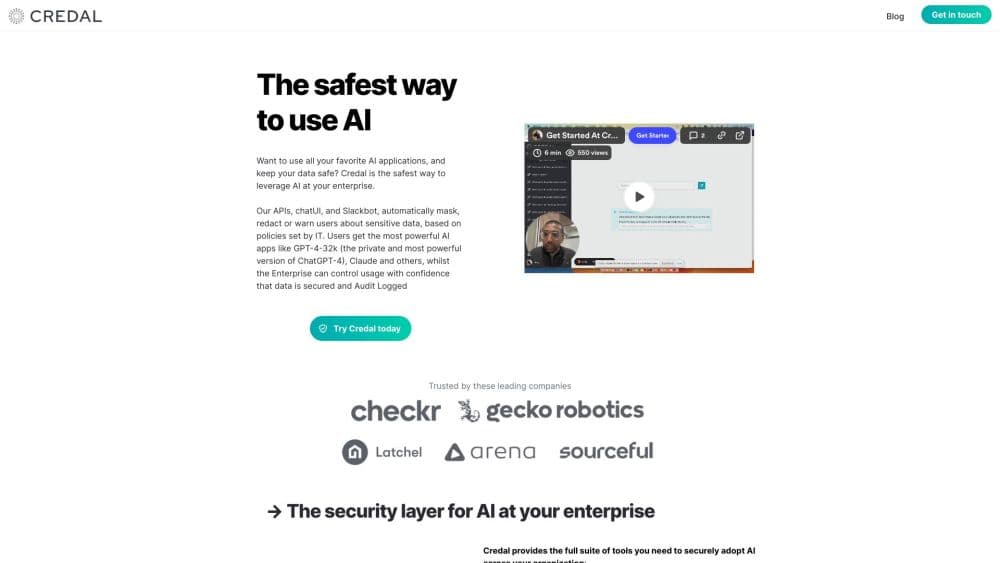
Credal is an enterprise AI platform where teams build and govern MCP servers and agents, with curated context, inherited permissions, and cost-to-accuracy evals for every workflow.
About Credal
What Is Credal
Credal is a control layer for enterprise AI agents and MCP servers, an enterprise AI platform built around governance. It connects the tools and data your teams already use, like Google Drive, Slack, Salesforce, Confluence, and Snowflake, then turns each source into a governed MCP server curated by the people who know it best. Agents built on Credal query those servers from Claude, ChatGPT, Cursor, Slack, or your own apps.
The problem it solves shows up once AI moves past demos. Agents get handed every tool and every record, so they drift, answer wrong, and burn tokens. Credal scopes each agent down to the tools, data, and instructions it actually needs, and enforces the same company rules no matter which chat surface the work runs through.
The main constraint is fit. Credal is built for organizations running many agents across departments, not for a single user who wants a personal chat assistant. Pricing sits behind a demo, and the value grows as you connect more systems.
Getting Started
- Request a demo and describe the team or workflow you want to start with. There is no self-serve signup.
- Connect your systems and data sources. Credal offers over 1,000 connectors and syncs permissions from each source.
- Bundle the right tools, data, and instructions into a governed MCP server for a specific team.
- Publish that server into Claude, ChatGPT, Cursor, Slack, or your own app, and set who can reach it.
- Watch the audit log, review spend by team and model, and adjust scopes as usage grows.
Product Information
A quick look at Credal's pricing, supported platforms, and performance.
Best for
The users, tasks, and scenarios where this tool fits best.
Users
- Platform and IT teams rolling out AI across a company
- Domain experts who own a workflow
- Security and compliance reviewers
Tasks
- Grounding agents in real business context
- Controlling AI spend
- Cutting duplicate work
Scenarios
- A company running dozens of agents across sales, support, and engineering
- Teams that switch between Claude, ChatGPT, and Cursor all day
- Regulated industries handling sensitive records
Key features
Governed MCP servers
Credal lets you bundle the right tools, data, and instructions into an MCP server for one team, then share it across the company. Everything else stays out of the agent's context. NVIDIA and others describe this scoping as the difference between an agent that guesses and one that answers from the right data.
Scoped context and enforced parameters
You set which tools an agent can call and enforce parameters like region, row limits, or record stage, so the agent reads only what it should and takes only allowed actions. The payoff is a smaller context per query. Credal cites a customer cutting context per query by 87%.
Unified AI spend visibility
Every agent and MCP server feeds one audit log that attributes cost to the team, workflow, and model that spent it. The system flags where a cheaper model holds accuracy and lets you route workflows to it, so you cut spend without guessing at the tradeoff.
Agent registry with version control
The registry version-controls every agent and MCP server with rollback and a full audit trail over each action and tool call. Platform teams get one place to see what is live, while domain owners keep control of their own servers.
Permission inheritance and approvals
Credal inherits permissions from each source system at query time, so if a user cannot open a file in Google Drive or Confluence, they will not see it through an agent either. Sensitive actions can require human sign-off before they run.
Model-agnostic by design
Credal works across providers, so you can use the right model for the right job without rebuilding for each one. Connect your own Azure OpenAI deployment, self-hosted open models, or Credal's managed access to frontier models from OpenAI and Anthropic.
Pros and cons
Pros
- Scoping agents down to the tools and data they need fixes both accuracy and cost at the same time, since too much context causes both problems.
- Permissions inherited at query time mean agents never see records a user was not already allowed to open, which is what gets security teams to sign off.
- One registry for agents and MCP servers gives platform teams versioning, rollback, and a single view of what is deployed.
- Cost attribution by team, workflow, and model turns AI spend into something you can actually manage and reduce.
- Flexible deployment, including cloud, single-tenant, and on-prem, fits organizations with strict data residency rules.
Cons
- Pricing is not published, so you need a demo and a sales conversation before you can compare it against alternatives.
- There is no self-serve tier, which rules out individuals and small teams who want to try it on their own.
- The value depends on connecting many systems, so a setup with one or two data sources will not get much out of the governance layer.
- If a source system has messy or wrong permissions, those problems carry straight into what the agent can reach.
Frequently asked questions
Credal lets enterprises build and govern MCP servers and AI agents on top of their own tools and data. You connect systems, scope what each agent can reach, and run the agents from Claude, ChatGPT, Cursor, Slack, or your own app with permissions and rules applied everywhere.
Related content
Explore related tools, skills, and articles for Credal.
Credal Alternatives

Base Code
Base44 (Wix) · Coding · ProductivityBase Code is a shared cloud development environment from Base44. Teammates describe changes to an existing GitHub codebase in chat, preview them live and send them back as pull requests.

Google EmbeddingGemma 2
Google DeepMind · Writing · Image · CodingGoogle EmbeddingGemma 2 is a 740M-parameter open model that turns text, code, images, audio, and video frames into vectors in one 768-dimension space, running on phones and laptops.

GitGlow
GitGlow · Coding · ProductivityGitGlow is a local-first desktop Git client that lets independent developers review their own code and their AI agents' changes in one place before shipping.