
Credo AI
Credo AI · Other
Credo AI is an enterprise AI governance platform that catalogs every model, agent, and vendor, then maps each one to rules like the EU AI Act and NIST AI RMF.
About Credo AI
What Is Credo AI
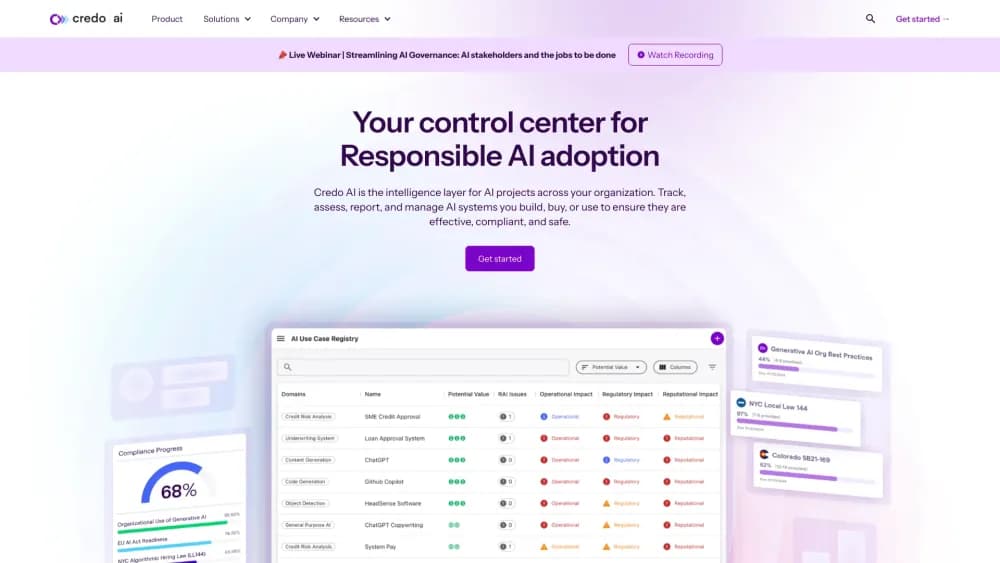
Credo AI is AI governance software for companies that have more AI running than they can account for. It builds a registry of every model, agent, application, and third-party vendor in use, scores each one through its AI risk management workflow, and produces the evidence an auditor or regulator will ask for.
The company started in 2020, before governance was a budget line. It now sells to banks, insurers, and large enterprises, with Mastercard and Booz Allen among the named customers. Analyst firm Forrester put it in the Leader band of its AI governance Wave, and the vendor reports 12 perfect scores in that evaluation.
The limits matter as much as the strengths. There's no self-serve signup and no published price, so a small team can't test it without talking to sales first. Everything sits behind a demo request and a procurement cycle, which is normal for compliance software and frustrating if you just want to see the interface.
Getting Started
- Book a demo on credo.ai. Sales scopes your AI footprint, the regulations you answer to, and which teams need access.
- Connect the systems that already hold AI inventory data, such as cloud accounts, MLflow, GitHub, ServiceNow, or your Jira projects.
- Import or auto-discover AI systems into the AI registry, then classify each one by risk tier and business owner.
- Attach the policy packs that apply to you, like the EU AI Act or ISO 42001, and let the policy engine generate the required controls and evidence tasks.
- Run assessments on a schedule, route findings to owners, and export audit artifacts when a regulator or internal audit asks.
Product Information
A quick look at Credo AI's pricing, supported platforms, and performance.
Best for
The users, tasks, and scenarios where this tool fits best.
Users
- Chief AI officers and heads of AI governance
- Compliance and risk teams in regulated industries
- Engineering and ML platform leads
Tasks
- Building an AI inventory
- Producing audit evidence
- AI vendor risk assessment
Scenarios
- Preparing for EU AI Act obligations
- Governing AI agents in production
- Enterprise-wide AI adoption tracking
Key features
AI Registry and Shadow AI Discovery
The registry is the core of the product. It catalogs AI systems, models, agents, and vendors in one inventory, then maps dependencies so you can see which application relies on which model. Discovery connectors scan cloud and ML environments for AI you didn't know was running, which is the part most teams underestimate. Every entry carries an owner and a risk classification.
Agent Governance with Agent Cards
Credo AI treats agents as governed entities rather than features of an app. Each agent gets a card recording its purpose, the tools it can call, its permissions, and the human accountable for it. Because agents act in milliseconds without a person in the loop, the platform checks behavior against policy at trace level instead of waiting for a monthly review. This is the piece competitors built for security monitoring and GRC vendors skipped entirely.
Risk Intelligence and the Agentic Control Library
Risk scoring runs continuously and pulls in business context, so a claims agent at an EU insurer gets different controls than a marketing agent at a US retailer. The control library includes agent specific risks such as tool misuse, scope drift, and risk that passes between connected agents. Dashboards connect to your observability tools and raise alerts when behavior drifts from the approved baseline.
Policy Engine and Prebuilt Policy Packs
The policy engine turns written policy into code. Ready made packs cover the EU AI Act, NIST AI RMF, ISO 42001, OMB M-25, Colorado's ADMT rules, and NAIC AI guidance, and each pack ships with the controls and evidence tasks that framework expects. Teams that already wrote internal policy can map it to those frameworks instead of maintaining two parallel sets of documents.
GAIA Governance Assistant
GAIA, short for Govern AI Assistant, is the vendor's AI assistant inside the platform. It drafts assessments, summarizes regulatory text, and answers questions about your own registry, which cuts the weeks of reading that normally sit between a new rule and a working process. Credo AI says the assistant is generally available today, not a preview.
Integrations with Your Existing Stack
Native connectors cover Snowflake, Databricks, AWS, Azure, ServiceNow, Jira, Confluence, Slack, GitHub, and MLflow. In practice that means evidence collection happens where engineers already work, and findings land as tickets rather than as another dashboard nobody opens. Governance teams stop asking for screenshots and start reading the same records as the people building the system.
Pros and cons
Pros
- Breadth in one place: models, applications, agents, and vendors share a single registry, so you don't stitch three tools together to answer one audit question.
- Regulatory depth: policy packs are written by a team that sits in ISO, NIST, and EU standards work, and the mappings are usable on day one.
- Agent level controls: agent cards, tool use tracking, and inter agent risk are modeled properly, which is rare in this category.
- Analyst validation: a Forrester Wave Leader position with 12 perfect scores gives procurement a defensible reason to shortlist it.
Cons
- No public pricing and no free tier: you can't evaluate cost or try the interface without a sales conversation, which slows down small teams and early research.
- Implementation depends on your data: discovery only finds what your connectors can reach, so fragmented cloud estates still need manual registry work at the start.
- Enterprise weight: the platform assumes dedicated governance staff, and a company without a compliance function will find the workflow heavier than its needs.
- Opaque API story: the vendor documents integrations well but doesn't publish a public API reference, so custom automation needs a conversation with their team.
Frequently asked questions
It builds an inventory of every AI system in a company, scores each one through its AI risk management workflow, and produces the documentation and evidence needed to show compliance with rules such as the EU AI Act or ISO 42001. Think of it as the system of record for AI governance rather than a model testing tool.
Related content
Explore related tools, skills, and articles for Credo AI.
Credo AI Alternatives

Odyssey 3
Odyssey · OtherOdyssey-3 is Odyssey's foundation world model. It simulates physics in real time, turns a prompt into an interactive environment, and adapts to robots, cars and games.

JarvisCore
Prescott Data · Coding · Productivity · OtherJarvisCore is an open source Python runtime where AI agents work as equal peers on an agent mesh, claim tasks from a shared ledger, and reach external services through a zero-trust broker.
Clef
Cloudflare · Business · OtherClef is Cloudflare's open-source decision model for Workers AI. It returns calibrated probabilities for typed questions, not generated text, so agents can classify, route, and act fast.