

Croct
Croct · Coding · Productivity
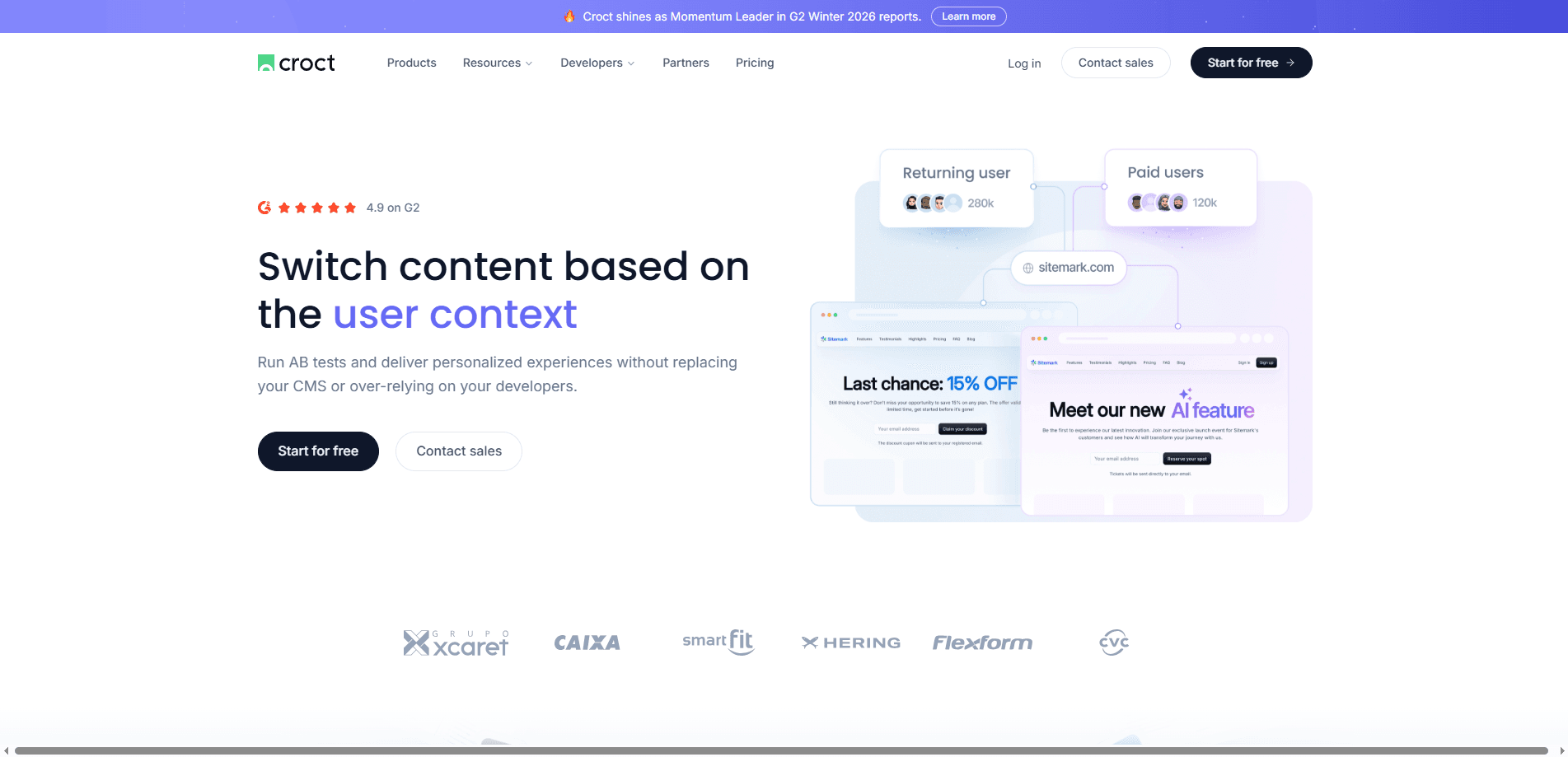
Croct is a component-based headless CMS with personalization and A/B testing built in. It resolves content on the server, so a page arrives already tailored to the visitor instead of flashing a default version first. Marketing teams use it to run experiments and tailor pages without filing a developer ticket every time, and it sits alongside a CMS you already run rather than replacing it. Think of it as an A/B testing tool and content management system in one package.
About Croct
What Is Croct
Croct is a personalization platform built for teams that want to change what each visitor sees without wiring together a separate CDP, feature-flag tool and analytics contract. Content lives in slots, which are placeholders you drop into your application. Each slot renders a component, and Croct decides which variation that visitor gets at request time, on the server.
That server-side design is the part most teams notice first. There's no flash of default content and no anti-flicker snippet blanking the page while a script loads. According to Croct, end-to-end response times run under 90 milliseconds at the 95th percentile. That number matters if you care about Core Web Vitals.
The trade-off is scope. Croct isn't a general-purpose CMS for authoring long articles or managing media libraries. It's built to make content contextual. Who sees what, when, and which variation wins. If your team mainly needs a place to draft posts, this is more machinery than you need. It also assumes a headless stack. A monolithic site won't get much out of it without a rebuild.
Getting Started
- Run
npx croct@latest init, which installs the SDK, wires up the provider and generates TypeScript types for every slot. - Sign in to the Croct interface and define your first audiences, either from behavior and traits or with CQL, its English-like query language.
- Add slots to your application, then create experiences and A/B tests inside the interface once setup is done.
- Launch and let Croct resolve content server-side, then read results from the unsampled analytics included on every plan.
Product Information
A quick look at Croct's pricing, supported platforms, and performance.
Best for
The users, tasks, and scenarios where this tool fits best.
Users
- Marketing teams
- Growth and CRO specialists
- Developers on headless stacks
Tasks
- Personalizing landing pages
- Running A/B and multivariate tests
- Building real-time audiences
Scenarios
- A site you already pay to drive traffic to
- Geo-specific offers
- Teams wary of another data vendor
Key features
Server-Side Content Resolution
Croct decides what each visitor sees before the page is sent, not after it loads in the browser. That means no flicker and no anti-flicker script holding the page hostage while it decides. It's fast, too. For anyone who's watched a page visibly reshuffle as personalization kicks in, this is the difference that matters most, and it's the reason server-side resolution keeps showing up on the shortlist for teams that care about how a page actually feels.
Bayesian A/B Testing
Experiments use Bayesian statistics on unsampled data, which lets you read results from your full audience rather than a slice. You get A/B, A/B/n and multivariate tests, plus cross-device consistency so a signed-in user's variation holds wherever they land. Bot filtering keeps crawler traffic out of the numbers. That last part adds up.
Audience Segmentation with CQL
Audiences are written in CQL, a query language that reads close to plain English. A rule like user is returning and location's city's name is "New York" is something a marketer can write and check without a data team. Segments update the instant a visitor qualifies. No waiting on a nightly job.
Component CMS
Content lives in typed, versioned components and slots instead of static pages. This is what makes the same content adaptable to different visitors. The typing carries through to generated TypeScript, so your editor and your code agree on structure. Content management here means deciding who sees what, not just storing a draft.
Real-Time User Profiles
Croct builds visitor profiles from behavior as it happens. It connects anonymous visits to identified ones when someone signs in. Profiles can be enriched from your own data and exported. That matters if you don't want your customer data locked inside the platform.
Built-In Analytics
Analytics on Croct run on the same unsampled data as the experiments, on every plan including the free one. You don't bolt on a third measurement tool. Experiment results and traffic numbers speak the same language. So what does that mean in practice? Fewer dashboards to reconcile, and less chance of two tools disagreeing about the same visitor.
Pros and cons
Pros
- Personalization resolves server-side, so there's no flicker and no render-blocking script slowing the page down while it works out what each individual visitor should actually see first.
- One platform covers segmentation, profiles, experimentation and analytics, which removes a separate CDP and related vendors from the stack.
- Works alongside Storyblok, Sanity, Strapi, Contentful and Shopify Hydrogen instead of forcing you to migrate.
- Marketers can run audiences, experiences and tests in the Croct interface after the first setup.
- Genuinely usable free tier with the core features, no credit card, good for small sites and pilot projects.
Cons
- Pricing is tied to monthly active users, so high-traffic sites can climb the volume tiers quickly past the free 10,000 MAU.
- The forever-free plan caps you at 3 content slots and 1 experience or experiment, which runs out fast for real testing.
- It assumes a headless setup, so teams on a monolithic CMS face a rebuild before they see any benefit.
- Go over your quota and Croct stops serving personalization and tracking until you upgrade or the month renews.
Frequently asked questions
It manages content and decides which variation each visitor should see, then measures the result. Think of it as a CMS where the content adapts to the person viewing it, plus the testing and analytics to back up those decisions.
Related content
Explore related tools, skills, and articles for Croct.
Croct Alternatives
Forefront
Forefront · CodingForefront is a web platform for building with open-source AI. It lets you fine-tune leading open-source language models on your own data, evaluate how they perform, and run them through an API or export them to host yourself. Developers who want the convenience of a closed-source platform but insist on owning their models and data are the target audience here.

Startkit
StartKit.AI · CodingStartkit is a boilerplate for building AI SaaS and AI wrapper products. Think of it as an AI startup boilerplate with the boring parts already wired up: authentication, Stripe and Lemon Squeezy payments, usage limits, transactional email, and an AI API starter that talks to OpenAI, Anthropic, Groq, or Llama. You clone the repo, set your price, and start on the part of your product that people actually pay for. It's Next.js under React and Tailwind, so most of the boilerplate code already feels familiar.
Testim
Tricentis · CodingTestim is an AI-powered test automation platform for building and running end-to-end tests across web, mobile, and Salesforce applications. It leans on machine learning to keep tests stable when an interface changes, so teams spend less time fixing broken selectors. Not bad for an automated testing tool you can start using today. You create tests by recording actions in a browser, then optionally add JavaScript when you need more control. It's a solid pick for busy QA teams.