

Crustdata
Crustdata Inc. · Coding · Marketing
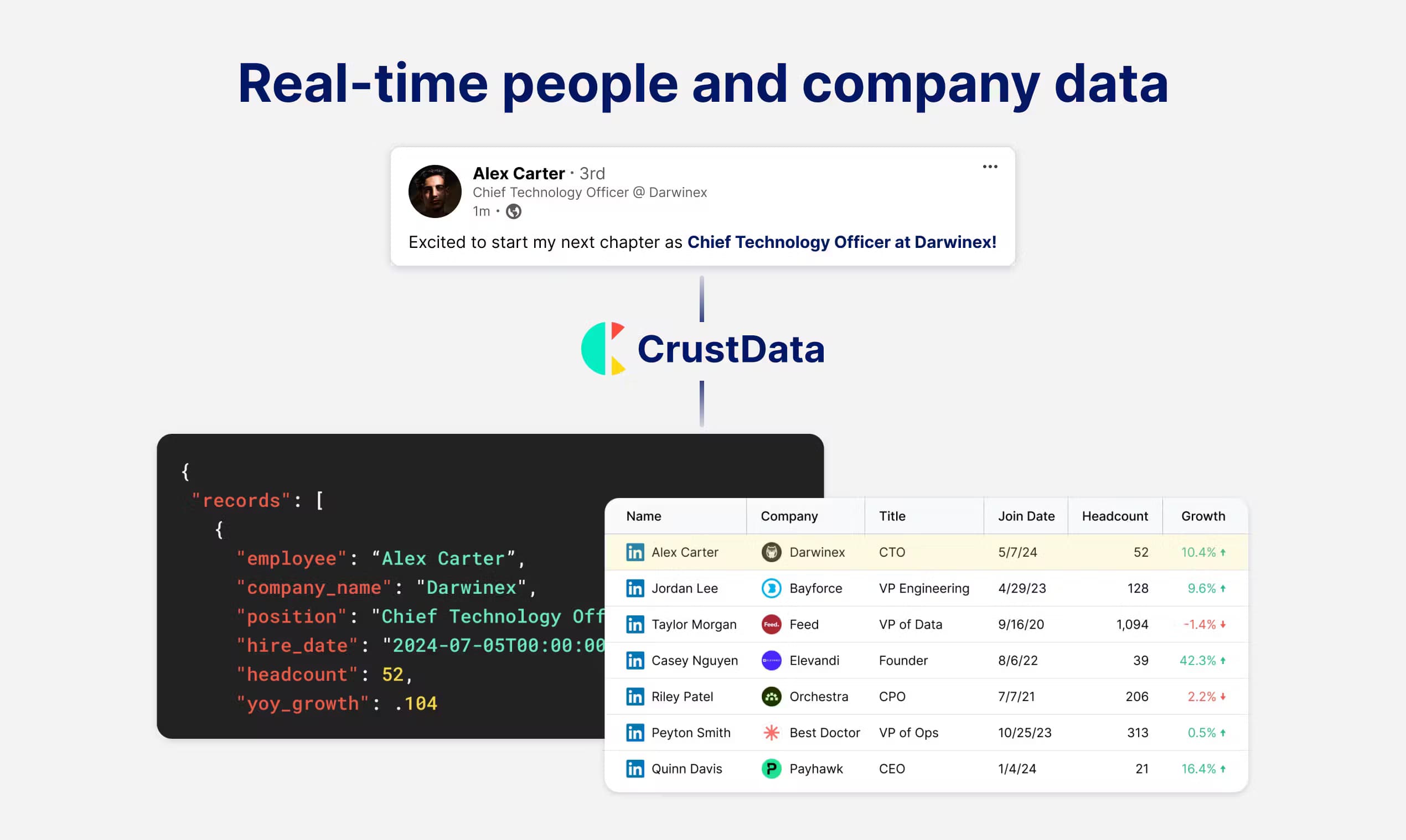
Crustdata is a real-time B2B data API and MCP server that hands AI agents live profiles on 1B+ people and 60M+ companies that sales teams, recruiters and investors can act on.
About Crustdata
What Is Crustdata
Crustdata is a data layer for teams and agents that need company and people information they can act on right away. It indexes public web pages and resolves them into one live graph, where each company and each person maps to a single record with work history, funding, headcount and hiring signals attached.
The product ships as three things under one roof: a REST API for search and enrichment, a flat-file dataset refreshed on a schedule, and an MCP server that drops the same real-time company data into Claude, Cursor or any other MCP client as callable tools. Sales teams use it as sales prospecting data, recruiters use it to score candidates, and investors use it to catch early signals like a quiet new hire or a fresh incorporation.
The main limit is cost structure. Access runs on credits, and some live endpoints stay gated to higher plans, so heavy real-time use adds up. There is also no full free tier for production use. The free part is a sandbox key aimed at developers who want to test the API before committing.
Getting Started
- Sign up at app.crustdata.com and request an API key or a demo, depending on whether you are building or evaluating.
- Pull the free sandbox key if you are a developer, then send your first company search request with the Bearer token and the current API version header.
- Pick the API area you need, such as company search or people enrichment, and narrow your list with filters before enriching records.
- Connect the MCP server to your agent if you want the same data reachable from a plain-English prompt.
- Watch your credit balance in the dashboard, since every call returns an X-Credits-Used header showing what it cost.
Product Information
A quick look at Crustdata's pricing, supported platforms, and performance.
Best for
The users, tasks, and scenarios where this tool fits best.
Users
- Sales and revenue teams
- Recruiters and talent platforms
- Developers building AI agents
Tasks
- Building prospect and candidate lists
- Enriching leads and records
- Monitoring companies for signals
Scenarios
- Powering an AI SDR or recruiting agent
- Deal sourcing and diligence
- Replacing a stack of stale data tools
Key features
Real-time company and people search
Search runs over the indexed dataset of 1B+ people and 60M+ companies, and it favors intent over filter menus. You describe the companies or people you want, such as US firms with at least 50 employees and a recent raise, and the API returns matching records. Search endpoints stay low-cost on purpose, so you can narrow a list before spending credits on enrichment.
Enrichment API for people and companies
Enrichment starts with a company or person you already have and adds fresh attributes on demand. A person enrich call begins with a base profile and adds cost only when you request higher-value data, such as verified business or personal emails, phone numbers or developer profiles. This keeps spend tied to the fields you actually need.
MCP server for AI agents
The MCP server exposes 40 tools covering search, enrichment, job signals, social posts and web research, and it works with Claude, Cursor and any MCP client. Your agent calls these tools from a plain-English prompt instead of code, which shortens the path from a question to a usable list. It ships alongside skill templates and a free sandbox key.
Watcher API and webhooks
The Watcher API pushes a notification the moment a tracked company, person or event changes. You follow job changes, funding rounds or new hires and get the alert through a webhook rather than polling for updates. That timing matters when a signal is only useful before a competitor spots it.
Web search and social post data
Beyond structured records, Crustdata runs web search across news, web, scholar and social sources, and indexes social posts by text, author and engagement. You can fetch the HTML content of a URL or pull recent posts for a person or company. This gives agents a way to gather context that a profile field alone would miss.
Flat-file datasets and integrations
For teams that want no integration work, Crustdata delivers a flat-file dataset of companies and people, refreshed monthly and unified from 11+ sources, as CSV or JSON. Companies filter it by funding, stage, headcount or industry, then load it into analytics or ML pipelines. The same data also flows into internal sales tools and CRMs.
Pros and cons
Pros
- Covers both people and companies in one graph, so you do not stitch two vendors together for a single workflow.
- Ships an MCP server with 40 tools, which lets agents use the data from a prompt instead of a custom integration.
- Credit model ties cost to usage, and every call returns an X-Credits-Used header so you can see what a request cost.
- Free sandbox key and full API access let developers test the platform before paying.
Cons
- No full free tier for production. Teams past the sandbox have to move onto a credit plan or contact sales.
- Some live, real-time endpoints stay plan-gated, so the freshest data may sit behind a higher tier.
- Credit costs vary by endpoint and by premium fields, which takes planning before you scale day-to-day usage.
- Heavy reliance on enrichment credits means a large list can get expensive fast if you enrich every record.
Frequently asked questions
Crustdata is used to search, enrich and monitor company and people data. Sales teams build prospect lists, recruiting platforms score candidates on live signals, and investors catch early moves such as a new hire or a fresh incorporation.
Related content
Explore related tools, skills, and articles for Crustdata.
Crustdata Alternatives

Base Code
Base44 (Wix) · Coding · ProductivityBase Code is a shared cloud development environment from Base44. Teammates describe changes to an existing GitHub codebase in chat, preview them live and send them back as pull requests.

Google EmbeddingGemma 2
Google DeepMind · Writing · Image · CodingGoogle EmbeddingGemma 2 is a 740M-parameter open model that turns text, code, images, audio, and video frames into vectors in one 768-dimension space, running on phones and laptops.

GitGlow
GitGlow · Coding · ProductivityGitGlow is a local-first desktop Git client that lets independent developers review their own code and their AI agents' changes in one place before shipping.