

Dagster
Dagster Labs · Coding
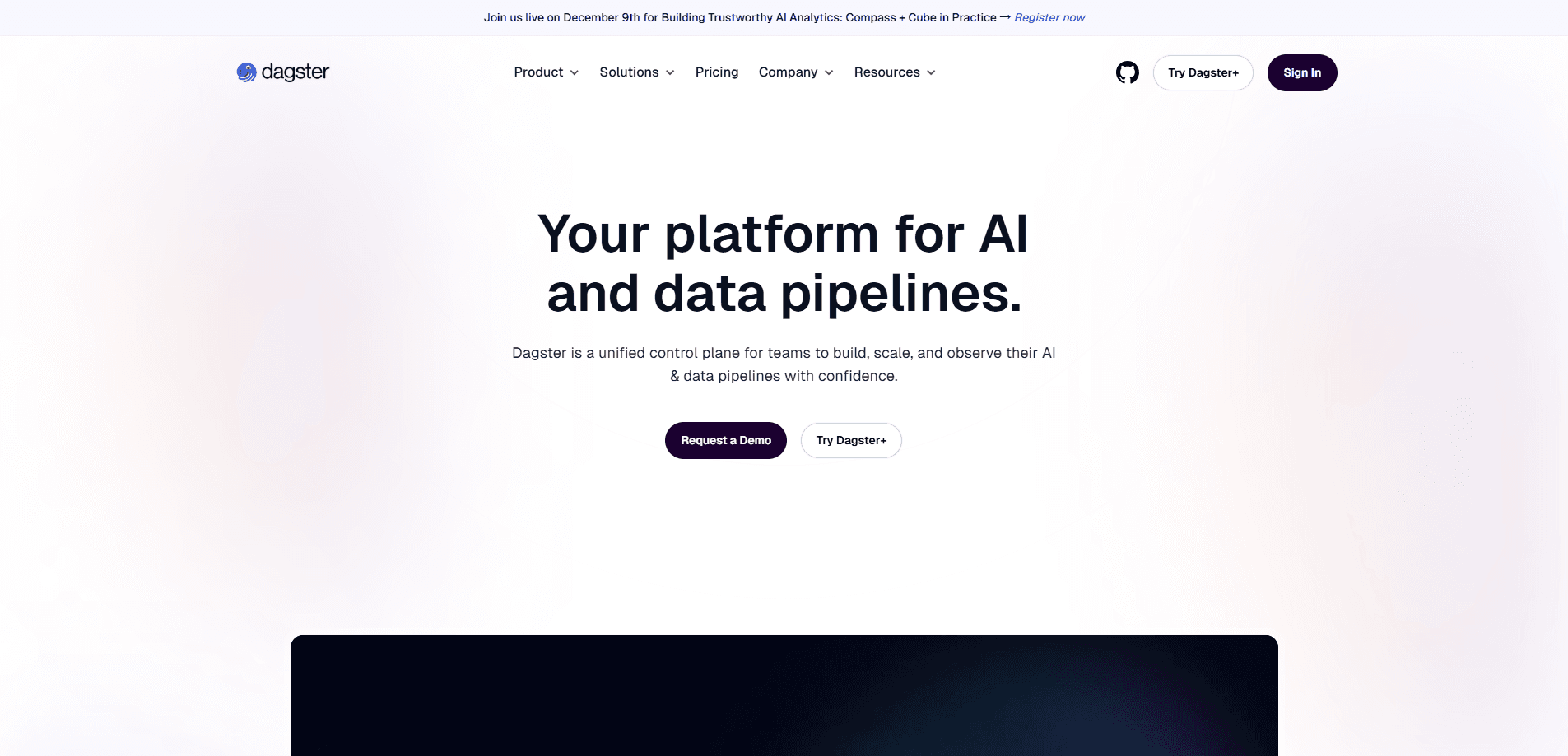
Dagster is an open-source data orchestration platform that helps data teams build, schedule, and monitor reliable data and AI pipelines. It treats every output as a first-class asset, so lineage, quality checks, and dependency context come attached by default. Data pipeline orchestration rarely looks this tidy. A hosted version called Dagster+ adds serverless deployment, alerting, and role-based access for teams that don't want to run the infrastructure themselves.
About Dagster
What Is Dagster
Dagster is a modern data orchestration platform built around the idea that pipelines should be defined by the data they produce, not just the tasks they run. Most orchestration tools describe jobs as steps in a sequence. Dagster flips that model. You declare assets like tables, files, and models, and the platform works out what has to run and when. That shift matters. It's what lets you trace a number back to its source, check freshness automatically, and hand a clean operational picture to the rest of the team.
The project started in the open-source world and is maintained by Dagster Labs (formerly Elementl), with the cloud product Dagster+ layered on top. Teams reach for it when they've outgrown cron jobs and shell scripts, or when a managed workflow scheduler feels too rigid. The usual trigger is a data stack that spans several tools. dbt models, ELT jobs, and now AI pipelines. No single place to see how they connect.
The most important limitation is scope. Dagster doesn't transform your data for you and won't replace your warehouse, your transformation layer, or your BI tool. It orchestrates the work around all of them. It's also a developer-facing product. Writing pipelines means writing Python, so teams without engineering support will find the learning curve steep compared to a no-code scheduler.
Getting Started
- Install the open-source core locally with pip and scaffold a project using the dg command-line tool.
- Define your first asset in Python, describing what it produces and which upstream assets it depends on.
- Add asset checks and freshness policies so the platform can flag stale or broken data without you watching it.
- Test the pipeline locally in the web UI, using run history and lineage views to confirm everything links up.
- Deploy to Dagster+ for scheduled runs, alerting, and shared access, or self-host on your own infrastructure.
Product Information
A quick look at Dagster's pricing, supported platforms, and performance.
Best for
The users, tasks, and scenarios where this tool fits best.
Users
- Data engineers
- Analytics teams running dbt
- Platform teams at growing companies
Tasks
- Orchestrating ELT and dbt jobs
- Monitoring data freshness
- Backfilling and partition management
- Running AI and LLM pipelines
Scenarios
- A dbt project that's outgrown simple scheduling
- Debugging a broken dashboard number
- Scaling from one team to several
Key features
Asset-Based Orchestration
Dagster's core idea is that you describe the data you want, not the order of steps. Each asset knows what it produces and what it depends on, and the platform resolves the execution graph for you. That structure is what makes lineage, freshness, and quality checks possible. No extra plumbing.
Built-In Data Lineage and Observability
Every asset carries its dependencies, metadata, and health signals in one view. So what happens when something breaks? You trace which upstream source caused it and which downstream reports are affected. This is the part most teams cite as the reason they switched from a task-based scheduler.
Native dbt Integration
Dagster reads your dbt project and turns models into assets, with dbt tests showing up as asset checks. You keep writing dbt the way you already do. Dagster handles scheduling, dependencies, and visibility around it.
Data Quality Checks and Freshness Policies
Asset checks let you assert conditions on your data, and freshness policies define how current an asset should be. Violations trigger alerts through email, Slack, or Microsoft Teams. Problems surface before a stakeholder does.
Branch Deployments
Pipeline changes can be tested in a production-like environment before they hit real data. Each branch gets its own isolated deployment. That makes reviewing a change on a running system far less nerve-wracking than approving a diff blind.
Hybrid and Serverless Deployment
You can run Dagster+ with serverless compute or connect it to your own infrastructure on Kubernetes, Docker, or a cloud provider. Hybrid setups keep data inside your network while still using the managed control plane. Nice.
Dagster+ AI and MCP Server
The newer AI layer works from the context Dagster already tracks, like runs, failures, and automation history. It can help diagnose issues and explain pipeline behavior. An MCP server connects the platform to AI coding assistants.
Pros and cons
Pros
- Asset-based model makes dependencies and lineage visible by default, which is the feature teams mention most when they explain why they moved.
- Strong dbt support means you don't have to abandon an existing transformation workflow to get better orchestration.
- Open-source core keeps the entry cost at zero, and the paid tiers start low for solo builders.
- Testability is a first-class concern, so pipelines can be validated before they touch production data.
Cons
- It's a code-first tool, so teams without Python skills will find a no-code scheduler easier to adopt.
- It doesn't transform data or replace your warehouse and BI layer, so it's one more piece in the stack rather than a single solution.
- Features vary a lot by plan: catalog search, RBAC, and cost tracking sit on higher tiers, so small teams may hit limits on the cheaper plans.
Frequently asked questions
It orchestrates data and AI pipelines: scheduling jobs, tracking dependencies, checking data quality, and showing lineage across your whole stack. Think of it as the layer that coordinates the tools you already use rather than replacing them.
Related content
Explore related tools, skills, and articles for Dagster.
Dagster Alternatives
Forefront
Forefront · CodingForefront is a web platform for building with open-source AI. It lets you fine-tune leading open-source language models on your own data, evaluate how they perform, and run them through an API or export them to host yourself. Developers who want the convenience of a closed-source platform but insist on owning their models and data are the target audience here.

Startkit
StartKit.AI · CodingStartkit is a boilerplate for building AI SaaS and AI wrapper products. Think of it as an AI startup boilerplate with the boring parts already wired up: authentication, Stripe and Lemon Squeezy payments, usage limits, transactional email, and an AI API starter that talks to OpenAI, Anthropic, Groq, or Llama. You clone the repo, set your price, and start on the part of your product that people actually pay for. It's Next.js under React and Tailwind, so most of the boilerplate code already feels familiar.
Testim
Tricentis · CodingTestim is an AI-powered test automation platform for building and running end-to-end tests across web, mobile, and Salesforce applications. It leans on machine learning to keep tests stable when an interface changes, so teams spend less time fixing broken selectors. Not bad for an automated testing tool you can start using today. You create tests by recording actions in a browser, then optionally add JavaScript when you need more control. It's a solid pick for busy QA teams.