

DataVisor
DataVisor · Other
DataVisor is an AI fraud and AML platform for banks, fintechs, and payment firms. It scores transactions in real time with unsupervised machine learning and cross-entity link analysis.
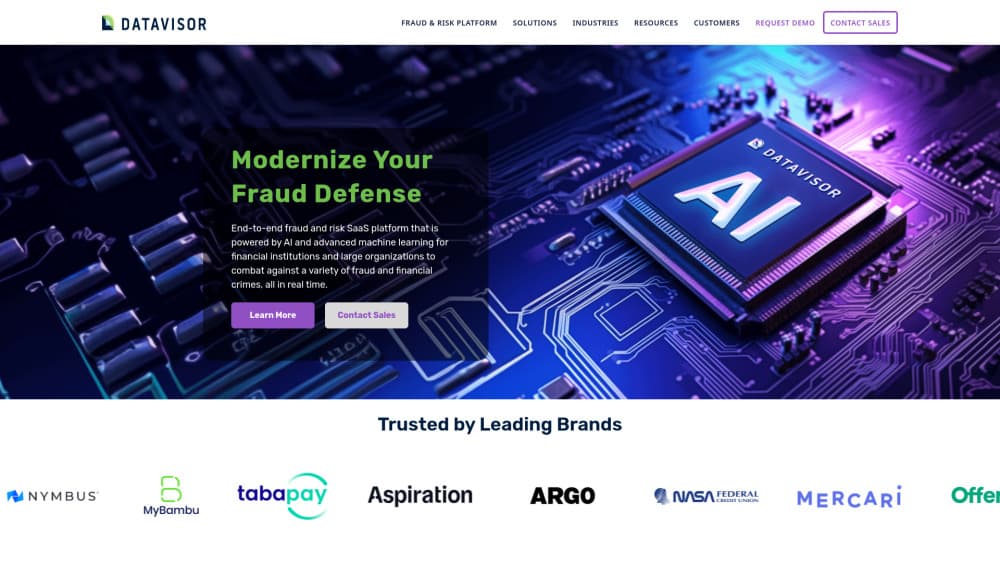
About DataVisor
What Is DataVisor
DataVisor is a fraud prevention software platform built for banks, payment providers, and large digital businesses. Its core is unsupervised machine learning: the models look for unusual clusters of behavior across accounts and transactions instead of waiting for someone to label past fraud. That's how new fraud rings surface before a single confirmed case exists.
The company started in 2013 in Mountain View, California, and has stayed on financial crime since. As a fraud detection platform, it sells one decisioning layer rather than a menu of point tools. Signals from your own systems combine with the platform's consortium data, get scored in under 100 milliseconds, and come back as a block, an approval, or an alert for an analyst.
Two limits shape whether it fits. Pricing isn't published and buying means a sales-led integration project, typically weeks rather than hours. And the AML platform assumes you already have a fraud ops team with rules and queues to migrate. A solo developer can't sign up and start scoring the same afternoon.
Getting Started
- Book a demo and scope the use case. DataVisor's team maps which flows you want covered, such as onboarding, card payments, ACH and wires, or account takeover.
- Connect your data. You push transaction, device, and account events through the APIs and SDKs, or stream them from your existing pipeline.
- Build strategies. Analysts assemble decision flows from model scores, rules, lists, and thresholds in the platform, with a test environment for each change.
- Run in parallel first. Most teams score live traffic in shadow mode for a few weeks and compare the alerts against their current system before switching.
- Go live and tune. Once decisions are wired into your checkout or onboarding path, tuning agents and Vera, the conversational assistant, help adjust thresholds and review cases.
Product Information
A quick look at DataVisor's pricing, supported platforms, and performance.
Best for
The users, tasks, and scenarios where this tool fits best.
Users
- Fraud and risk teams at banks
- Payment providers and fintechs
- AML and compliance analysts
Tasks
- Catching fraud patterns nobody has labeled yet
- Shrinking the manual review queue
- Investigating connected accounts
- Filing AML alerts and reports
Scenarios
- Launching a new payment rail
- A signup spike you can't review by hand
- Replacing a legacy rules stack
Key features
Unsupervised Machine Learning Detection
The detection engine groups accounts and events by shared behavior, then flags clusters that don't look like anything seen before. No historical labels are needed to start, which is the difference between catching a new fraud ring in week one and catching it after chargebacks arrive. Supervised models and rules still run alongside it for the cases you already know well.
Cross-Entity Link Analysis
Link analysis connects accounts, devices, phone numbers, addresses, and payment instruments into a graph, so an analyst sees the ring rather than the single account in front of them. Shared attributes that look harmless alone become evidence in context. It's the feature that turns a queue of alerts into a handful of investigations.
Real-Time Decisioning and Automation
Scoring runs at under 100 milliseconds, at production volumes the company puts above 15,000 queries per second. Decisions can block, approve, step up authentication, or route to review, and the flow is assembled visually. Automation takes the obvious cases off the queue, which is the part that changes headcount math for a risk team.
AI Agents for Strategy and Investigation
DataVisor ships agents that draft strategies, tune thresholds, investigate alerts, and assemble reports. Vera, its conversational agent, takes plain-language requests such as "show me accounts linked to this device" and returns the query result. Treat the agents as accelerators for experienced analysts, not a replacement for judgment on edge cases.
Vera Code and Developer Tooling
Vera Code is the developer kit for building fraud and AML flows without starting from the platform's default screens. Teams use the APIs to embed scoring in their own services, wire custom data sources, and ship a working flow in days. That matters when the risk model has to live inside a product team's release cycle.
Investigation, Case Management, and Reporting
Alerts land in a case workspace with the linked entities, the signals behind the score, and the decision history attached. Analysts add notes, escalate, or close with a reason, and reporting agents compile what regulators and internal audit ask for. Keeping the evidence next to the decision saves the reconstruction work that usually eats review time.
Pros and cons
Pros
- Unsupervised detection finds fraud rings without waiting for labeled cases, which is the gap rules engines leave open.
- Link analysis puts connected accounts on one screen, so one investigation covers what used to take several alerts.
- Sub-100ms scoring at high query volume means decisions don't slow down checkout or onboarding.
- The AI agents and Vera cut the manual work in strategy tuning and alert triage.
- APIs and Vera Code let engineering teams embed scoring in their own services instead of bolting on a separate tool.
Cons
- No published pricing. You need a sales conversation and a quote before you know whether the platform fits your budget.
- Implementation is a project, not a signup. Data integration and rule migration typically take weeks and pull in engineering time.
- The platform is built for enterprise fraud ops. Small teams without analysts to run cases will pay for capability they can't use.
- Model behavior takes explaining. Unsupervised clusters surface patterns that your team still has to interpret and defend to auditors.
Frequently asked questions
DataVisor is used to detect and block fraud and financial crime in real time, covering account opening, account takeover, card payments, checks, ACH and wire transfers, and AML monitoring. Banks, payment providers, and large digital businesses run it as the decisioning layer between their transaction streams and their review teams.
Related content
Explore related tools, skills, and articles for DataVisor.
DataVisor Alternatives

Odyssey 3
Odyssey · OtherOdyssey-3 is Odyssey's foundation world model. It simulates physics in real time, turns a prompt into an interactive environment, and adapts to robots, cars and games.

JarvisCore
Prescott Data · Coding · Productivity · OtherJarvisCore is an open source Python runtime where AI agents work as equal peers on an agent mesh, claim tasks from a shared ledger, and reach external services through a zero-trust broker.
Clef
Cloudflare · Business · OtherClef is Cloudflare's open-source decision model for Workers AI. It returns calibrated probabilities for typed questions, not generated text, so agents can classify, route, and act fast.