

Dawiso
Dawiso (UD4D) · Coding · Leaning
Dawiso is an AI-powered data governance platform that turns scattered metadata into a single governed context layer for both people and AI agents. It scans your warehouses, lakes, BI tools, and documents, then connects a data catalog, business glossary, and column-level lineage so teams can find trusted data in minutes instead of days. Companies mainly pick it to feed AI assistants accurate business context without building custom glue code.
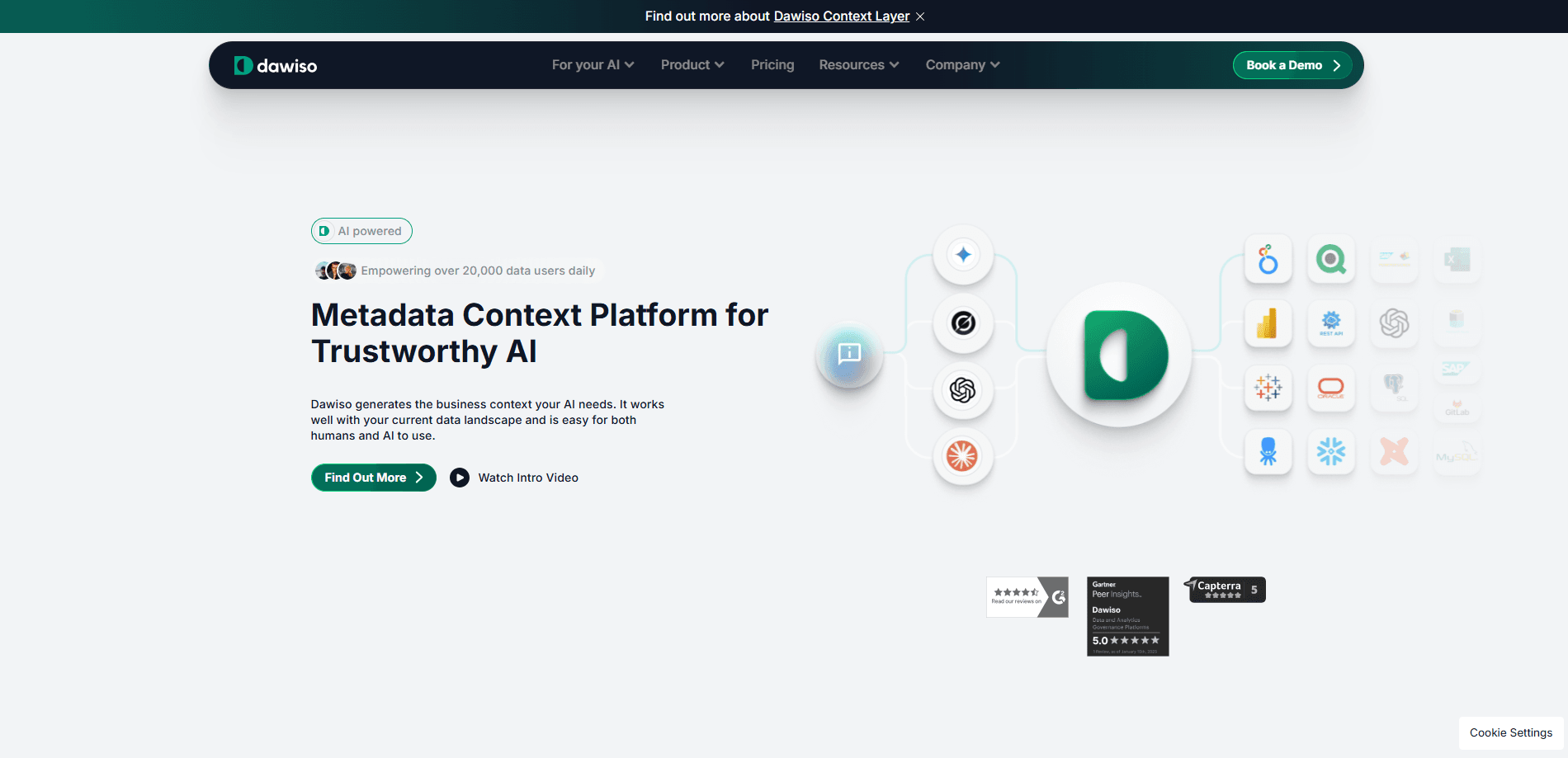
About Dawiso
What Is Dawiso
Dawiso is an enterprise data governance platform built around one idea: your AI is only as good as the context you give it. It maps what you already have, defines what the data means, and serves that meaning to humans and AI models through the same layer. The pitch is simple. Instead of stitching together a catalog here and a glossary there, you get one searchable knowledge base that acts like the internal Wikipedia and Google for your data.
The platform started in 2019 as a spin-off from UD4D, built by practitioners who'd spent years inside enterprise data projects at banks, insurers, and energy firms across Europe. CEO Petr Mikeška came from Profinit, where he delivered data work for banks and insurers like Société Générale and Generali. Co-founder Michal Ventruba spent a decade leading BI at Komerční banka. They watched organizations sit on valuable data they couldn't turn into trustworthy assets, so they built the tool they wanted. Dawiso now says it's trusted by 24,000+ data professionals across banking, insurance, energy, and manufacturing.
The catch is the audience. This is a platform for companies with real data stacks, not a solo tool you spin up on a weekend. So who's it actually for? Pricing starts at a five-seat Standard plan, and the MCP server, which is the part that feeds AI systems, only unlocks on Corporate and Enterprise licenses. If you're a small team or an individual, most of what makes Dawiso useful is priced out of reach.
Getting Started
- Sign up for a Dawiso trial or contact the sales team to pick a plan that matches your team size.
- Connect your data sources. Dawiso scans warehouses, lakes, BI tools, business systems, and documents with no pipelines to build.
- Review the auto-generated catalog. Column-level lineage and quality signals show up after the first scan.
- Define glossary terms, metrics, and calculations, then approve the AI-drafted updates so definitions stay current.
- Serve the context to people through search and to AI agents through the MCP server or APIs, under the same permissions.
Product Information
A quick look at Dawiso's pricing, supported platforms, and performance.
Best for
The users, tasks, and scenarios where this tool fits best.
Users
- Data teams at mid-size and large companies
- Data stewards and governance leads
- AI and platform engineers
Tasks
- Building a data catalog software setup from existing systems
- Keeping a business glossary current
- Grounding AI assistants in business context
- Documenting unstructured knowledge
Scenarios
- Rolling out AI agents that touch real enterprise data
- Meeting compliance and audit requirements
- Migrating off a patchwork of open-source tools
Key features
AI Context Layer
Dawiso generates the business context AI models need, then serves it through one governed layer. Four stages handle it. Map what you have. Define what it means. Make it accountable, then serve it to people and AI. The result is that a chatbot answers from your glossary and lineage rather than plain table names. It's the feature the whole product is built around.
Data Catalog with Column-Level Lineage
Dawiso scans warehouses, lakes, BI tools, business systems, and documents without pipelines, then assembles a single catalog that tracks column-level lineage and quality signals so analysts can trace where any number came from. Your data never leaves its source. That's the core promise. That's more granular than most catalogs manage. For metadata management, it's a real edge.
Business Glossary
Glossary terms, metrics, and calculations are versioned, reviewed, and re-approved as the business changes. AI drafts the updates and your experts confirm them. That split matters. Definitions go stale when nobody owns them, and letting AI propose edits while humans approve keeps the glossary accurate without turning it into a full-time job.
MCP Server
The MCP server connects any MCP-enabled chatbot or LLM to your enterprise data and business knowledge, letting agents search data in natural language, get only allowed and up-to-date information, and even write back by enriching descriptions or applying tags. It runs on your existing Dawiso deployment with no extra deployment fees. You do need a Corporate or Enterprise license. Claude Code is one supported client.
Governance and Approval Workflows
Every asset and definition gets an owner, a policy, and an audit trail. Approval workflows keep a human in the loop, which Dawiso frames as the difference between an AI answer that's defensible and one that's merely plausible. Automatic metadata context generation cuts the manual entry that usually makes governance projects stall.
Wide Connector Coverage
Dawiso connects to more than 40 data platforms, with unlimited connections even on the cheapest plan. The connector list keeps growing, and you can check the current set on the site. For teams running a mixed stack, that breadth decides whether the platform covers everything or leaves gaps you patch by hand.
Flexible Deployment
Dawiso runs as SaaS or on-premise from day one, with a test environment available on Enterprise. Adjustable support contracts and SLAs come with the Enterprise tier. On-premise matters for organizations that can't send metadata to a vendor cloud, and the option has been there since launch rather than bolted on later.
Pros and cons
Pros
- Connects to more than 40 data platforms with unlimited connections on every plan.
- Unusually cheap entry point for enterprise data governance, with a published starting price you can see up front.
- The MCP server feeds AI agents the same governed context people use, under shared permissions.
- Column-level lineage is more detailed than what many catalogs offer.
- Configurable enough that banks, insurers, and manufacturers run it in production.
Cons
- No free plan. A five-seat minimum means individuals and tiny teams can't test it cheaply.
- MCP server access is gated behind Corporate and Enterprise licenses, so the AI features that drive the pitch cost the most.
- Pricing is quoted in euros and scales by seat count, which makes budgeting harder for US-based teams.
Frequently asked questions
Dawiso is a data governance platform that builds a governed context layer from your metadata, glossary, and lineage. People get search and self-service, while AI models and agents get the same context through its MCP server and APIs. It's aimed at making both trust the same definitions.
Related content
Explore related tools, skills, and articles for Dawiso.
Dawiso Alternatives
Forefront
Forefront · CodingForefront is a web platform for building with open-source AI. It lets you fine-tune leading open-source language models on your own data, evaluate how they perform, and run them through an API or export them to host yourself. Developers who want the convenience of a closed-source platform but insist on owning their models and data are the target audience here.

Startkit
StartKit.AI · CodingStartkit is a boilerplate for building AI SaaS and AI wrapper products. Think of it as an AI startup boilerplate with the boring parts already wired up: authentication, Stripe and Lemon Squeezy payments, usage limits, transactional email, and an AI API starter that talks to OpenAI, Anthropic, Groq, or Llama. You clone the repo, set your price, and start on the part of your product that people actually pay for. It's Next.js under React and Tailwind, so most of the boilerplate code already feels familiar.
Testim
Tricentis · CodingTestim is an AI-powered test automation platform for building and running end-to-end tests across web, mobile, and Salesforce applications. It leans on machine learning to keep tests stable when an interface changes, so teams spend less time fixing broken selectors. Not bad for an automated testing tool you can start using today. You create tests by recording actions in a browser, then optionally add JavaScript when you need more control. It's a solid pick for busy QA teams.