

Daytona Cloud - AI Agent Infrastructure
Daytona PlatformS Inc. · Coding
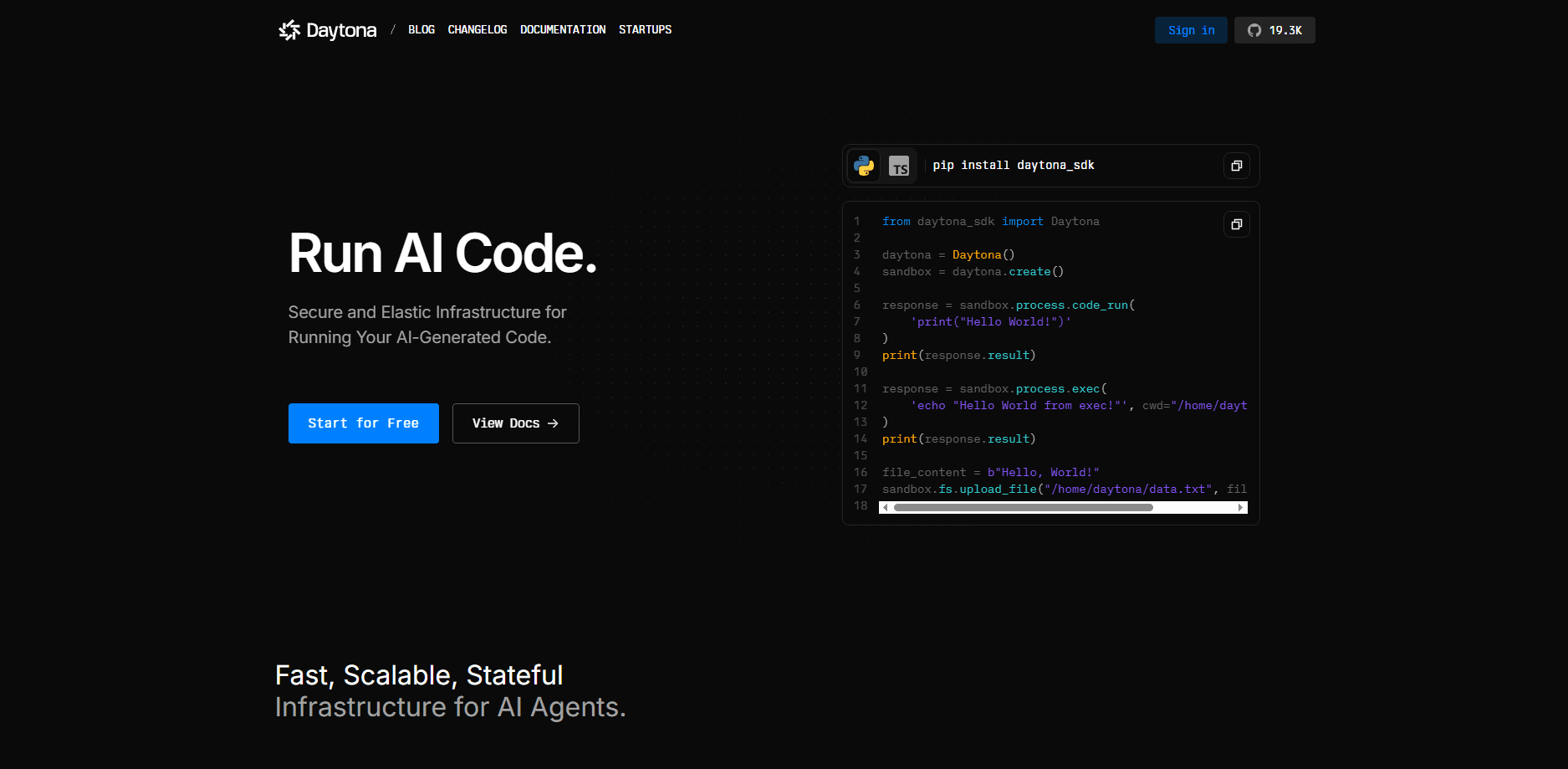
Daytona Cloud is infrastructure for running AI-generated code. It spins up isolated sandboxes in under 90ms, keeps state across long agent sessions and bills by the second.
About Daytona Cloud - AI Agent Infrastructure
What Is Daytona Cloud
Daytona Cloud is a managed platform that gives AI agents and developers a safe place to run code. Every run happens inside a sandbox with its own kernel, filesystem, network stack and allocated CPU, RAM and disk. If the code the model wrote misbehaves, the damage stays inside one box. Nothing touches your own servers.
The product solves a problem that shows up the moment an agent stops just talking and starts doing. A coding agent needs to install packages, edit files and run commands to check its own work. Running that output on your machine is a real risk, and building the runtime yourself is slow and expensive. Safe code execution is the whole point of the platform. Daytona takes over the runtime layer, so the model gets a real computer on demand and you keep your infrastructure out of the blast radius.
Two limits are worth knowing before you commit. Daytona Cloud is a developer product, so you interact with it through SDKs, an API and a CLI rather than a point-and-click app. And the free tier is a starting allowance, not a full workspace. Once you pass it, you pay for every CPU second and every gigabyte you keep, which rewards teams that scale sandboxes down as fast as they spin them up.
Getting Started
- Create a free account at app.daytona.io and generate an API key from the dashboard
- Install the SDK for your language, with Python, TypeScript, Ruby, Go and Java all supported
- Call daytona.create to launch a sandbox, then run code or commands inside it through the process API
- Save the sandbox state as a snapshot or delete it when the run ends, so you only pay for what you use
Product Information
A quick look at Daytona Cloud - AI Agent Infrastructure's pricing, supported platforms, and performance.
Best for
The users, tasks, and scenarios where this tool fits best.
Users
- AI engineers building coding agents
- Platform and infrastructure teams
- Data and ML teams running evaluations
- Enterprises with strict compliance needs
Tasks
- Secure code execution
- Using a code interpreter
- Testing agent output
- Running AI evaluations
- Desktop and browser automation
- Training agent policies with reinforcement learning
Scenarios
- A coding agent needs to verify a fix
- An eval batch hits a thousand runs
- A long-running research agent works overnight
- A team handles customer data
- A model needs a full desktop
Key features
Sub-90ms Sandbox Creation
The headline number is speed. Daytona starts a sandbox in under 90 milliseconds from code to execution, which is faster than the multi-second cold starts of standard containers and VMs. That difference matters at scale. When you're provisioning tens of thousands of sandboxes, milliseconds per run turn into hours across a batch, so agents stay responsive instead of waiting on a queue.
Stateful Sandboxes and Snapshots
Sandboxes run indefinitely and keep their state, so they're built for long-running tasks rather than one-shot jobs. You can save a sandbox as a snapshot and restore it later, which makes every run reproducible. That's what separates Daytona from a plain code runner: an agent can pause work, come back and pick up exactly where it left off, across sessions.
Isolation and Runtime Security
Each sandbox has its own kernel, filesystem and network stack, so code runs in full isolation rather than sharing a host. Daytona Secrets keeps plaintext credentials outside the sandbox and swaps them in at network egress, so an agent can call an API without ever holding the real key. For teams handling regulated data, that separation is often the reason to pick this over running code directly.
SDK, API and CLI Access
You control sandboxes programmatically rather than through a dashboard. There are official SDKs for Python, TypeScript, Ruby, Go and Java, plus a REST API and a command-line tool. Operations cover the whole lifecycle: creating and deleting sandboxes, filesystem CRUD, process and code execution, Git operations and runtime config. An LSP server is built in, so editors get completion and diagnostics inside the sandbox.
Computer Use Sandboxes
Daytona can hand an agent a full desktop, not just a shell. Computer Use sandboxes come in Linux (Ubuntu), Windows and macOS flavors, each with programmatic control and root-level access. MacOS instances are useful for iOS build and test work, while Windows covers desktop-specific automation. This is the piece that lets an agent click, type and navigate a real OS the way a person would.
Docker Compatibility and Image Building
Daytona stays compatible with the tooling teams already use. Sandboxes are built on OCI and Docker, so you can run off-the-shelf Docker images without wrappers, run Docker inside a Daytona sandbox, and drop in a Dockerfile or a Compose file. A declarative image builder lets you create snapshots straight from the SDK, with no CLI step, no manual upload and no registry to manage.
Distributed Runs Across Regions
Sandboxes deploy in regions close to your agents, with options such as US East, US West, EU Central, EU West and India. Running near the workload cuts latency for agents that call into a sandbox on every step. Volumes let agents share data across sandboxes without breaking isolation, which keeps multi-step pipelines from copying the same files over and over.
Pros and cons
Pros
- Sandbox creation lands under 90ms, which holds up even when a batch fans out to thousands of parallel runs
- Stateful sandboxes and snapshots make long agent workflows and reproducible evaluations practical, not just short scripts
- Built-in Secrets, full isolation and customer-managed compute answer the security questions that block untrusted code execution
- Broad SDK support across Python, TypeScript, Ruby, Go and Java, plus a REST API and CLI, fits most existing stacks
- Pay-as-you-go billing by the second with $200 in free compute lets small teams start without a contract
Cons
- It's a developer platform, so there's no visual app to click through and you'll need to write code to use it
- The free compute is an allowance rather than a permanent free tier, so sustained use always turns into a real bill
- Long-running stateful sandboxes are convenient but keep billing while they sit idle, so you have to manage teardown
- Enterprise features like SSO, audit logs and BYOC sit behind a sales conversation rather than self-serve signup
Frequently asked questions
Daytona Cloud is a managed infrastructure platform for running AI-generated code. It gives agents and developers isolated sandboxes that start in under 90ms, keep their state across long sessions and run any language from Python to Java, all controlled through SDKs, an API and a CLI.
Related content
Explore related tools, skills, and articles for Daytona Cloud - AI Agent Infrastructure.
Daytona Cloud - AI Agent Infrastructure Alternatives

Base Code
Base44 (Wix) · Coding · ProductivityBase Code is a shared cloud development environment from Base44. Teammates describe changes to an existing GitHub codebase in chat, preview them live and send them back as pull requests.

Google EmbeddingGemma 2
Google DeepMind · Writing · Image · CodingGoogle EmbeddingGemma 2 is a 740M-parameter open model that turns text, code, images, audio, and video frames into vectors in one 768-dimension space, running on phones and laptops.

GitGlow
GitGlow · Coding · ProductivityGitGlow is a local-first desktop Git client that lets independent developers review their own code and their AI agents' changes in one place before shipping.