

Deep Infra
Deep Infra · Other
Deep Infra is a cloud AI inference platform that lets you run open-source AI models through a single open-source model API instead of managing your own GPUs. It hosts text, image, audio, and embedding models from major open labs, bills by usage, and keeps setup to an API key. The main draw is predictable cost and control over your AI stack without vendor lock-in.
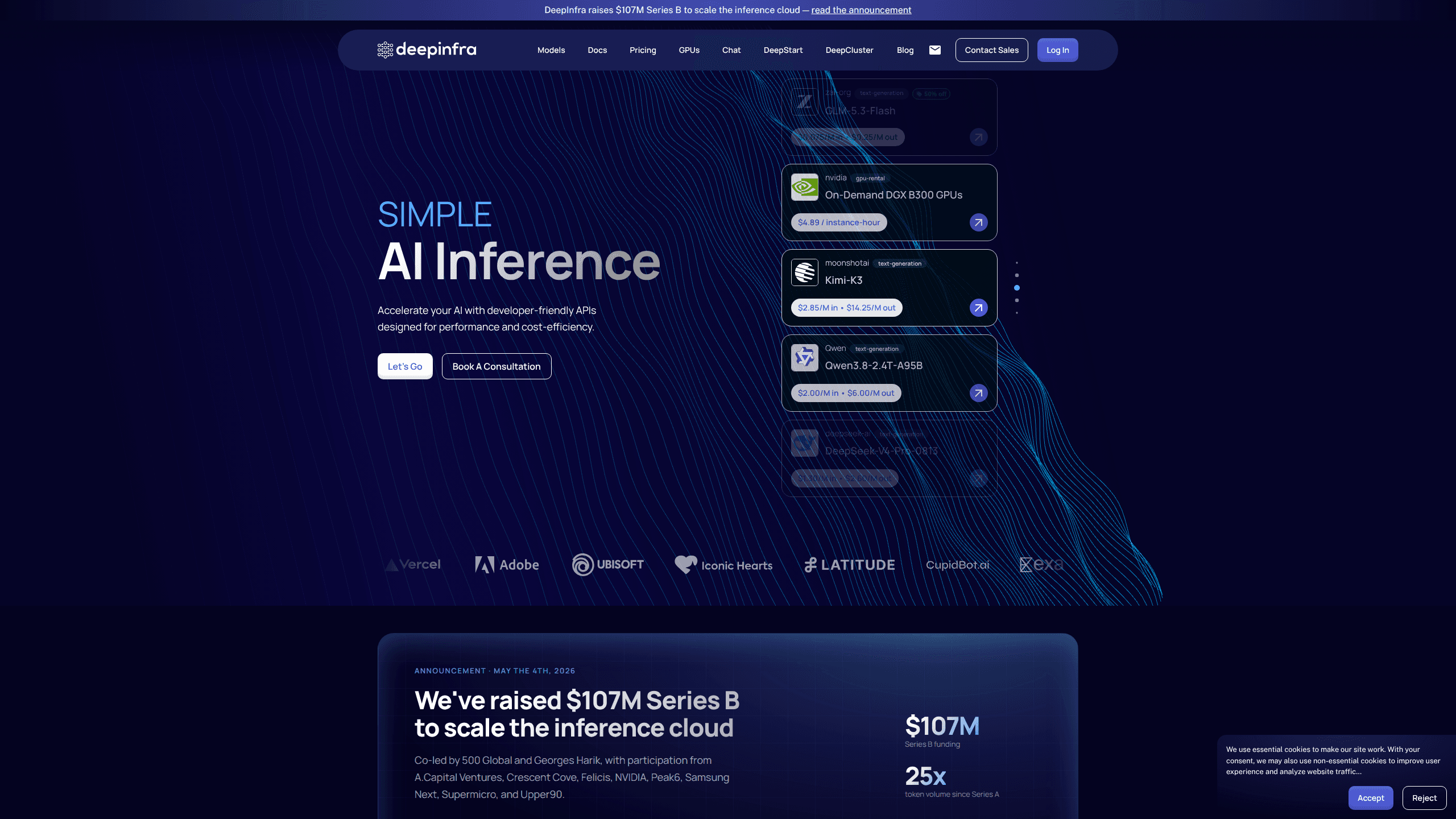
About Deep Infra
What Is Deep Infra
Deep Infra is an infrastructure company that turns open-source machine learning models into production-ready endpoints. You point a request at a model name, send your input, and get results back through a model inference API. It handles the GPU fleet, scaling, and deployment behind the scenes so you don't have to rent servers or babysit clusters.
The platform covers several model families in one place: large language models for chat and generation, diffusion models for images, speech models for transcription, and embedding models for search and retrieval. That range matters if you're building a product that mixes modalities, because you can call everything from one account with one billing line while keeping a single API key to rotate.
The biggest limitation is that Deep Infra is an inference provider, not a training service. You can't fine-tune or train your own models on the platform. It's also aimed at developers and teams writing code. There's no drag-and-drop app builder for non-technical users. No GPUs to rent, no cluster to patch. That's the whole pitch.
Getting Started
- Create an account on the Deep Infra website and grab your API key from the dashboard.
- Pick a model from the catalog and note its exact identifier, such as a DeepSeek or Qwen variant.
- Send a request to the model endpoint using your key, following the OpenAI-compatible chat format for language models.
- Watch usage in the dashboard as requests run, since billing tracks tokens or inference time.
- Scale up or down by adding or removing endpoints, with no long-term contract to renegotiate.
Product Information
A quick look at Deep Infra's pricing, supported platforms, and performance.
Best for
The users, tasks, and scenarios where this tool fits best.
Users
- Backend and ML developers
- Startups shipping AI features
- Teams avoiding vendor lock-in
Tasks
- Running text generation and chat
- Generating images from prompts
- Transcription and speech
- Building search and retrieval
Scenarios
- Prototyping an AI feature before you commit hardware
- Handling spiky demand
- Keeping a production app's inference bill predictable
Key features
OpenAI-Compatible API
Most language models on Deep Infra follow the same request shape as OpenAI's chat API, so if you've written code against that format you can run an LLM API call by changing the base URL and key. It cuts migration time to a config edit for many projects.
Multi-Modal Model Catalog
The catalog spans text, image, audio, and embedding models in one dashboard. Need an embedding model and an image generator in the same project? You can route a RAG pipeline, an image generator, and a speech-to-text job through the same account, which simplifies key management and billing across every service you run inside a single deployment.
Pay-As-You-Go Pricing
Deep Infra pricing is usage-based. You're billed for what you use. Some language models charge per token, including discounted rates for cached input, while others bill for inference execution time. There are no upfront costs and no long-term contracts, so idle time doesn't cost you anything.
Serverless AI Inference
Endpoints scale with traffic on their own. When a feature goes viral or a batch job lands, serverless AI inference follows the load instead of you pre-buying GPUs and hoping the estimate holds.
Cached Input Discounts
Several models offer a lower rate for cached input tokens, which rewards repeated context like a fixed system prompt or document. For chat apps that resend the same instructions, that discount adds up over a month. Small line item, real savings.
Open-Weight Model Focus
Deep Infra centers on open-source and open-weight models rather than proprietary ones. That gives you visibility into what's running and a path to move the same model elsewhere if you ever need to, because the weights and the API contract both travel with you rather than locking into a single vendor's closed system.
Pros and cons
Pros
- Hosted inference for open-source models without managing GPU servers.
- Transparent usage-based pricing with no upfront or long-term commitment.
- Broad catalog covering text, image, audio, and embeddings under one account.
- OpenAI-compatible endpoints simplify migration for existing code.
Cons
- No fine-tuning or training, so custom models have to be trained elsewhere.
- Developer-oriented with no low-code interface for non-technical users.
- Exact model availability and rates change often, so you'll need to check the catalog before pricing a project.
Frequently asked questions
It's used to run open-source AI models in production without owning hardware. You call hosted endpoints for text, image, audio, or embedding tasks and pay only for what you consume.
Related content
Explore related tools, skills, and articles for Deep Infra.
Deep Infra Alternatives

Odyssey 3
Odyssey · OtherOdyssey-3 is Odyssey's foundation world model. It simulates physics in real time, turns a prompt into an interactive environment, and adapts to robots, cars and games.

JarvisCore
Prescott Data · Coding · Productivity · OtherJarvisCore is an open source Python runtime where AI agents work as equal peers on an agent mesh, claim tasks from a shared ledger, and reach external services through a zero-trust broker.
Clef
Cloudflare · Business · OtherClef is Cloudflare's open-source decision model for Workers AI. It returns calibrated probabilities for typed questions, not generated text, so agents can classify, route, and act fast.