

D.Waste
D.Waste · Business · Other
D.Waste is an AI waste sorting platform that identifies items from a photo, automates audits and rewards correct recycling with points and leaderboards.
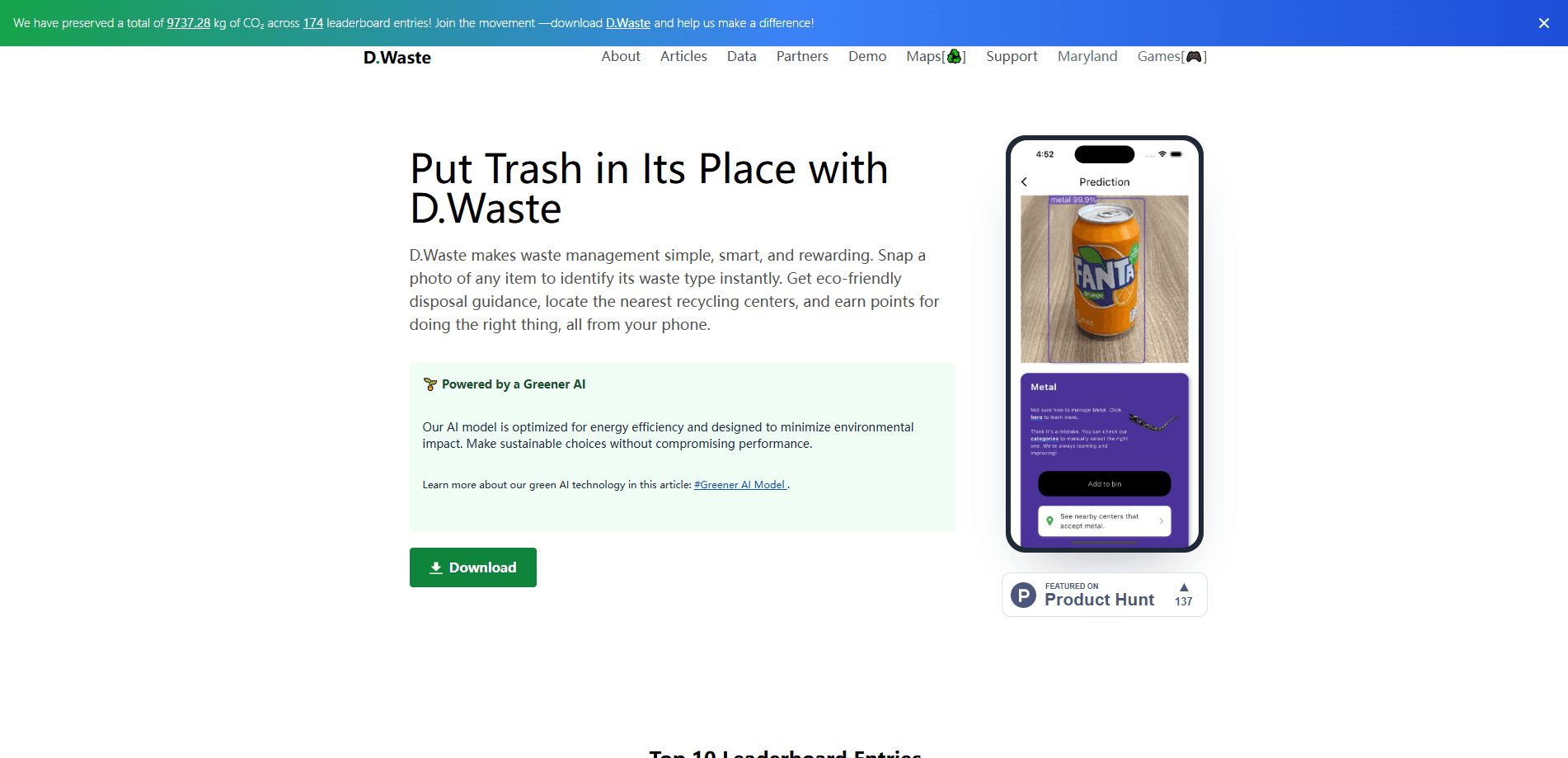
About D.Waste
What Is D.Waste
D.Waste is a waste sorting and recycling platform built for schools, campuses, businesses and public spaces. You point your phone at an item, and the app identifies it, then tells you how to dispose of it based on your own organization's rules rather than generic guidance. Points and leaderboards turn that daily habit into a competition between dorms, classes or whole campuses, and administrators get a dashboard tracking how much waste actually gets diverted.
The company's angle is where the AI runs. Most recycling vision systems lean on cloud servers, and that carries a real energy and privacy cost. D.Waste runs compact vision models straight on the device or on a low-power edge box near the bins, so images never leave the hardware. The team frames this as a net-positive setup: the carbon saved by better sorting outweighs the power the models draw. Details on the approach appear in peer-reviewed papers the team published on waste classification and sorting hardware.
The catch is the scope. D.Waste is an institutional product, not a consumer utility. The app works on its own, but the automated sorting hardware, the edge devices and the analytics that most organizations want come through a deployment with the D.Waste team. Solo households can use the free app, but the platform is designed around a campus or facility rollout.
Getting Started
- Download the free D.Waste app on iPhone, iPad or Android and open it with no account required
- Point the camera at a waste item so the AI identifies it and returns disposal instructions for your location's rules
- Sort the item and collect points, then climb the leaderboard for your dorm, class or campus
- For an organization, talk to D.Waste about edge devices and smart bins, then watch diversion and contamination data in the admin dashboard
Product Information
A quick look at D.Waste's pricing, supported platforms, and performance.
Best for
The users, tasks, and scenarios where this tool fits best.
Users
- Sustainability officers
- Students and campus staff
- Teachers and program leads
- Facility and operations managers
Tasks
- Sorting an item at the bin
- Running a waste audit
- Detecting contamination
- Tracking diversion rates
- Teaching recycling
Scenarios
- A dining hall full of mixed waste
- A school rolling out a Green School Program
- A campus pursuing Zero Waste or LEED certification
- A material recovery facility losing money to contaminated bales
- A site with patchy Wi-Fi
Key features
AI Sorting Guidance
The core of the DWaste app is a camera that turns a waste item into a decision. Snap a photo and the model classifies it, then returns disposal instructions drawn from your organization's own rules, not a generic national guide. That last part matters on campuses, where the same cup can belong in different streams depending on the local program. No more standing at the bin second-guessing yourself.
Gamified Participation
Correct sorting earns points, and points feed leaderboards that rank classes, dorms or entire campuses against each other. Recognition and a friendly competition give students a reason to keep going past week one, which is where most recycling programs quietly die. The DSort game pushes the idea further with a drag-and-drop sorting challenge, puzzles and an Eco-Certificate you can earn.
Automated Waste Audits
Manual audits are slow and easy to get wrong, so the platform automates them. Snap, capture and report on waste composition as you go, then export the results for LEED, Zero Waste and Green Lab submissions with a click. What used to be an afternoon with a clipboard becomes a running record you can pull at any time.
Real-Time Bin Data and Edge Devices
An optional edge device mounts near the bins and captures the waste stream automatically, no phone needed. It runs its inference locally, so images stay on the hardware and the data arrives instantly. Smart bins take it a step further: a six-compartment unit with a flapper mechanism physically separates recyclables, organics and waste the moment an item drops in.
DInsights for Material Recovery Facilities
DInsights is the audit app aimed at MRFs, and it does all its analysis on your iPhone or iPad. It flags non-recyclables as they appear, tracks material quality, and exports sustainability reporting without sending a single image to a server. For a facility that lives or dies on bale quality, that combination of instant feedback and zero cloud dependency is the point.
Privacy and Offline Use
Every image is processed on the device, and the free app carries no ads and no tracking. Core features keep working without a connection, which suits basements, back lots and anywhere the Wi-Fi is thin. No account is required to start, so there's no sign-up wall between a user and their first sorted item.
Certification-Ready Reporting
The dashboard tracks diversion, contamination and engagement in one place, then packages it for the certifications organizations actually report against. Teams chasing Green School, Zero Waste, LEED or Green Lab targets get numbers tied to the reporting they already file, which turns sustainability work into demonstrable results rather than a vague claim.
Pros and cons
Pros
- The app is free with no ads and no tracking, so students and staff can use it without a budget line
- Disposal rules are configurable per institution, which fits campuses that sort differently from the national standard
- Edge processing keeps waste images on the hardware, a stronger privacy story than cloud-based vision systems
- Gamification with leaderboards keeps participation up after the novelty of a new program fades
- Audit exports line up with LEED, Zero Waste and Green Lab reporting, cutting the manual paperwork
Cons
- The full platform, including edge devices, smart bins and dashboards, is an enterprise rollout rather than a self-serve purchase
- Hardware pricing isn't published, so organizations have to request a quote before they can budget
- Automated sorting depends on the edge devices, and the free app alone won't capture bin-level streams automatically
- Some advanced features assume decent connectivity for sync, and the core app runs offline on its own
Frequently asked questions
D.Waste is an AI waste sorting and recycling platform. A mobile app identifies waste from a photo and gives disposal instructions based on your institution's rules, while optional edge devices and smart bins automate sorting and feed a dashboard that tracks diversion and contamination.
Related content
Explore related tools, skills, and articles for D.Waste.
D.Waste Alternatives

Knocket
Knocket (Tencent RTC team) · Productivity · Business · ChatbotKnocket is a free live chat and contact page tool that lets visitors message you from your website, app, or a shareable link, with every reply handled from Telegram or one inbox.

shippedit.me
Krawlup · Marketing · Businessshippedit.me now redirects to Krawlup, a web platform that audits SEO, AEO and page speed every week, then hands the fixes to AI coding agents over MCP.

Ayven
Alknoma · Productivity · BusinessAyven is an AI control centre by Alknoma that turns a plain-language goal into a dated plan, hands the work to your people and AI agents, and asks for your approval only when the call is yours.