
Deepgram
Deepgram · Voice & Language
Deepgram is a voice AI platform that turns speech into text and text into speech through APIs, so developers can build transcription tools and voice agents.
About Deepgram
What Is Deepgram
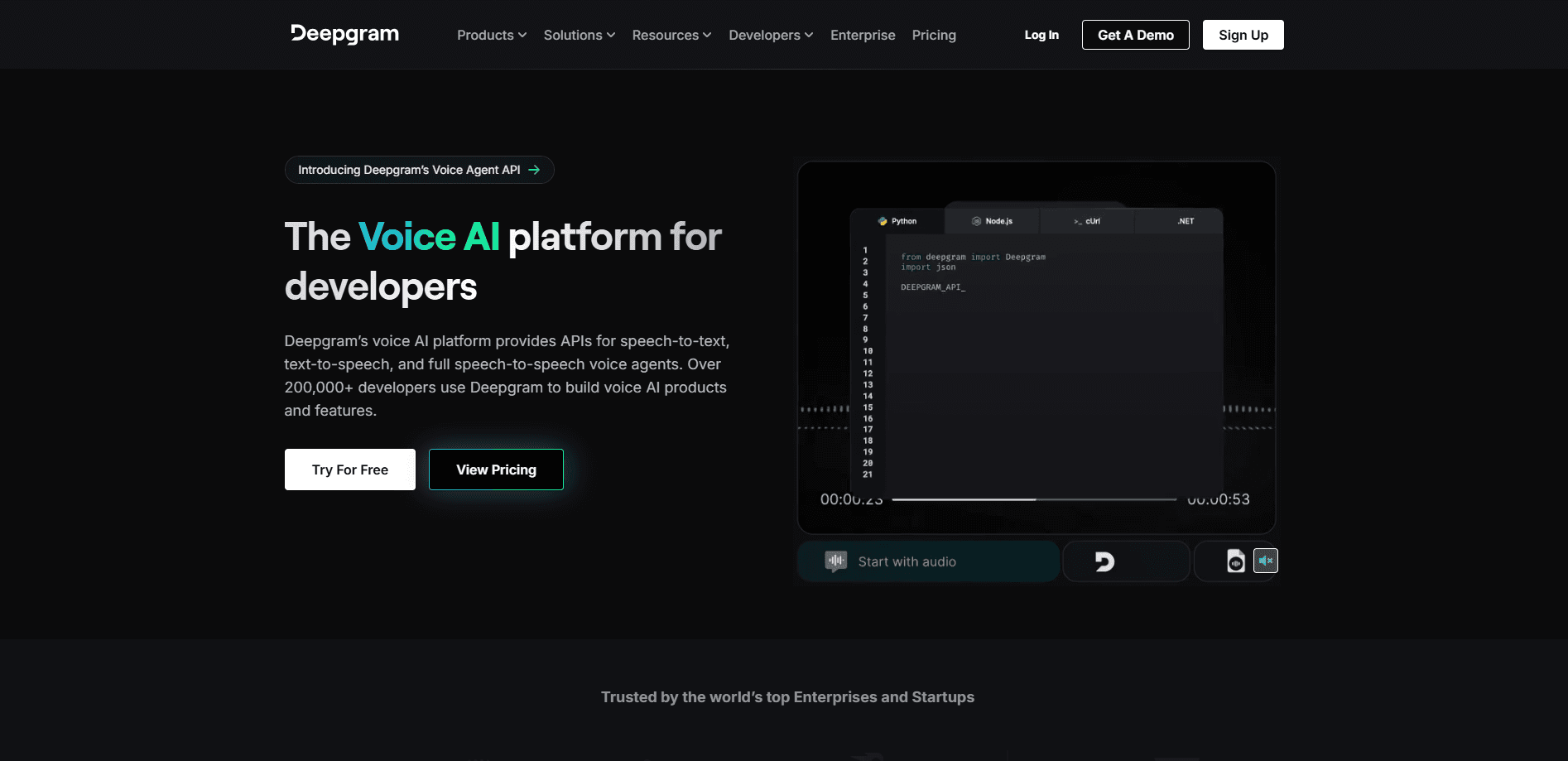
Deepgram is a company that builds speech models and exposes them through a developer API. Its platform covers the whole voice stack: speech-to-text, text-to-speech, and voice agents that hold a live conversation. The company started in 2015 out of Y Combinator, when its founders were still working on physics research and machine learning for audio search.
The core promise is accuracy and speed at a low cost per minute. Teams that need to transcribe calls, caption video, or run a phone bot can plug in one API instead of training their own model. Deepgram also offers self-hosted and on-premise deployment for companies that can't send audio to a third-party cloud.
The biggest limitation is that Deepgram sells a developer product, not an app. There's no consumer interface to click through. You need to write code, manage API keys, and understand concepts like streaming versus batch audio before you get anything useful out of it.
Getting Started
- Create a free account on the Deepgram console and claim the free credit that comes with it.
- Copy your API key from the console and store it as an environment variable in your project.
- Install the official SDK (Python, JavaScript, Go, or .NET) or send a raw HTTPS request to the transcription endpoint.
- Upload an audio file or open a WebSocket stream, then pick a model such as Nova-3 for transcription.
- Read the JSON response, which includes the transcript, word timings, and any extra features you turned on.
Product Information
A quick look at Deepgram's pricing, supported platforms, and performance.
Best for
The users, tasks, and scenarios where this tool fits best.
Users
- Developers who need a transcription API
- Product teams building voice features
- Call centers and support teams
- Enterprises with compliance rules
Tasks
- Transcribing recorded meetings and interviews
- Captioning video at scale
- Running a phone or chat voice bot
- Redacting sensitive details
- Generating spoken audio
Scenarios
- A startup shipping its first voice feature
- A media company clearing a backlog of recordings
- A support team reviewing flagged calls
- An enterprise moving voice workloads on-premise
Key features
Nova-3 speech-to-text
Nova-3 is Deepgram's flagship transcription model. According to Deepgram, it improves accuracy on hard audio like noisy calls and heavy accents, and it supports more than 45 languages. For English, it also handles multilingual code-switching, so a caller who mixes two languages mid-sentence stays in one transcript.
Flux conversational speech recognition
Flux is built for live conversation rather than plain transcription. It detects when a speaker has finished a turn based on meaning, not silence, which keeps a voice agent from cutting people off. The model also handles barge-in, so a user who interrupts gets a response instead of a frozen line.
Text-to-speech voices
The Aura and Flux TTS models turn written text into natural speech with latency as low as 80 milliseconds. Flux TTS keeps tone and context across a whole conversation, so answers don't sound like isolated clips. You can mix Deepgram TTS with another provider if you already have a preferred voice.
Unified Voice Agent API
Instead of wiring a speech-to-text tool, a text-to-speech tool, and a language model together, the Voice Agent API bundles all three. One call handles the listening, the thinking, and the speaking. That cuts integration work and the delay that stacks up when data hops between separate services.
Audio Intelligence
Audio Intelligence adds meaning on top of a transcript. Summarization condenses a long call into key points, topic detection flags what was discussed, and sentiment analysis scores how the conversation felt. Entity detection pulls out names, places, and dates automatically.
Speaker diarization and smart formatting
Diarization labels who spoke when, which is what you need for multi-person calls and interviews. Smart formatting adds punctuation, fixes casing, and rewrites spoken dates and currency into readable form. Both run as add-ons, so you turn them on only for the projects that need them.
Deployment flexibility
Deepgram runs in its own cloud, but it also offers self-hosted and on-premise options for teams with strict data rules. A dedicated EU endpoint keeps audio processing inside the European Union. That flexibility is aimed at enterprises that can't use a shared public cloud.
Pros and cons
Pros
- Pay-as-you-go pricing lets you start small and scale without a contract negotiation.
- One platform covers speech-to-text, text-to-speech, and voice agents, which reduces the number of vendors to manage.
- Low-latency streaming works for live calls, not just uploaded files.
- Self-hosted and EU data residency options fit teams with hard compliance requirements.
- Strong accuracy claims backed by published benchmarks on noisy and accented audio.
Cons
- There's no consumer app, so non-developers can't use it without building something first.
- Costs grow with minutes, and heavy transcription bills can climb faster than a flat-rate competitor.
- Some advanced features like redaction and language support vary by model and language, so you must check compatibility per project.
- Self-hosting adds infrastructure work that small teams may not be ready to take on.
Frequently asked questions
Deepgram provides APIs that convert speech to text, turn text into speech, and power voice agents. Developers call these APIs inside their own apps to add voice features without training a model from scratch.
Related content
Explore related tools, skills, and articles for Deepgram.
Deepgram Alternatives

Foley
Hanamori Labs, LLC · Voice & Language · Productivity · AI AssistantFoley is a voice to-do list that turns a spoken sentence into a filed task, complete with project, date and time, then helps you plan the day around what is already there.

HireKey
HireKey · Voice & Language · Productivity · LeaningHireKey is an AI job search copilot built by a former tech recruiter. It checks role fit, tailors resumes, runs interview practice and tracks every application.

Fluence
Yay Software (Yannick Huchard) · Writing · Voice & Language · ProductivityFluence is an Android app that reads PDFs, EPUBs, Word files and web articles aloud, follows each sentence as it speaks, and answers questions about the text on the phone itself.