

Deepgram Voice AI
Deepgram · Voice & Language
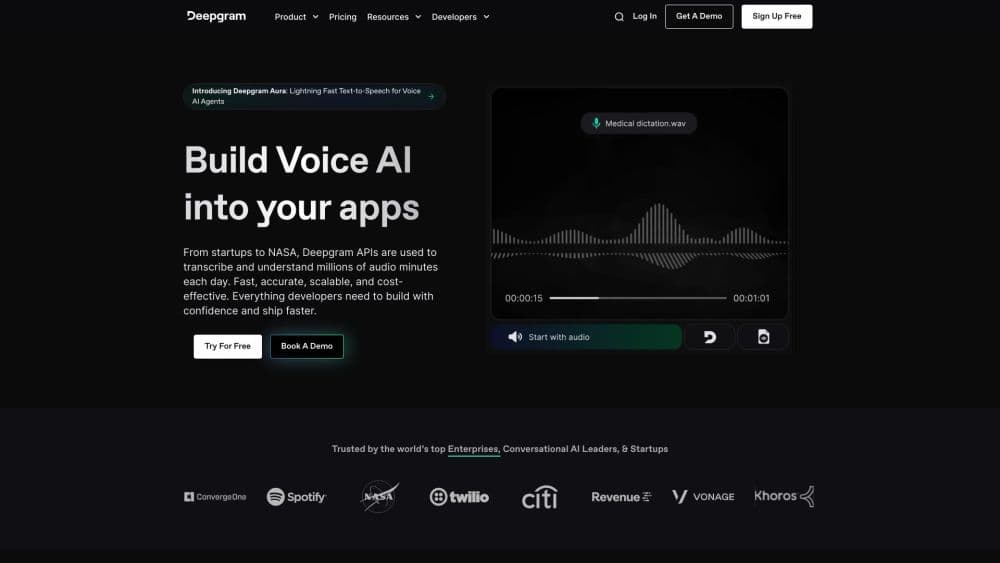
Deepgram is a voice AI platform that turns speech into text, text into speech, and runs real-time voice agents through a single set of APIs.
About Deepgram Voice AI
What Is Deepgram
Deepgram is a voice AI platform built for developers who need speech recognition and speech synthesis inside their own products. It handles the listening, the thinking, and the speaking parts of a voice app, so you don't have to glue together three separate vendors.
The company started in 2015 out of machine learning research at the University of Michigan. Today its models are used by more than 200,000 developers, and partners like Twilio and Cloudflare build voice features on top of the same APIs. Deepgram says its infrastructure has processed over 50,000 years of audio.
The main limit is audience. This is an API-first product, not an app you open and talk to. If you don't write code, there's no everyday interface to use. Pricing also runs on usage, so heavy traffic needs a careful cost estimate before launch.
Getting Started
- Create a free account in the Deepgram Console. New accounts get $200 in credit with no credit card required.
- Pick a model and endpoint: streaming speech-to-text for live audio, pre-recorded for files, or the Voice Agent API for full conversations.
- Grab your API key and send your first request from the docs, or test a voice in the Playground before writing any code.
- Wire the API into your own app or agent, then watch usage in the Console to keep spending in range.
Product Information
A quick look at Deepgram Voice AI's pricing, supported platforms, and performance.
Best for
The users, tasks, and scenarios where this tool fits best.
Users
- Developers building voice features
- Product teams at growing startups
- Enterprises with compliance needs
Tasks
- Live call transcription
- Batch audio to text
- Voice agent conversations
Scenarios
- Turning recorded meetings into notes
- Answering customer calls automatically
- Filtering sensitive data from call archives
Key features
One Platform for the Whole Voice Stack
Deepgram bundles speech-to-text, text-to-speech, and agent orchestration under one account and one API key. You manage billing, limits, and models in a single Console instead of reconciling three vendors. For teams shipping fast, that removes a lot of integration work.
Nova-3 and Flux Speech-to-Text
Nova-3 is Deepgram's general-purpose transcription model, and Flux is purpose-built for real-time voice agents with built-in turn detection. Both handle multilingual audio, background noise, and far-field input. The models themselves are trained in-house, which is why Deepgram leans on accuracy and latency as its main pitch.
Low-Latency Text-to-Speech
The TTS side covers Aura-1, Aura-2, and the newer Flux TTS, which Deepgram markets for conversational use with latency as low as 80 milliseconds. You pick a voice and stream audio back to the caller, and the service bills per 1,000 characters rather than per minute.
Voice Agent API
The Voice Agent API runs a full conversation loop in one WebSocket connection: it listens, sends text to an LLM, and speaks the reply. You can bring your own LLM or TTS to cut cost, and Deepgram handles interruption and turn-taking so the agent doesn't talk over the user.
Audio Intelligence Add-ons
Beyond raw transcription, Deepgram offers summarization, topic detection, sentiment analysis, and intent recognition. These run on Deepgram's own small models, so they're cheaper than pushing the same text through a general-purpose LLM, and they help you pull answers out of recorded conversations.
Cloud, EU, and Self-Hosted Deployment
You can call Deepgram from its US cloud, route traffic to the EU endpoint for data residency, or run self-hosted containers on your own GPUs. That range lets regulated teams keep audio inside their own network while still using the same models.
Pros and cons
Pros
- STT, TTS, and agent tools live under one API, which cuts the vendor stitching most voice projects start with.
- True per-second billing means short clips aren't rounded up, so you pay for the exact audio length processed.
- The $200 signup credit never expires, letting you prototype for months without a deadline.
- Multilingual models and EU data residency give global teams options without leaving the platform.
Cons
- There's no consumer app, so non-developers have nothing to open and use directly.
- Usage-based pricing is hard to predict: a busy month can spike the bill, and the Growth plan needs a $4,000 upfront commitment.
- The cheapest tiers cap concurrency, which means high-traffic production work may be throttled until you upgrade.
- Self-hosted deployment requires your own NVIDIA GPUs, a real cost and ops burden for smaller teams.
Frequently asked questions
Deepgram is used to add speech recognition and speech synthesis to software. Teams use it to transcribe calls, generate spoken replies, and run voice agents that answer questions in real time.
Related content
Explore related tools, skills, and articles for Deepgram Voice AI.
Deepgram Voice AI Alternatives

Foley
Hanamori Labs, LLC · Voice & Language · Productivity · AI AssistantFoley is a voice to-do list that turns a spoken sentence into a filed task, complete with project, date and time, then helps you plan the day around what is already there.

HireKey
HireKey · Voice & Language · Productivity · LeaningHireKey is an AI job search copilot built by a former tech recruiter. It checks role fit, tailors resumes, runs interview practice and tracks every application.

Fluence
Yay Software (Yannick Huchard) · Writing · Voice & Language · ProductivityFluence is an Android app that reads PDFs, EPUBs, Word files and web articles aloud, follows each sentence as it speaks, and answers questions about the text on the phone itself.