

deepsense.ai
deepsense.ai · Coding
deepsense.ai is an applied AI consultancy that designs, builds, and runs enterprise AI agents, RAG systems, and MLOps pipelines, backed by 120 engineers and 200 delivered projects.
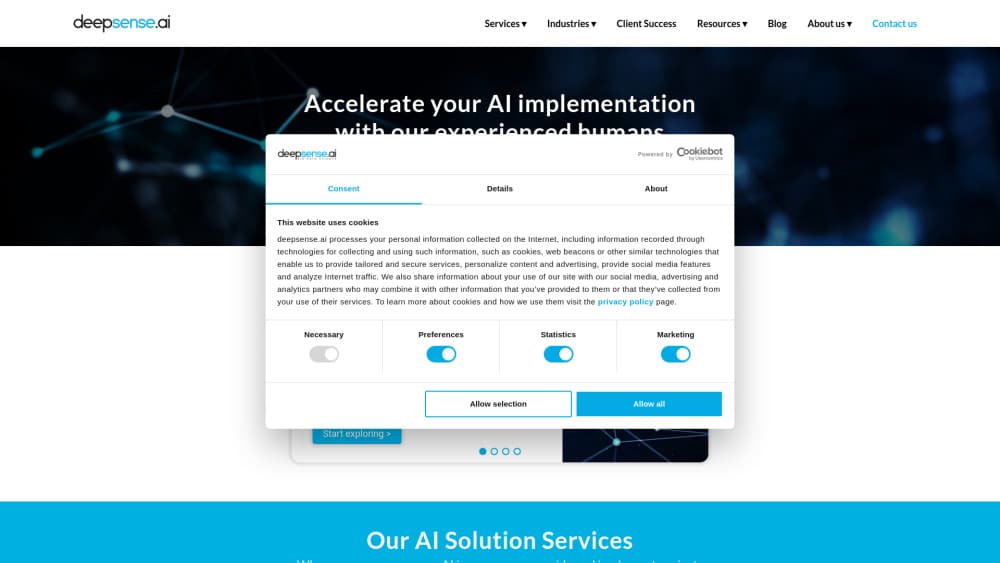
About deepsense.ai
What Is deepsense.ai
deepsense.ai is an AI consulting company that takes enterprise AI projects from a business case to a system running in production. The work covers custom AI development around internal data, plus AI agents, model evaluation, MLOps, computer vision, and edge deployments. Clients include Sky, Volkswagen, Nielsen, NOAA, Zebra Technologies, Brainly, and DocPlanner.
The company started in 2014 and now runs from Warsaw and Palo Alto with about 120 AI experts. It holds official partner status with OpenAI, Anthropic, Google Cloud, AWS, LangChain, and ElevenLabs, and it maintains open source projects such as ragbits, a Python library for agentic RAG pipelines, and db-ally, a tool for structured querying with LLMs.
The main limit is the buying model. There is no self-serve product, no public price list, and no free tier to test before a contract. Every engagement starts with a scoping conversation, which suits companies with a budget and a real workflow to fix, and frustrates anyone who wants to try software this afternoon.
Getting Started
- Book an intro call and describe the workflow you want to improve, along with the data sources and systems it touches.
- Run a discovery or advisory phase to pick one use case, set success metrics, and estimate cost and risk.
- Build a working prototype against your own data, then review the evaluation results before committing to a full build.
- Move the system into your cloud account with monitoring, access control, and documentation your team can own.
- Train internal staff during delivery so the AI program continues after the consultants leave.
Product Information
A quick look at deepsense.ai's pricing, supported platforms, and performance.
Best for
The users, tasks, and scenarios where this tool fits best.
Users
- Enterprise AI leads with a stalled pilot
- Regulated industries
- Product organizations adding AI features
- Scaleups without a senior ML team
Tasks
- Building an enterprise AI agent that answers from internal documents, calls tools, and escalates to a person when confidence drops.
- Creating LLM evaluation datasets and scoring runs so model changes get measured instead of argued about.
- Setting up MLOps services for deployment, monitoring, and retraining of models that already exist in the business.
- Adding computer vision or edge inference to a physical process, such as quality checks on a production line or document capture in the field.
- Writing an AI roadmap that names the first three use cases, the data gaps, and the cost of each step.
Scenarios
- A proof of concept has impressed the board and now has to survive security review, procurement, and a real user base.
- A pharma or healthcare team needs an AI assistant that cites sources and keeps a review trail for regulatory questions.
- A company wants to standardize how every department builds RAG pipelines, so teams stop shipping five different stacks.
Key features
AI Agents and GenAI Delivery
deepsense.ai builds agents that do a job rather than hold a conversation. Typical work covers tool calling, retrieval over internal knowledge, guardrails, and a human review step for decisions that carry risk. Delivery includes the evaluation set that proves the agent still works after a model upgrade.
Agentic RAG with ragbits
ragbits is the company's open source Python library for RAG pipelines, and it shows how the team approaches retrieval. You get modular components for ingestion, embeddings, reranking, and generation, plus a UI layer for chat interfaces. Because the library is public, a client team can read the code before signing anything.
LLM and VLM Evaluation Datasets
Model quality claims are hard to check without a test set. The team builds evaluation datasets for text and vision models, defines scoring criteria with domain experts, and runs comparisons when a new model ships. The output is a number a product owner can defend in a review meeting.
MLOps and Production Infrastructure
The MLOps services cover the unglamorous parts: containerized deployment, GPU scheduling, monitoring, drift detection, and retraining triggers. One published case reports 96.3% average GPU utilization on a 32 GPU training job after tuning the distributed setup. That kind of work decides whether a model is affordable to run.
Custom MCP Servers and Platform Integrations
For teams standardizing on Claude, ChatGPT Enterprise, or Gemini, the company builds custom MCP servers that expose internal data and tools to those assistants under controlled permissions. This is the practical route when a vendor assistant needs access to a private warehouse or a legacy system without opening a direct database connection.
AI Advisory and Adoption Programs
An advisory engagement usually runs four to eight weeks and ends with a decision, not a slide deck: which use case to fund, which vendor to pick, what the build will cost, and who owns it internally. The team also runs workshops that teach an in-house group to keep building after the contract ends.
Pros and cons
Pros
- Delivery covers strategy, engineering, and operations in one contract, so nobody has to translate between a strategy firm and a dev shop.
- Official partner status with OpenAI, Anthropic, Google Cloud, and AWS gives the team early access to platform changes and a direct line to vendor engineers.
- Public open source work in ragbits and db-ally lets you inspect code quality before the first meeting.
- Regulated industry experience shows up in the delivery method, with evaluation, traceability, and human review treated as standard parts of the build.
- Teams can be embedded alongside internal staff, which transfers knowledge instead of leaving a black box.
Cons
- No public pricing means budget planning needs a sales conversation first, which slows down smaller teams.
- There is no self-serve tier or trial, so you cannot test the work on a small project without a contract.
- Project minimums and enterprise focus make the firm a poor fit for a solo founder with a $2,000 idea.
- Timelines depend on client data access and security review, and those steps often take longer than the build itself.
Frequently asked questions
It builds AI systems for companies and helps them run those systems afterward. The work ranges from AI agents and enterprise search to computer vision, MLOps, and advisory projects that end with a funded roadmap.
Related content
Explore related tools, skills, and articles for deepsense.ai.
deepsense.ai Alternatives

Base Code
Base44 (Wix) · Coding · ProductivityBase Code is a shared cloud development environment from Base44. Teammates describe changes to an existing GitHub codebase in chat, preview them live and send them back as pull requests.

Google EmbeddingGemma 2
Google DeepMind · Writing · Image · CodingGoogle EmbeddingGemma 2 is a 740M-parameter open model that turns text, code, images, audio, and video frames into vectors in one 768-dimension space, running on phones and laptops.

GitGlow
GitGlow · Coding · ProductivityGitGlow is a local-first desktop Git client that lets independent developers review their own code and their AI agents' changes in one place before shipping.