

Deferred
Deferred · Other
Deferred is a no-fee 1031 qualified intermediary that runs like-kind exchanges online, holds funds in FDIC-insured accounts, and shares the interest those funds earn.
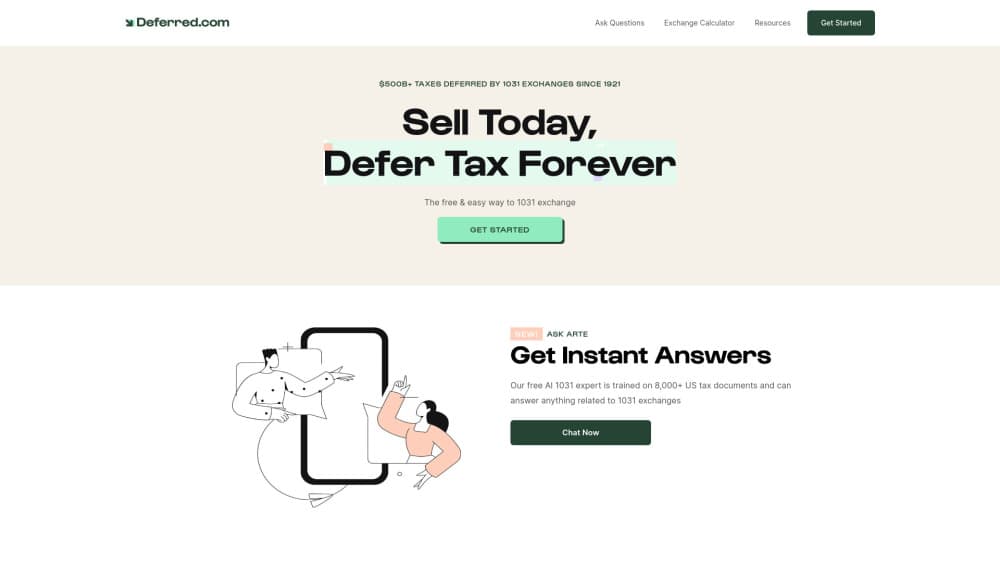
About Deferred
What Is Deferred
Deferred is a qualified intermediary (QI) for 1031 exchanges, the swap of one investment property for another so capital gains taxes stay deferred. A QI is the neutral party that holds sale proceeds between closing dates, and most of them charge $1,000 or more for the job. Deferred charges nothing on a standard forward exchange.
The company has completed more than 8,000 exchanges with a team of attorneys, CPAs, and exchange officers who bring 200+ years of collective experience. Files move through an online dashboard, and support runs from 8 a.m. to midnight ET, seven days a week.
The money side is the real difference. Client funds sit in segregated accounts at commercial banks with FDIC coverage that can reach $175M, and the interest those funds earn is shared back with the investor. Deferred keeps part of that interest as its revenue, which is why the fee line reads $0.
Limits exist. A no fee 1031 exchange covers forward deals, while reverse and improvement structures still cost money. Deferred also works in US real estate only, and every exchange depends on strict IRS timelines: 45 days to identify replacement property, 180 days to close.
Getting Started
- Fill out the lead form at app.deferred.com or call the team before your sale closes.
- Set up the exchange agreement with an exchange officer, who reviews the property, the entity, and your timeline.
- Send your closing agent Deferred's wiring instructions so the proceeds land in the exchange account.
- Identify replacement properties inside 45 days in the dashboard, then close within 180 days.
Product Information
A quick look at Deferred's pricing, supported platforms, and performance.
Best for
The users, tasks, and scenarios where this tool fits best.
Users
- Individual rental owners
- Repeat exchangers and family offices
- Agents, CPAs, and attorneys
Tasks
- Standard forward exchange
- Reverse exchange
- Improvement exchange
Scenarios
- Selling a rental and buying a bigger one in another state
- A closing calendar with no slack
- Portfolio reshuffles with entities and LLCs
Key features
No Fee on Forward Exchanges
Deferred charges $0 on a standard forward 1031 exchange. No wire fee, no rush fee, no per-property charge. Revenue comes from a share of the interest earned on client funds, so the quote you get is the amount you pay.
Shared Interest on Exchange Funds
Proceeds sit in interest-bearing accounts while the exchange is open, and the investor keeps most of what that money earns. Deferred's own calculator shows roughly $34,500 earned on a $4M exchange held for 180 days at rates from October 2026. Traditional intermediaries usually keep that interest for themselves.
Segregated, FDIC-Insured Accounts
Funds are held at commercial banks in individual segregated accounts, not pooled with other clients. Coverage can reach $175M through FDIC insurance, backed by a $25M fidelity bond and $5M in errors and omissions coverage. That's about 25 times the industry standard bond.
Online Exchange Dashboard
The 1031 exchange platform keeps the whole file in a web app. Investors upload the sale contract, identify replacement properties, watch deadlines, and pull documents without emailing an officer for a status update. Advisors see the same view, which cuts the back-and-forth on a shared client.
Deadline Tracking and Compliance Review
The 45-day identification and 180-day closing windows are hard 1031 exchange rules, and missing one voids the deferral. The platform surfaces both dates, and an exchange officer checks identifications for compliance before they're filed.
Extended Support Hours
Officers answer from 8 a.m. to midnight Eastern, seven days a week, weekends included. Closings happen on Fridays and holidays, so the wider window matters more than it sounds on a services page.
Pros and cons
Pros
- Zero fee on forward exchanges, which saves the $1,200 to $1,500 a traditional QI typically charges.
- Interest on exchange funds is shared instead of kept, and on large deals it can run into five figures.
- Strong fund protection: segregated accounts, FDIC coverage up to $175M, a $25M fidelity bond, and $5M E&O.
- An online dashboard plus weekend hours make deadline management easier for investors and their advisors.
Cons
- Reverse exchanges ($7,000 and up) and improvement exchanges ($7,500 and up) carry real costs, so the free headline applies to forward deals only.
- The model leans on interest rates. When short-term rates fall, the economics behind the no-fee offer thin out on both sides.
- No public API and no mobile app, so teams that want programmatic reporting or phone-native workflows are out of luck.
- US property and US taxpayers only, which rules out foreign investors and cross-border exchanges.
Frequently asked questions
It earns a share of the interest on funds held during the exchange. You keep the rest. That cut isn't a fee you pay upfront, and Deferred says there are no junk fees for extra properties, wires, or rush work.
Related content
Explore related tools, skills, and articles for Deferred.
Deferred Alternatives

Odyssey 3
Odyssey · OtherOdyssey-3 is Odyssey's foundation world model. It simulates physics in real time, turns a prompt into an interactive environment, and adapts to robots, cars and games.

JarvisCore
Prescott Data · Coding · Productivity · OtherJarvisCore is an open source Python runtime where AI agents work as equal peers on an agent mesh, claim tasks from a shared ledger, and reach external services through a zero-trust broker.
Clef
Cloudflare · Business · OtherClef is Cloudflare's open-source decision model for Workers AI. It returns calibrated probabilities for typed questions, not generated text, so agents can classify, route, and act fast.