

Describely
Describely · AI Detection · Business
Describely is an AI product content platform for ecommerce teams. It audits catalogs, writes descriptions and metadata in bulk, fills data gaps, and publishes to Shopify and other stores.
About Describely
What Is Describely
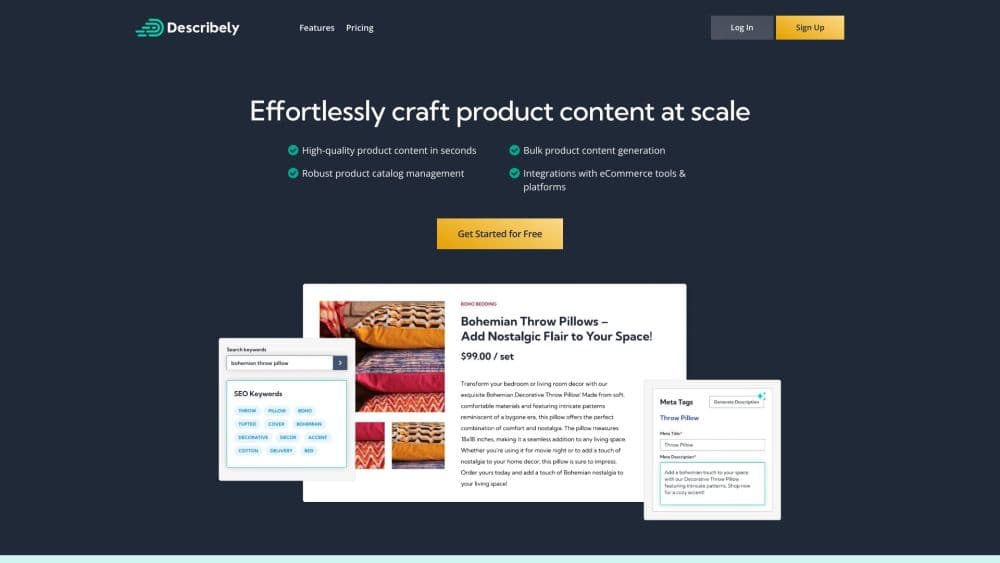
Describely is a browser-based AI product description generator and content platform built for online stores with more products than time. You connect a shop, a CSV file, or a PIM, and the platform scores each product on how it reads to search engines and to shoppers, then writes the titles, descriptions, bullets, and metadata that close the gaps. It suits teams working through a catalog, not someone who needs one clever paragraph.
The work it replaces is the repetitive middle of ecommerce content: rewriting the same desk lamp copy for a fourth season, chasing missing dimensions through a supplier PDF, and pasting meta descriptions into Shopify one product at a time. Describely keeps a ruleset per brand or department, so tone and structure stay fixed while the wording changes per SKU. The company's published Target Australia case study reports more than 1,000 product descriptions a week at 98% accuracy on the first pass.
Three limits matter before you sign up. You pay per product, so a 10,000-SKU catalog is a real budget line rather than a flat monthly fee. The GEO score is Describely's own measure of AI search readiness, not a promise that ChatGPT or Google will rank a page. Generated copy also needs a human check on specs, materials, and regulated claims. The app runs in a browser, with no desktop or mobile client.
Getting Started
- Create an account at app.describely.ai. The first five products are free and no credit card is required.
- Connect a source: Shopify, WooCommerce, Wix, Squarespace, Akeneo, a CSV or Excel upload, or the API.
- Run the catalog audit. Each product gets a GEO score for AI search readiness and a conversion score for shopper readiness.
- Set content rules for tone, length, structure, and banned claims, then pick the fields you want written.
- Generate in bulk, review the drafts, and publish back to the store or export the file.
Product Information
A quick look at Describely's pricing, supported platforms, and performance.
Best for
The users, tasks, and scenarios where this tool fits best.
Users
- Ecommerce content leads at stores with 500 to 10,000 SKUs
- Solo store owners
- Agencies and freelancers with several client stores
- Distributors and brands with PIM data
Tasks
- Clearing a description backlog
- Writing Shopify product descriptions for a new collection
- Filling missing attributes
- Getting catalog copy ready for AI search
Scenarios
- A seasonal refresh before peak trading
- A re-platforming project
- An agency taking on a messy client catalog
Key features
Bulk Product Description Generation
The core function writes titles, descriptions, bullet points, and tags for many products in one run. You choose the fields, set a ruleset, and the platform works through the catalog without prompting each item separately. Describely says each description is generated from that product's own details, so a catalog of similar items doesn't come back with identical copy. For a team replacing a manual copy workflow, that's product content automation with a person still in the review loop.
AI Catalog Audit with GEO and Conversion Scores
Before it writes anything, Describely grades each SKU on two axes. The GEO score estimates how likely the product is to surface in AI answers from ChatGPT, Gemini, or Perplexity, while the conversion score looks at whether a shopper has enough detail to buy. The audit points to specific gaps such as thin descriptions, missing attributes, or weak meta tags, which makes the rewrite list easier to prioritize.
Product Data Enrichment
Thin product data produces thin copy, and this feature attacks that problem directly. Enrichment pulls attributes from manufacturer pages, supplier documents, or the sources you allow, then fills the empty fields before generation starts. Data enrichment is billed separately at $0.55 per credit, so teams with clean PIM data can skip it and keep the cost lower.
Content Rules for Brand Voice
Content rules lock in tone, length, structure, and wording preferences for a brand, category, or department. Every description in that group follows the same brief, which cuts the back and forth that usually follows a bulk export. Agencies can keep several clients in one account without their voices bleeding together, and a retailer can run a formal tone for one category and a casual one for another.
Store Connectors and Direct Publishing
Describely connects to Shopify, WooCommerce, Wix, Squarespace, and Akeneo, and it accepts CSV or Excel uploads for everything else. Finished content publishes back to the storefront from inside the app, so there's no copy-paste step between the generator and the product page. Publishing is where most content tools stop short, and this one carries the work through to the live listing.
SEO and Metadata Tools
The platform writes meta titles, meta descriptions, and keywords alongside the main description, then checks them against the product's target terms. These are the fields that decide how a listing appears in a search result, and they're easy to leave half-finished when a team is rushing a launch. Having them generated in the same pass keeps the page complete.
AI Image Generation
Product images can be generated or varied inside the same workspace. The tool creates consistent visuals that match a catalog's style, which helps when a supplier sends one flat photo and the product page needs a cleaner set. Image processing is billed at $0.05 per credit, separate from description generation.
API, MCP Server, and Chat Agent
The API supports product CRUD, catalog access, ruleset access, and content generation, so a PIM or internal tool can push products in and pull finished copy out. API usage is priced at $0.20 per 1,000 tokens, with a typical product generation using 1,000 to 3,000 tokens. The same key powers an MCP server for Claude, Cursor, Windsurf, and VS Code, and a chat agent that runs catalog tasks in plain language.
Pros and cons
Pros
- Pay-as-you-go pricing removes the subscription commitment, so a small test costs $3.75 after the five free products.
- Bulk generation handles hundreds or thousands of SKUs in one run, which is the difference between a week of writing and an afternoon of review.
- Content rules keep a large catalog on brand without an editor rewriting every category from scratch.
- Direct connectors to Shopify, WooCommerce, Wix, Squarespace, and Akeneo publish finished copy without a manual import.
- The audit produces a prioritized fix list, so teams know which products need new copy and which only need better metadata.
Cons
- Per-product pricing scales with the catalog, and anything above 500 SKUs moves to a custom quote, which makes budgeting less predictable.
- The GEO score is Describely's own metric, so it works as a directional signal rather than a Google or ChatGPT ranking.
- Generated descriptions still need a factual check on specs, materials, and regulated claims, and that review time grows with the catalog.
- The app interface is in English and there's no mobile app, which is awkward for non-English teams and for approvals away from a desk.
Frequently asked questions
Describely writes and manages ecommerce product content at scale. It generates descriptions, titles, bullets, meta tags, and image variations, enriches missing product data, audits catalog quality, and publishes the result to a storefront.
Related content
Explore related tools, skills, and articles for Describely.
Describely Alternatives
Isgen AI
Isgen · AI DetectionIsgen AI is a web-based AI detector that scores text for machine authorship and shows you which sentences and phrases push the number up. It's built for teachers, editors, students, and writers. Their question is simple: did this draft come from ChatGPT, GPT-5, Claude, Gemini, DeepSeek, or another model? You paste or upload content, run a scan, and get a Human, AI, and Mixed breakdown in seconds. There's also a companion editor that scores text while you write it.
Humanizeai Tools
Humanizeai Tools · Writing · AI DetectionHumanizeai Tools is a web-based AI humanizer that rewrites machine-generated text so it sounds like a person wrote it, which is the whole point of the category it belongs to. Paste a draft from ChatGPT, Claude, or Gemini, run it through the tool, and it swaps out the phrases and sentence patterns that AI detectors flag. If your goal is to make AI text sound human before you publish it, this is the kind of tool built for exactly that. It suits students, bloggers, and marketers who need copy that reads naturally and clears tools like GPTZero, Copyleaks, and Winston AI after a single pass.

Hidemyai
Hidemyai · Writing · AI DetectionHidemyai is an AI content humanizer. It rewrites text from ChatGPT, Jasper, and similar tools so the result reads like a person wrote it. You paste your draft, pick a document type and tone, and the service returns a version meant to bypass AI detectors such as Originality.ai, Turnitin, and ZeroGPT. It targets writers, marketers, and students who lean on AI drafts but can't ship copy that sounds robotic. The promise is simple: make AI content undetectable.