

Devozy.ai
Devozy.ai · Coding · Productivity
Devozy.ai is a self-service DevOps automation platform that helps developers spin up cloud environments and CI/CD pipelines across AWS, Azure, and GCP without deep ops skills.
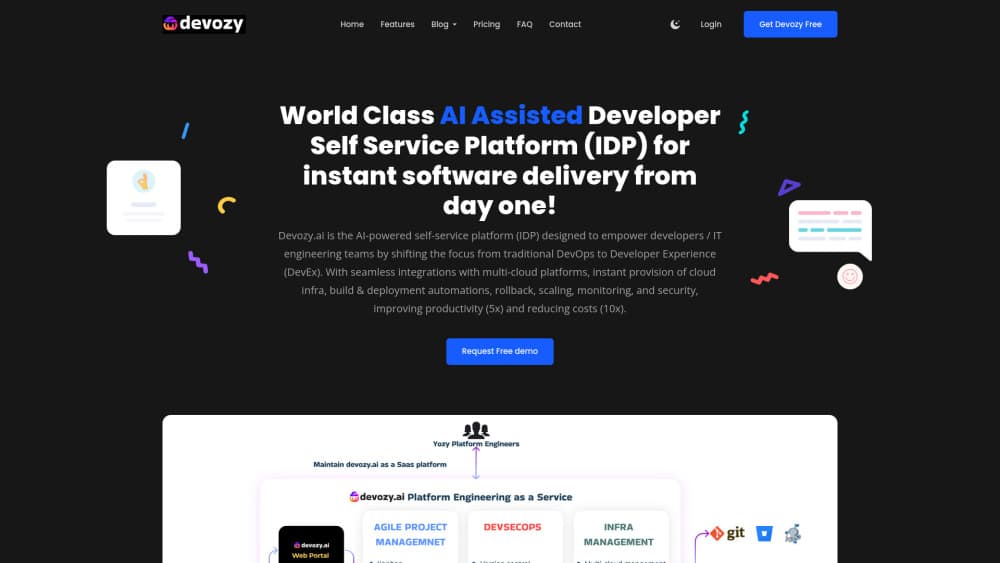
About Devozy.ai
What Is Devozy.ai
Devozy.ai is a developer self-service platform built for teams that want to ship software to the cloud without leaning on a dedicated DevOps crew. You link a cloud account and a code repository, and the platform provisions the pipelines and runtime environments for you. The pitch is simple: no scripts, no tickets to the infra team, just click and deploy.
It covers three clouds, AWS, Microsoft Azure, and Google Cloud Platform, plus Qlik Talend for data jobs. That spread matters for startups and small companies that don't run a platform engineering group and can't afford the delays that come with one or two specialists handling every release.
The limits are worth knowing up front. Devozy.ai is aimed at standard application delivery rather than custom infrastructure, so teams with unusual networking or compliance setups may still need hands-on work. Pricing also runs on project environments and user seats, which means the free tier covers only one environment.
Getting Started
- Sign up on the Devozy.ai site and pick a plan; the free tier needs no credit card.
- Connect a cloud account, choosing AWS, Azure, or GCP, and link the subscription you want to use.
- Add a code repository from GitHub, GitLab, Azure Repos, or Bitbucket.
- Create the CI/CD pipeline and the application environment from the ready-made automations.
- Deploy the app and adjust scaling, monitoring, or security scans from the dashboard.
Product Information
A quick look at Devozy.ai's pricing, supported platforms, and performance.
Best for
The users, tasks, and scenarios where this tool fits best.
Users
- Startups without a DevOps hire
- Small IT teams juggling releases
- Data engineers on Qlik Talend
Tasks
- Standing up a CI/CD pipeline
- Provisioning application environments
- Deploying across multiple clouds
Scenarios
- Shipping a first prototype to the cloud
- Cutting release delays from infra bottlenecks
- Reducing cloud and CI/CD running costs
Key features
Ready-made CI/CD pipelines
Devozy.ai builds continuous integration and delivery pipelines from templates rather than asking you to write the YAML and scripts yourself. It runs on Jenkins or the cloud-native CI tools each provider offers, so the pipeline fits AWS, Azure, or GCP rather than forcing one tool across all three. For a team without a platform engineer, this removes the steepest part of the setup.
Instant application environments
The platform provisions the runtime for your app in seconds, using virtual machines, container services, or managed Kubernetes depending on the cloud. That covers the step people usually stall on, since environment setup tends to involve networking, access rules, and storage that take days to wire up by hand. Here it runs off automations the platform already maintains.
Multi-cloud support across AWS, Azure, and GCP
One platform covers the three major clouds, with each provider getting its own integration for pipelines and runtime. The Business Plus tier and above extend this to two cloud subscriptions and multi-cloud brokerage, which helps teams that keep workloads on more than one provider. For multi-cloud deployment done by hand, that usually means learning three separate toolchains.
Qlik Talend and data pipeline integrations
Beyond app delivery, Devozy.ai handles Qlik Talend job deployments and upgrades, including support for Nexus and Jenkins in Talend projects. It also covers migrations from Informatica PowerCenter to Qlik Talend and report conversions to Qlik Sense. This makes the platform useful to data teams, not just application developers.
Built-in security, testing, and scaling
The pipeline runs security scans with SonarQube and Snyk, executes unit and functional tests, and scales app instances up or down on demand. These steps sit inside the build rather than as separate tools you bolt on later, so quality and scaling checks happen on every release.
Self-service model with a free tier
The platform is designed so developers run their own environments without filing requests to an infra team. A free plan covers one project environment, three users, one cloud subscription, and one code repository with no credit card. Paid tiers raise the environment and seat counts and add SSO, monitoring, and mobile access.
Pros and cons
Pros
- Removes the DevOps dependency for routine releases, so shipping doesn't wait on an infra team.
- Covers AWS, Azure, and GCP from one platform, which cuts the learning curve for teams spread across clouds.
- Free plan is real and needs no credit card, giving a genuine way to test the workflow before paying.
- Bundles security scans, testing, and scaling into the pipeline instead of leaving them as add-ons.
- Includes Qlik Talend support, which matters for data teams that most app-focused platforms ignore.
Cons
- Focused on standard application delivery, so teams with custom networking or strict compliance setups may still need manual work.
- Pricing for paid tiers is quote-based, which makes budgeting harder before you talk to sales.
- The free plan is tight at one environment, three users, and one cloud, so it's a trial rather than a working setup for a real team.
- API availability isn't documented publicly, which limits how far you can wire it into existing tooling.
Frequently asked questions
Devozy.ai is used to automate DevOps work for application delivery. You connect a cloud account and a code repository, and the platform creates the CI/CD pipeline and the runtime environment, then deploys your app. It targets teams that want to ship software without maintaining their own ops toolchain.
Related content
Explore related tools, skills, and articles for Devozy.ai.
Devozy.ai Alternatives

Base Code
Base44 (Wix) · Coding · ProductivityBase Code is a shared cloud development environment from Base44. Teammates describe changes to an existing GitHub codebase in chat, preview them live and send them back as pull requests.

Google EmbeddingGemma 2
Google DeepMind · Writing · Image · CodingGoogle EmbeddingGemma 2 is a 740M-parameter open model that turns text, code, images, audio, and video frames into vectors in one 768-dimension space, running on phones and laptops.

GitGlow
GitGlow · Coding · ProductivityGitGlow is a local-first desktop Git client that lets independent developers review their own code and their AI agents' changes in one place before shipping.