

Dflux.ai - Unified Data Science Platform
Dflux.ai · Other
Dflux.ai is an AI database migration platform that maps schemas, runs live dual-write migrations, and validates every row, so engineering teams move production data to the cloud without downtime.
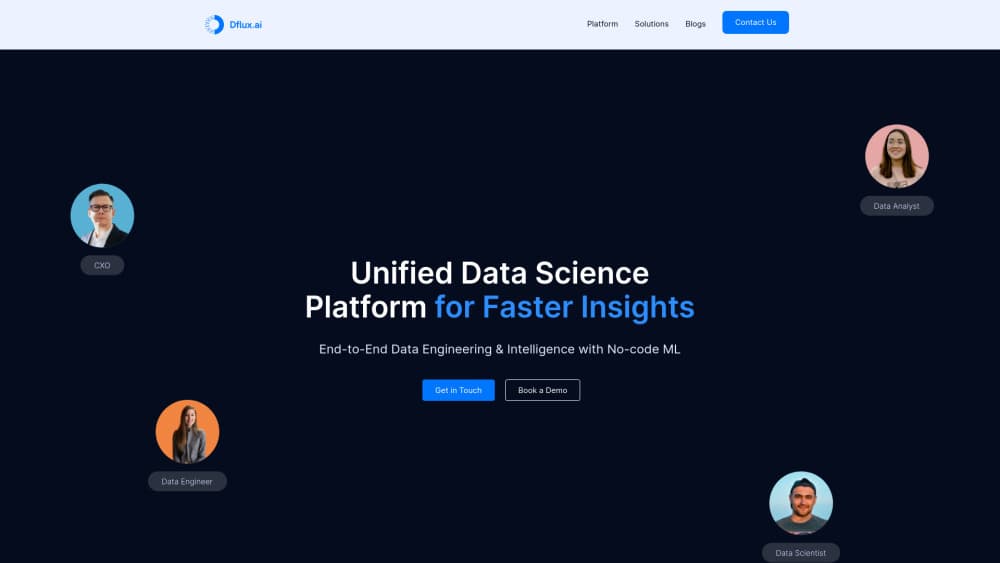
About Dflux.ai - Unified Data Science Platform
What Is Dflux.ai
Dflux.ai is a database migration platform built for teams that need to move production data from one engine to another without taking the application offline. Its selling point is automation at the boring, risky parts: reading the source schema, generating target mappings, keeping both databases in sync, and checking every row once the copy finishes.
The workflow runs on a set of AI agents. One scans indexes, constraints, and data volumes. Another resolves cross-database type conflicts and flags anything that needs a human decision. A third executes the live migration while a fourth validates row counts and checksums before cutover. In practice, that replaces the scripts most teams write by hand for a PostgreSQL to Snowflake migration or a move off legacy Oracle.
The limits matter too. This is a database migration tool sold to engineering organizations, so there's no self-serve signup and no published price list. You book a demo, run a proof of concept on your own schema, and get a quote. Connector coverage sits at 20 or so engines, which is broad but not universal. Small projects with a few gigabytes of data will find cheaper, simpler options.
Getting Started
- Book a demo through the official site and describe your source engine, target engine, and data volume.
- Connect the source database with credentials, a VPN tunnel, or a private link. Credentials sit in a vault and get deleted after the session.
- Let the schema analysis agent scan your tables, then review the generated mappings and the conflicts it flags.
- Start the live migration. Dual-write keeps source and target aligned while your application keeps reading from the original.
- Check the integrity report, pick a cutover window, and switch traffic. Rollback stays available while the session is open.
Product Information
A quick look at Dflux.ai - Unified Data Science Platform's pricing, supported platforms, and performance.
Best for
The users, tasks, and scenarios where this tool fits best.
Users
- Data engineering leads at mid-market and enterprise companies
- Platform and DevOps teams running live production databases
- Teams retiring an on-premise Oracle or SQL Server estate
Tasks
- Cross-engine schema conversion
- Zero downtime migration of a production database
- Post-migration integrity checks
- Migration planning without a freeze
Scenarios
- Moving a 1TB production database over a weekend
- Retiring a legacy Oracle estate for PostgreSQL
- Consolidating several operational databases onto Snowflake or BigQuery
Key features
AI Schema Mapping
The mapping agent reads primary keys, foreign keys, indexes, and constraints from the source, then generates target definitions with types already converted. Conflicts come back flagged rather than silently guessed, and the platform learns from the corrections your team makes. Reviewers approve a script before anything runs.
Zero Downtime Live Migration
A dual-write layer keeps the source and target databases aligned during the whole move, so applications keep reading and writing to the original. Cutover is a controlled switch measured in seconds. If you need to migrate database to cloud on a date your customers never notice, this is the feature that decides the purchase.
Automated Validation
After the copy, Dflux.ai compares row counts and checksums, then runs statistical anomaly detection to catch truncation and drift. The result is a full integrity report. Any threshold breach can trigger a rollback without a human in the loop, which is the difference between a bad hour and a bad month.
20+ Database Connectors
The platform covers relational engines like PostgreSQL, MySQL, Oracle, SQL Server, and MariaDB, NoSQL stores like MongoDB, Cassandra, DynamoDB, and Redis, and warehouses like Snowflake, BigQuery, Redshift, and Azure Synapse. Cross-cloud and hybrid pairs are supported, and new connectors land each quarter.
One Click Rollback
Rollback runs from the same dashboard as the migration and reverts the target while the source stays authoritative. Support teams quote minutes for a clean revert. For anyone who has cleaned up a half-finished migration by hand, that alone changes the risk math.
Security and Audit Trail
Data is encrypted with TLS 1.3 in transit and AES-256 at rest. Role-based access control limits who can approve mappings or trigger cutover, and every agent action lands in an audit log. The company states SOC2 Type II audit and GDPR compliance, which is the paperwork enterprise procurement will ask for.
Pros and cons
Pros
- AI schema mapping removes the slowest manual step in a cross-engine database migration, especially between engines with different type systems.
- Dual-write architecture means you don't need a maintenance window, which matters for any product with paying customers online.
- Automated rollback triggers on validation breaches, so a failed migration doesn't become a multi-week cleanup project.
- Connector breadth covers the common source and target pairs without a second tool for the warehouse side.
- Live monitoring shows throughput, lag, and per-agent activity while the job runs.
Cons
- No published pricing and no self-serve tier, so you can't evaluate cost without talking to sales.
- The free plan is not available at all, which rules out trying the platform on a side project.
- 20 plus connectors still leaves gaps: if you run an uncommon engine, you'll wait for the quarterly connector release or stay put.
- The platform assumes an engineer who can read a schema diff and approve mappings, so it won't rescue a team with no database knowledge.
Frequently asked questions
It moves production databases between engines with AI agents handling schema analysis, mapping, live data transfer, and validation. You connect a source and a target, review the generated mappings, and run the migration.
Related content
Explore related tools, skills, and articles for Dflux.ai - Unified Data Science Platform.
Dflux.ai - Unified Data Science Platform Alternatives

Odyssey 3
Odyssey · OtherOdyssey-3 is Odyssey's foundation world model. It simulates physics in real time, turns a prompt into an interactive environment, and adapts to robots, cars and games.

JarvisCore
Prescott Data · Coding · Productivity · OtherJarvisCore is an open source Python runtime where AI agents work as equal peers on an agent mesh, claim tasks from a shared ledger, and reach external services through a zero-trust broker.
Clef
Cloudflare · Business · OtherClef is Cloudflare's open-source decision model for Workers AI. It returns calibrated probabilities for typed questions, not generated text, so agents can classify, route, and act fast.