

Didit
Didit · Other
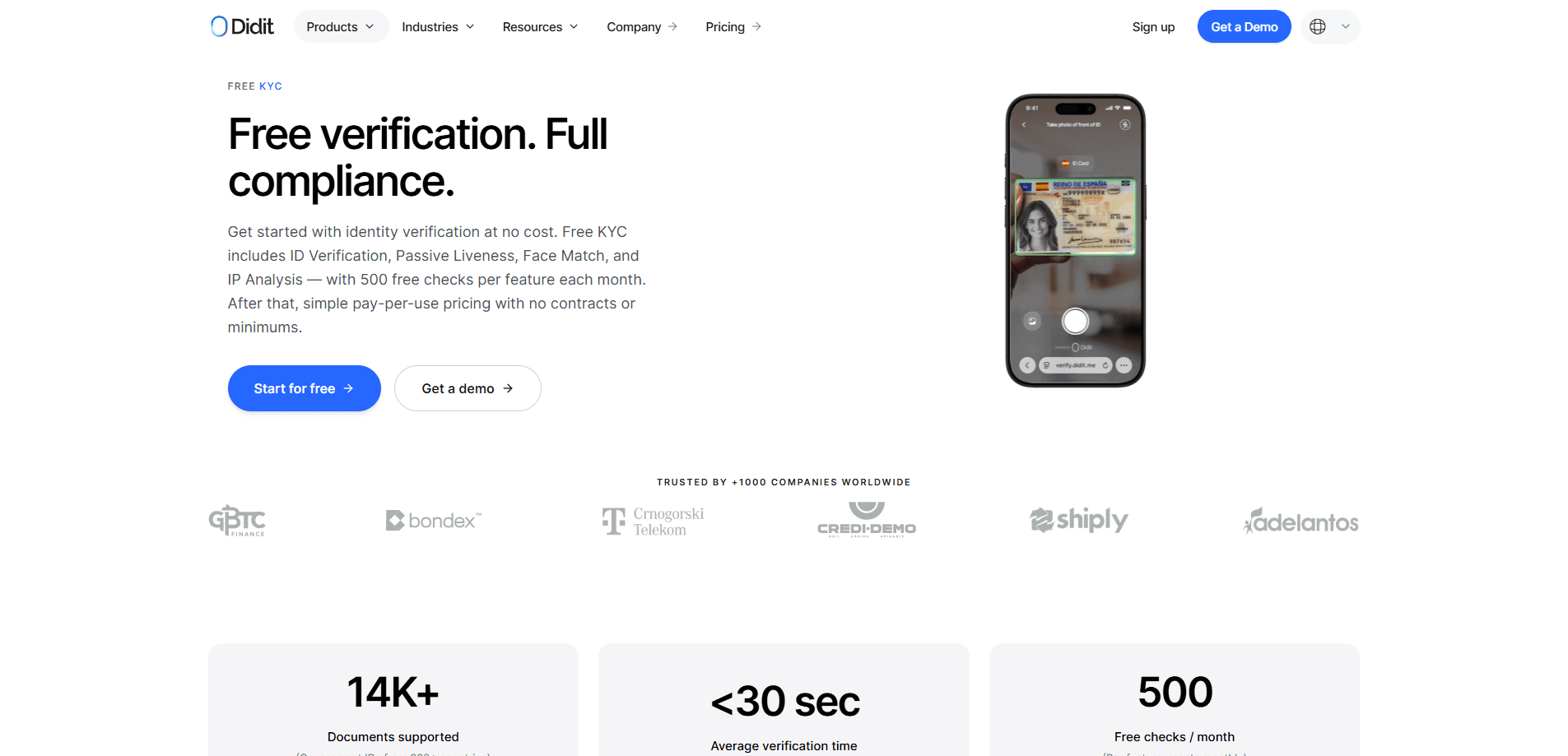
Didit is an AI-native identity verification platform that bundles ID checks, liveness detection, face match, and IP analysis into a single API. Developers get 500 free KYC checks every month, and pay $0.33 per check after that. It ships with a sandbox, an MCP server, and 25+ verification modules.
About Didit
What Is Didit
Didit is an identity and fraud infrastructure platform built around one API. That's the whole pitch. Instead of stitching together separate vendors for document checks, biometrics, and anti-money-laundering screening, you compose a flow from modular pieces and run them in a single session. The company reports 2,000+ organizations use it, across 220+ countries and 14,000+ document types. The claim holds up in its pricing page numbers.
The free tier is the part most developers care about. Every account gets 500 full KYC checks each month, forever, with no credit card required. Those checks run on the same engine paying customers use, not a cut-down trial model. Check 501 simply starts billing at $0.33. No asterisk.
The main constraint is that Didit expects you to work through its API or console. This is a developer-first product, so teams wanting a drag-and-drop no-code tool may find the setup heavier than they'd like. It's also priced per check rather than per seat, which rewards steady volume. Get your flow wrong and the meter still runs.
Getting Started
- Sign up with a work email at business.didit.me. No card is needed for the free quota.
- Grab an API key from the console, then open the sandbox and test a full KYC flow end to end.
- Build a workflow in the Workflow Builder by dragging in modules like ID Verification, Liveness, Face Match, or AML Screening.
- Start a session per user with a single POST request to the workflows endpoint, passing the features you want to run.
- Read the JSON response, which returns identity, liveness, and risk signals for that session.
Product Information
A quick look at Didit's pricing, supported platforms, and performance.
Best for
The users, tasks, and scenarios where this tool fits best.
Users
- Indie developers and small startups
- Fintech, crypto, and iGaming teams
- Product engineers at larger companies
Tasks
- Verifying a user's government ID
- Confirming a selfie matches a portrait
- Screening for fraud signals
- Meeting AML obligations
Scenarios
- Launching a neobank onboarding flow
- Running an identity-wallet rollout
- Scaling past a prototype
Key features
One API for identity and fraud
Didit puts KYC, KYB, AML, transaction monitoring, and biometric matching behind a single API key and workflow engine. You chain checks inside one session instead of integration-hopping between products. That matters when a fraud team wants to add wallet screening without a second vendor onboarding.
500 free KYC checks every month
The free quota is a full bundle, not a sample. ID, passive liveness, face match, and IP analysis all run. The count resets monthly at the workspace level. Sandbox runs don't count against it. That's often enough for a solo developer to reach real traction.
Modular workflow builder
You drag modules into a flow: ID Verification, Liveness, Face Match, AML, Wallet Screening, KYB, Proof of Address, Age Estimation, and more. Each module shows its public price next to it, so you see the cost before you ship. Order and combination are yours to decide. No black boxes.
Transparent, published pricing
Didit publishes the price of every module rather than hiding rates behind a sales call. Full KYC is $0.33 per check. AML screening starts at $0.07, transaction monitoring runs $0.02 each, and wallet screening is $0.15 per check. Volume discounts apply automatically.
Agent-native integration
Didit's MCP server is live, with published agent skills. You can ask Claude Code, Codex, or Cursor to integrate it, and the agent creates the workspace, configures the workflow, and ships the first API call on its own. No dashboard clicks required. That's unusual for this category.
Passive liveness and face match
Passive liveness is iBeta Level 1 PAD-certified and runs without asking the user to turn their head or blink on command. Face Match then compares the portrait to the selfie. Together they catch spoofing attempts that a document check alone would miss. Good luck faking both.
200+ fraud signals and IP intelligence
Every session can pull IP signals for VPN, proxy, Tor, and hosting risk, plus device intelligence and duplicate detection that flags a clean-looking ID submitted from a datacenter IP halfway around the world.
Pros and cons
Pros
- 500 free full KYC checks a month, forever, with no credit card to start.
- Public per-module pricing, so you can estimate cost per user before writing code.
- The free tier runs on the same engine and model weights as paid checks, with identical responses.
- One API covers KYC, KYB, AML, and wallet screening, cutting down on vendor sprawl.
- MCP server and published agent skills let a coding agent handle the integration.
Cons
- It's a developer-first platform, so non-technical teams face a real learning curve with the API and workflow builder.
- Per-check pricing is predictable at volume but can add up while you're still experimenting with flow design.
- Check 501 onward is billed with no soft landing, so a sudden traffic spike hits your balance directly.
- There's no free quota reset within a month, meaning a burst of test users can exhaust the 500 checks early.
Frequently asked questions
The free tier gives you 500 full KYC checks every month at $0. After that, a full KYC check costs $0.33, with automatic volume discounts. Individual modules carry their own prices, such as AML screening from $0.07.
Related content
Explore related tools, skills, and articles for Didit.
Didit Alternatives
BinkBink
BinkBink · OtherBinkBink is a free online game platform and AI game maker that lets anyone turn a short text description into a playable browser game. You can jump into hundreds of community-made games. Or describe your own idea and play it in seconds, then share it with friends. Want to create your own game? You don't need to code. No engine setup, no download, no hassle.

Audiogen
Audiogen Inc. · OtherAudiogen is an AI music generator built by Audiogen Inc., a small research team that spent about 2.5 years training its own generative music model and designing a web interface around it. Instead of a plain text box, this AI music tool turns the timeline into a beginner-friendly Generative Audio Workstation, or GAW, where inpainting, extending, remixing and stem editing work more like painting on a canvas. The product is still in beta, so access runs through a waitlist or an invite. Paid plans aren't published yet.

Aiml API
AIMLAPI OÜ · OtherAiml API is a unified AI model API that puts more than 1000 models from OpenAI, Google, Anthropic, and others behind one endpoint and one bill. You write code against a single OpenAI-compatible schema, then switch between chat, image, video, and audio models by changing a model string. It suits developers and small teams who want multi-model access without juggling a dozen separate provider accounts, and it removes the usual billing headache that comes with testing several vendors. One key covers it all.