

Digital Software Labs
Digital Software Labs · Other
Digital Software Labs is a custom software development company that builds mobile apps, web platforms, cloud systems and AI features for startups and enterprises, with projects quoted per scope.
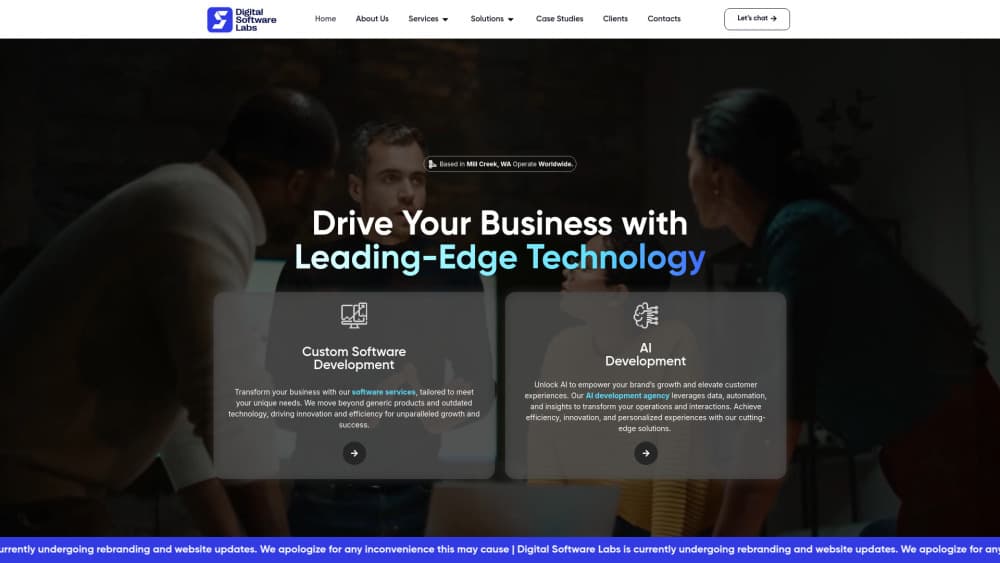
About Digital Software Labs
What Is Digital Software Labs
Digital Software Labs is a software development firm, not a self-serve product. You bring the business problem, and its teams design, build, and maintain the application behind it. The line covers mobile apps for iOS and Android, web and enterprise applications, cloud services, UI and UX design, and AI features such as automation and machine learning models wired into an existing workflow.
Work gets sold two ways. Fixed-scope projects run from discovery to launch, and team augmentation puts vetted developers inside your own squad when there's already a roadmap and you just need hands. Both start with a call, because nothing on the site is priced or self-service.
That model decides who this fits. There's no free tier to poke at and no rate card to compare against a $20 subscription. If you need a deliverable built to your spec and you're ready to discuss scope, it works. If you want to try software this afternoon, it doesn't.
Getting Started
- Book a call through the contact form and describe the problem, the timeline, and any constraints you already know about.
- Go through discovery. The team maps scope, picks a stack, and puts rough numbers on cost and delivery dates.
- Approve the design and prototype before code starts. Wireframes and clickable mockups come first, and changes are cheaper at that stage.
- Follow the build in agile sprints, with integration, security checks, and QA running inside the same cycle.
- Move to launch and handover, then agree on support for fixes, monitoring, and the next round of features.
Product Information
A quick look at Digital Software Labs's pricing, supported platforms, and performance.
Best for
The users, tasks, and scenarios where this tool fits best.
Users
- Startup founders without an engineering team
- Product managers at growing companies
- IT leads in regulated sectors
Tasks
- Turning an app idea into a working first version
- Adding AI features to a product that already ships
- Rebuilding a backend that can't keep up
- Filling a skills gap for a fixed period
Scenarios
- A prototype needed for an investor demo
- A seasonal traffic spike that the current stack can't survive
- A healthcare or e-commerce launch that needs security sign-off
Key features
AI Integration for Existing Products
AI integration services cover the practical end of the work: recommendation models, document and image processing, chat interfaces, and the automation of repetitive back-office steps. The team starts from a workflow that already costs you time and then decides whether a model helps or a simpler rule does the job.
Mobile App Development on Native and Cross-Platform Stacks
As a mobile app development company, the firm builds iOS, Android, and iPad apps on native toolchains or on Flutter and React Native. Cross-platform gets picked when one codebase and a shared release schedule matter more than the last few percent of device-level performance.
Web and Enterprise Application Builds
Enterprise software development here means custom web apps, client portals, custom CRM systems, and e-commerce storefronts, including Shopify builds. Internal tools get the same treatment as customer-facing products, which matters when a spreadsheet has quietly become your order system.
Cloud Migration, Scalability and Security Work
Cloud services range from a first migration off a single server to cost tuning and access control on an existing estate. Security and compliance checks are part of the package rather than a separate audit you book later.
A Seven Stage Delivery Process
Discovery, research and strategy, design and prototyping, development and integration, testing, launch, and support. Each stage lists its own outputs, so you can see what's due before the next invoice. It's a standard agency pipeline, documented well enough to hold a schedule against.
Team Augmentation
Software development outsourcing usually means handing over a project. This option works the other way: developers join your standups and your ticketing system while you keep control of priorities. It suits teams that lost a senior engineer or need to ship faster for two quarters.
Pros and cons
Pros
- One vendor for mobile, web, cloud, and AI work, which cuts the handover cost between separate shops.
- The delivery process is written down from discovery to support, so milestones are visible before work starts.
- Team augmentation lets you add capacity without a full outsourcing handover.
- Industry coverage includes regulated fields such as healthcare, fintech, and logistics.
- Design, build, and maintenance come from the same group, so nobody blames the other team when something breaks.
Cons
- No published pricing, so comparing quotes against each other takes a sales call and a wait.
- No free trial or self-serve plan, which means you can't test the team's output before committing to a project.
- The site shows case studies and client quotes but not team sizes or named engineers, so you can't judge who will actually do the work.
- Timelines for a full build run in months, and the discovery phase adds weeks before code starts.
Frequently asked questions
It designs and builds custom software: mobile apps, web platforms, internal tools, cloud setups, and AI features added to existing products. Engagements are project-based or staffed through team augmentation.
Related content
Explore related tools, skills, and articles for Digital Software Labs.
Digital Software Labs Alternatives

Odyssey 3
Odyssey · OtherOdyssey-3 is Odyssey's foundation world model. It simulates physics in real time, turns a prompt into an interactive environment, and adapts to robots, cars and games.

JarvisCore
Prescott Data · Coding · Productivity · OtherJarvisCore is an open source Python runtime where AI agents work as equal peers on an agent mesh, claim tasks from a shared ledger, and reach external services through a zero-trust broker.
Clef
Cloudflare · Business · OtherClef is Cloudflare's open-source decision model for Workers AI. It returns calibrated probabilities for typed questions, not generated text, so agents can classify, route, and act fast.