

Div-idy
Div-idy · Coding
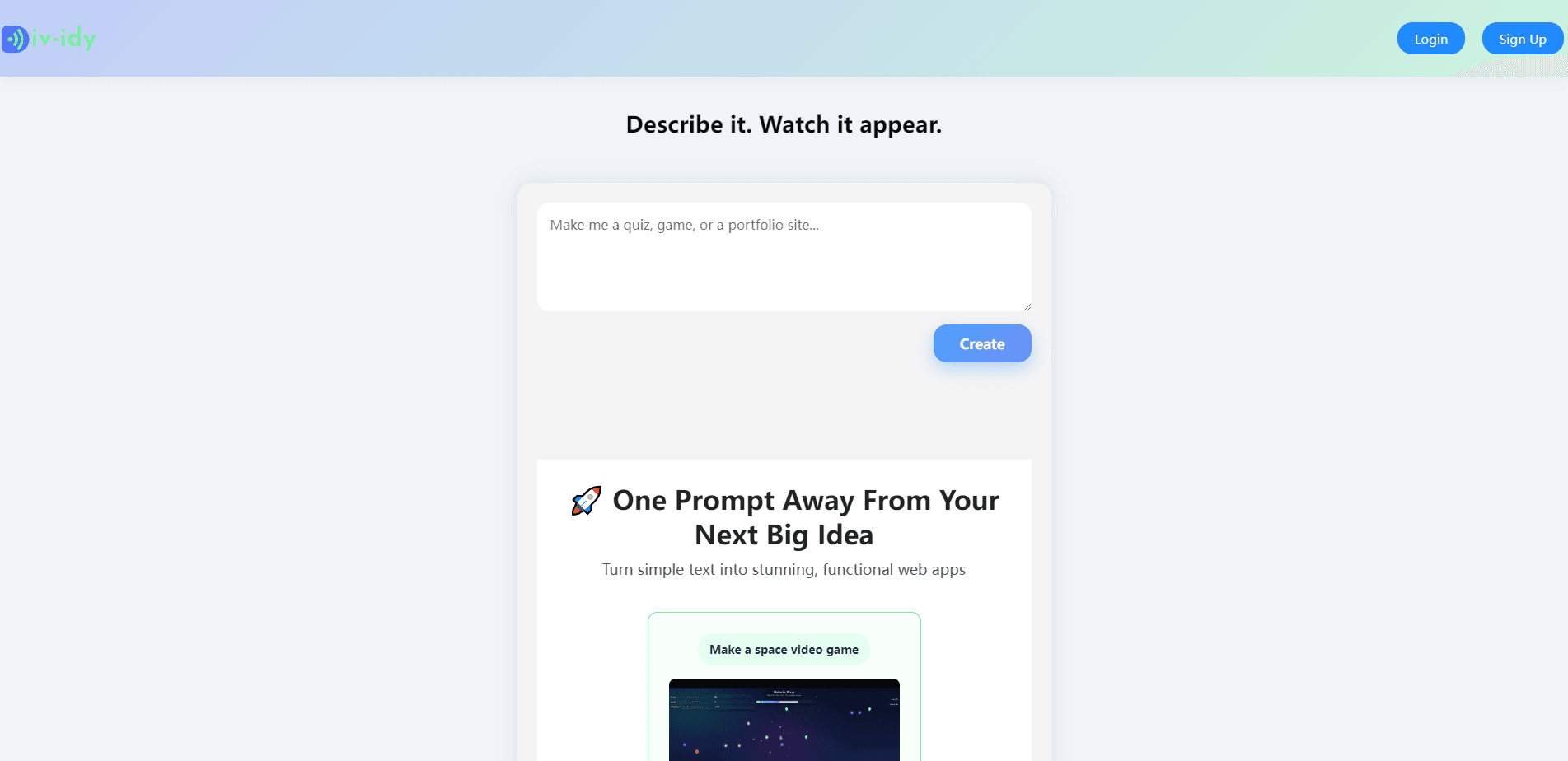
Div-idy is an AI web app builder from Omaha that turns a plain-language prompt into a working web app, game, landing page, tool, or AI assistant. You describe what you want, it writes the HTML, CSS, and JavaScript, and then you refine the result with more prompts before publishing it through an unlisted share link. It sits in the no-code camp but keeps the generated code editable, so the output isn't a black box you're locked out of.
About Div-idy
What Is Div-idy
Div-idy is a prompt-based app builder that builds small web projects from text. You type something like "create a survey with a slider" or "make a Space Invaders game," and the tool generates the front-end code and shows you the running app. The pitch is simple. Skip the blank canvas, skip the setup checklist, and get straight to a result you can react to.
Think of it as a no-code app builder that still hands you real code. That's the part most people don't expect.
The people it's aimed at are non-developers who still want real output. Founders testing an idea, teachers building a quick quiz, small teams that need an internal dashboard. The team behind Div-idy is a small Omaha software shop founded in 2023, so this is a young product rather than a long-established platform.
The biggest limit is scope. Div-idy targets lightweight apps, landing pages, and simple tools, not large production systems. It also runs on a credit system. Every prompt you send burns one credit. That adds up. Heavy iteration on a single project costs more than the headline price suggests.
Getting Started
- Create an account at div-idy.com through the signup link, then open a new project to start a blank workspace.
- Describe what you want in plain language, for example "a calculator with a history panel" or "a signup page for a product launch."
- Review the generated app, then refine it with follow-up prompts to change layout, add a database, connect maps, or adjust mobile design.
- Add the extras you need, such as SEO metadata, analytics, or an AI assistant with your own context.
- Publish the project and share the unlisted link, or keep it private while you keep improving it.
Product Information
A quick look at Div-idy's pricing, supported platforms, and performance.
Best for
The users, tasks, and scenarios where this tool fits best.
Users
- Non-developers
- Founders and solo builders
- Small teams
Tasks
- Building simple games
- Creating landing pages
- Building AI assistants
- Collecting form data
Scenarios
- Testing an idea over a weekend
- Running a small campaign
- Shipping an internal utility
Key features
Prompt-Based App Generation
The core of Div-idy is a single text box. You describe what you want, and it returns the HTML, CSS, and JavaScript and shows you the result. That matters. It removes the two things that stall most non-coders: an empty editor and not knowing which framework to pick. So if you want to build web apps with AI, this is the shortest path the tool offers. Each prompt counts as one credit, so you're paying roughly per revision.
Prompt-Based Editing
Once an app exists, you change it by asking. "Move the button to the top," "add a dark mode," "make the layout work on phones" all work as prompts, and the builder shows the updated version so you can see what changed. No templates to hunt through. No starting over when the design drifts from what you wanted. It's a different model entirely.
Built-In Database
Projects can store data without a separate backend service. Form submissions, leads, feedback, and records get saved inside the same builder. The basic tier gives you 100MB, and Pro goes up to 10GB. It works. For internal tools and simple data collection, this is the feature that turns a pretty page into something actually useful.
AI Assistants and Custom Context
You can build chatbots, assistants, and AI-powered pages and give them your own context and instructions. That lets you ship a support bot or a helper that knows your product. Not a generic chat window. The advanced tier adds richer context options, so the assistant's answers stay closer to your material.
SEO Editor, Analytics, and A/B Testing
On the paid tiers you get an SEO editor for metadata and sitemaps, an analytics tool that tracks sessions and shows how people find your project, and A/B testing on the top plan to compare variants. That's a real set. These are the tools that turn a one-off page into something you can actually measure and improve over time.
Publishing and Share Links
Every project can stay private or go live through an unlisted share link that Div-idy says is safety-scanned. Unlisted links are the default publishing path on all plans. That suits prototypes and client previews where you don't want the page indexed or discoverable.
Ad Monetization
The Standard and Pro plans include ad monetization, so you can add ad creatives to a project and manage them as it grows. That's unusual for this category. It points at pages and tools meant to earn something back, not just exist.
Pros and cons
Pros
- Describing an app in plain language is genuinely faster than starting from a template or a blank editor.
- Generated code stays editable HTML, CSS, and JavaScript, so you're not locked into a proprietary format.
- The built-in database handles form and lead collection without a second service.
- SEO, analytics, and A/B testing live in the same builder, so you don't jump between tools.
- Publishing to an unlisted link is quick and works on every plan.
Cons
- The credit system can get expensive: each prompt costs one credit, so lots of small edits drain a monthly allowance fast.
- The paid tiers start at $19.99/mo with a free first month, and there's no permanent free plan to test at length.
- It's aimed at small projects, so larger production apps will outgrow what the builder comfortably handles.
Frequently asked questions
It builds small web apps, games, landing pages, tools, and AI assistants from text prompts. You describe what you want, it generates the code, and you publish the result through a share link.
Related content
Explore related tools, skills, and articles for Div-idy.
Div-idy Alternatives
Forefront
Forefront · CodingForefront is a web platform for building with open-source AI. It lets you fine-tune leading open-source language models on your own data, evaluate how they perform, and run them through an API or export them to host yourself. Developers who want the convenience of a closed-source platform but insist on owning their models and data are the target audience here.

Startkit
StartKit.AI · CodingStartkit is a boilerplate for building AI SaaS and AI wrapper products. Think of it as an AI startup boilerplate with the boring parts already wired up: authentication, Stripe and Lemon Squeezy payments, usage limits, transactional email, and an AI API starter that talks to OpenAI, Anthropic, Groq, or Llama. You clone the repo, set your price, and start on the part of your product that people actually pay for. It's Next.js under React and Tailwind, so most of the boilerplate code already feels familiar.
Testim
Tricentis · CodingTestim is an AI-powered test automation platform for building and running end-to-end tests across web, mobile, and Salesforce applications. It leans on machine learning to keep tests stable when an interface changes, so teams spend less time fixing broken selectors. Not bad for an automated testing tool you can start using today. You create tests by recording actions in a browser, then optionally add JavaScript when you need more control. It's a solid pick for busy QA teams.