

Doctective
Doctective · Coding
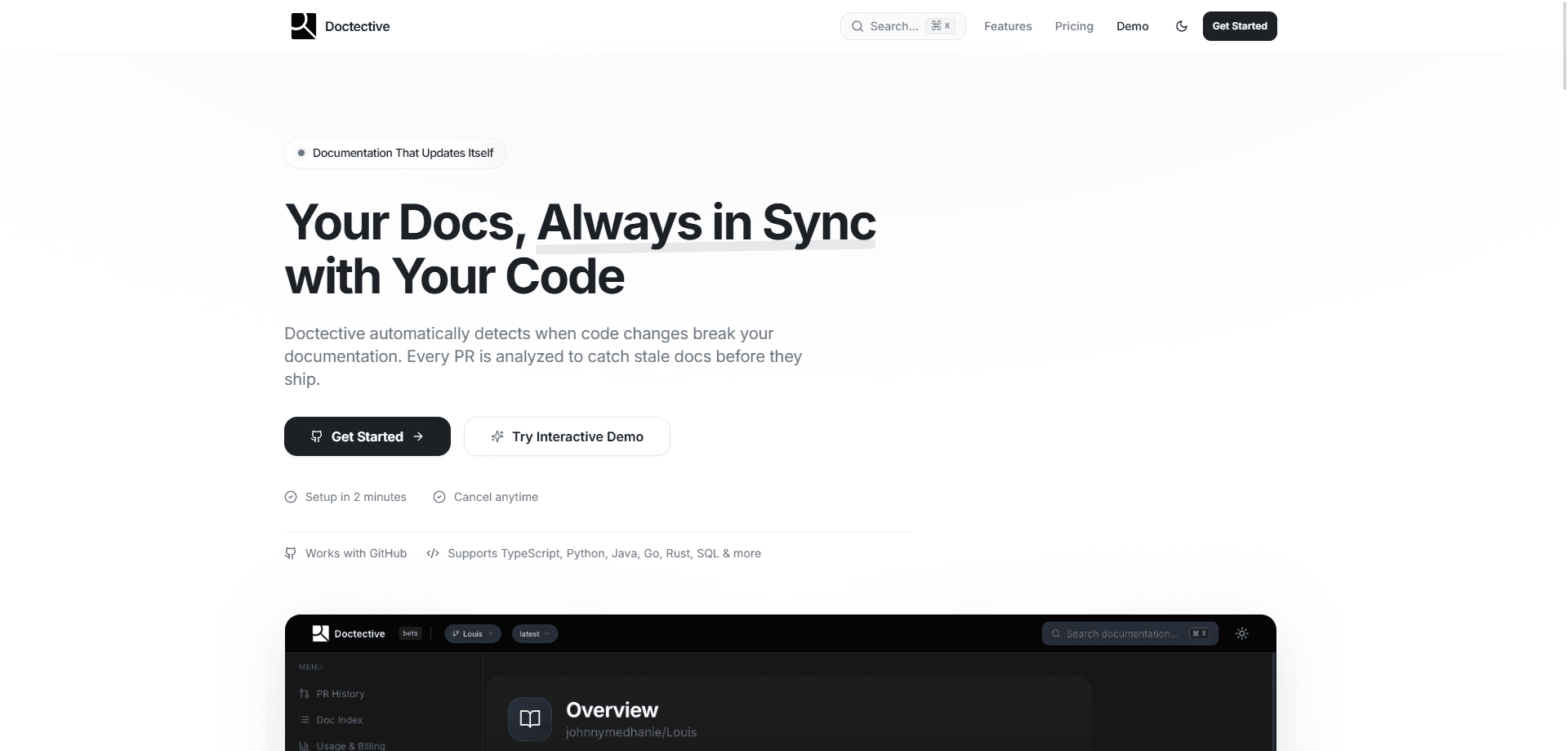
Doctective is an AI documentation tool that keeps your README and inline docs in sync with your code, and it treats automated documentation as something that runs on every commit rather than a project you schedule once a quarter. It connects to GitHub, reads every pull request, and works out which documentation your change just made wrong. Instead of nagging you with a warning, it opens a companion PR with AI-suggested fixes you can review and merge, which is the kind of pull request analysis most teams never get around to doing by hand. The pitch is simple: install once, and your documentation maintenance stops being a chore you forget about until a new hire complains.
About Doctective
What Is Doctective
Doctective is a developer tool built around one stubborn problem: code changes constantly, and documentation doesn't. When someone renames a function, changes a config flag, or rewrites an endpoint, the docs describing that behavior quietly go stale. Nobody notices until it costs someone an afternoon.
Doctective watches for that drift. It indexes your codebase and your docs, then draws semantic links between the two. When a pull request touches code that a doc references, the tool flags the affected pages and drafts a companion PR with suggested updates. You still approve everything, but the first pass is done for you.
It's worth being clear about the scope. Doctective reads source code and documentation, so it lives in developer workflows rather than marketing sites or customer wikis. If your team doesn't use GitHub, you're probably not the audience here.
Does that mean it only helps people with messy docs? Not exactly, because even disciplined teams let a single refactor leave three pages describing the old behavior.
Getting Started
- Visit doctective.app and click Get Started, which kicks off a GitHub connection.
- Install the Doctective GitHub App and grant it access to the repositories you want monitored.
- Pick which repos to index. Doctective starts building semantic links between your code and your docs right away.
- Open a pull request as usual. When it touches documented code, Doctective comments on the PR and opens a companion PR with suggested doc edits.
- Review the suggested changes, adjust the wording if needed, and merge what you want to keep.
Product Information
A quick look at Doctective's pricing, supported platforms, and performance.
Best for
The users, tasks, and scenarios where this tool fits best.
Users
- Backend and platform developers
- Startup engineering teams
- Open-source maintainers
- Tech leads and reviewers
Tasks
- Detecting stale documentation after a code change
- Drafting documentation updates
- Auditing documentation coverage
- Onboarding review prep
Scenarios
- Shipping a breaking change to an API
- Renaming or refactoring a core function
- Sprint-end documentation cleanup
- Adopting documentation-as-code
Key features
PR Impact Detection
Doctective analyzes pull requests to work out which documentation a code change affects. It builds semantic links between your source files and your docs, so when a function or flag changes, it knows which pages depend on it. You get a clear list of affected docs instead of guessing, and the review happens while the reasoning behind the change is still fresh in everyone's head.
Companion PR Generation
Rather than just warning you, Doctective opens a second pull request with suggested documentation updates. The changes sit in your normal review flow, which means you can edit, reject, or merge them like any other diff, and the whole exchange stays inside the pull request where the original change already lives. It takes the blank-page problem out of doc maintenance, which is usually the real reason documentation work stalls in the first place.
AI-Powered Doc Updates
The suggested edits come from an LLM that reads the code change and the surrounding documentation for context. It drafts new wording that matches what the code now does. Treat the output as a solid first draft, not a finished answer. You'll still want a human eye on anything user-facing.
Multi-Language Support
Doctective handles TypeScript, JavaScript, Python, Java, Go, Rust, SQL, and more. On the documentation side it reads Markdown, MDX, JSDoc, and docstrings, so it works across most modern stacks without a format migration.
GitHub Integration
Setup runs through the Doctective GitHub App. You authorize it, choose the repositories to monitor, and it starts indexing. There's no CI pipeline to wire up by hand, which keeps adoption light for teams that don't want another config file.
Pros and cons
Pros
- Catches stale documentation inside the pull request, while the change is still fresh in context.
- Opens a companion PR with suggested edits, so you review a draft instead of writing from scratch.
- Supports many languages and doc formats, including Markdown, MDX, JSDoc, and docstrings.
- Fits an existing GitHub review workflow, so there's little to learn.
- Indexes code and docs together, which also surfaces gaps where documentation is missing entirely.
Cons
- No free plan. Every tier is paid, starting at $9.99/mo, so you can't trial it on a hobby project without spending.
- It's GitHub-only. Teams on GitLab, Bitbucket, or a self-hosted setup can't use it.
- AI-suggested edits still need review. On subtle behavioral changes, a generated doc paragraph can read confidently and be slightly wrong.
- Repository and seat limits bite on bigger teams. The Team plan caps at 10 repos and 10 seats, and Enterprise pricing isn't published.
Frequently asked questions
It monitors your GitHub pull requests, detects when a code change makes existing documentation stale, and opens a companion PR with suggested doc updates. You review and merge the ones you want.
Related content
Explore related tools, skills, and articles for Doctective.
Doctective Alternatives
Forefront
Forefront · CodingForefront is a web platform for building with open-source AI. It lets you fine-tune leading open-source language models on your own data, evaluate how they perform, and run them through an API or export them to host yourself. Developers who want the convenience of a closed-source platform but insist on owning their models and data are the target audience here.

Startkit
StartKit.AI · CodingStartkit is a boilerplate for building AI SaaS and AI wrapper products. Think of it as an AI startup boilerplate with the boring parts already wired up: authentication, Stripe and Lemon Squeezy payments, usage limits, transactional email, and an AI API starter that talks to OpenAI, Anthropic, Groq, or Llama. You clone the repo, set your price, and start on the part of your product that people actually pay for. It's Next.js under React and Tailwind, so most of the boilerplate code already feels familiar.
Testim
Tricentis · CodingTestim is an AI-powered test automation platform for building and running end-to-end tests across web, mobile, and Salesforce applications. It leans on machine learning to keep tests stable when an interface changes, so teams spend less time fixing broken selectors. Not bad for an automated testing tool you can start using today. You create tests by recording actions in a browser, then optionally add JavaScript when you need more control. It's a solid pick for busy QA teams.