

dolv
dolv · Coding
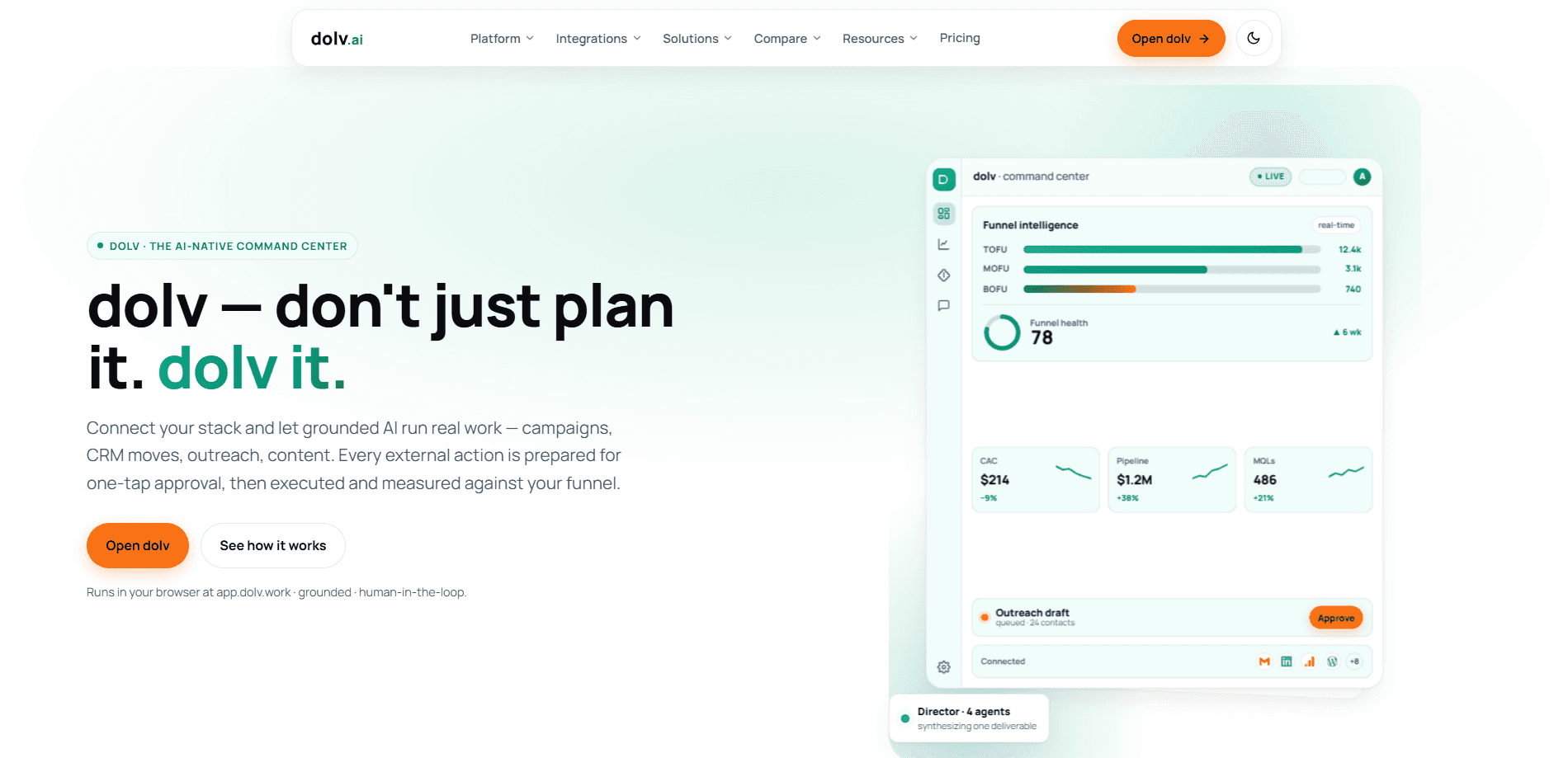
dolv is an AI command center built for go-to-market teams. A Director agent plans the work, a team of named agents produces drafts and calls real tools across your existing stack, and every external send waits for a human tap before it ships. Once something goes out, live metrics roll into one funnel so you can see which campaign actually moved the number you named.
About dolv
What Is dolv
dolv is an AI marketing automation platform that connects to the tools a go-to-market team already uses, then does the work inside them. You point it at your site, docs and data, name the number you want to move, and it comes back with campaigns tied to editable key results. From there, agents draft posts, emails, outreach and landing copy in your voice.
The product is built around human-in-the-loop control rather than full autonomy. Internal, reversible work runs on its own, but anything public or irreversible, like an email, a LinkedIn post or a blog publish, is parked in an Approvals inbox until a person signs off. That middle ground is dolv's whole pitch: it takes the busywork off your plate without letting a model speak for you unchecked. Big difference.
The biggest limitation is scope. dolv is a go-to-market tool, not a general assistant, so it earns its keep for teams running campaigns, sales outreach and content at volume. If you need one-off writing or a personal chatbot, it's more machinery than you need. So who is it for? Teams that run campaigns every week. Pricing also runs on a fixed monthly plan plus a per-agent budget cap you set, so hot months cost more than quiet ones.
Getting Started
- Sign up with an email at app.dolv.work and start the 14-day free trial. No card is required to begin.
- Connect your stack in Settings. One Google OAuth links Gmail, Calendar, Drive, Sheets and Docs, and one Microsoft OAuth links Outlook, Teams, OneDrive and Excel. Other tools like WordPress, Ahrefs, GA4 and Search Console connect with an API key or property ID.
- Name the number you want to move in the Director chat, then review the campaigns and key results it returns.
- Let the agents draft the work, then open Approvals to read each prepared message, edit a word if needed, and approve it.
- Watch the funnel as approved work ships from your own accounts and metrics report back into the TOFU, MOFU and BOFU view.
Product Information
A quick look at dolv's pricing, supported platforms, and performance.
Best for
The users, tasks, and scenarios where this tool fits best.
Users
- Solo founders and small marketing teams
- Growing in-house marketing teams
- Agencies managing multiple clients
Tasks
- Drafting campaign copy
- Email and outreach sequencing
- Publishing content at volume
- Measuring what moved
Scenarios
- Running a launch week with a small team
- Keeping brand voice consistent across channels
- Reporting to leadership without a spreadsheet scramble
Key features
Director agent and the agent team
dolv runs on a Director agent that plans the day, then hands work to named agents with a role, a prompt and a monthly budget cap. Agents run in parallel or in sequential handoff toward one approval-ready deliverable. You can open the full run history for any agent instead of trusting a black box.
Approval-gated execution
Every external or irreversible action is prepared, then queued for your sign-off. The four prepare tools handle email, Outlook email, LinkedIn posts and blog posts. Each one moves through prepared, approved, executing and done. Internal, reversible work runs immediately. That keeps the approval inbox worth reading.
Read-and-write integrations
dolv ships 30 connectors that both read live data and write real work back into the tool it came from. One Google OAuth and one Microsoft OAuth cover both suites, and tools like Ahrefs, WordPress, GA4 and Search Console connect with a key or ID. Approved work leaves from your own accounts, so there's no silo.
Funnel intelligence and attribution
Live metrics from your integrations map onto one TOFU, MOFU and BOFU funnel, scored against a rolling 30-day baseline. The composite health score weights TOFU at 0.25, MOFU at 0.40 and BOFU at 0.35. Multi-touch attribution ties each result back to the campaign that earned it.
Grounded AI drafting
Every draft reads your docs, your site and your data before it writes a word. Output is on-brand by default rather than by prompt engineering. That's the gap between a grounded command center and a chatbot that forgets your context.
Workflow builder
A drag-and-drop workflow builder combines triggers, tool steps, agent steps, conditions and approval gates. That lets you automate a repeatable sequence while still holding the public sends for a human check.
AI sales and CRM
Deals, accounts, contacts and pipeline live in one place alongside intent-signal lead scoring, so sales work shares the same command center as marketing rather than splitting across tools.
AI SEO and content
dolv can draft, queue and publish content to WordPress, Docs and Sheets, then measure the outcome in Search Console. It closes the loop between publishing a piece and seeing whether it earned traffic.
Pros and cons
Pros
- The human-in-the-loop design keeps you in control of anything public, which lowers the risk of an AI post going out off-brand.
- One command center covers marketing, sales and SEO content, so you're not stitching together separate tools for each job.
- Every plan includes every feature, so the tiers change LLM tokens, seats and agent runs rather than locking capabilities behind a higher price.
- Agent budget caps are enforced, so spend stops the moment an agent hits its monthly limit instead of surprising you at billing.
- Multi-touch attribution shows which campaign produced a result, not just that traffic went up.
Cons
- It's a commitment to go-to-market work. Teams that only need occasional copywriting will find it heavier than the job requires.
- Cost is two numbers, the plan plus each agent's budget cap, so your monthly bill depends on how much the agents actually run.
- The Approvals model means nothing public ships hands-free. If you want full autonomy, dolv deliberately won't give it to you.
Frequently asked questions
dolv is an AI command center for go-to-market teams. It plans campaigns from a goal you name, drafts the work with agents grounded in your own docs and data, holds external sends for your approval, and measures every result in one funnel.
Related content
Explore related tools, skills, and articles for dolv.
dolv Alternatives
Forefront
Forefront · CodingForefront is a web platform for building with open-source AI. It lets you fine-tune leading open-source language models on your own data, evaluate how they perform, and run them through an API or export them to host yourself. Developers who want the convenience of a closed-source platform but insist on owning their models and data are the target audience here.

Startkit
StartKit.AI · CodingStartkit is a boilerplate for building AI SaaS and AI wrapper products. Think of it as an AI startup boilerplate with the boring parts already wired up: authentication, Stripe and Lemon Squeezy payments, usage limits, transactional email, and an AI API starter that talks to OpenAI, Anthropic, Groq, or Llama. You clone the repo, set your price, and start on the part of your product that people actually pay for. It's Next.js under React and Tailwind, so most of the boilerplate code already feels familiar.
Testim
Tricentis · CodingTestim is an AI-powered test automation platform for building and running end-to-end tests across web, mobile, and Salesforce applications. It leans on machine learning to keep tests stable when an interface changes, so teams spend less time fixing broken selectors. Not bad for an automated testing tool you can start using today. You create tests by recording actions in a browser, then optionally add JavaScript when you need more control. It's a solid pick for busy QA teams.