

DoubleCloud
DoubleCloud · Coding
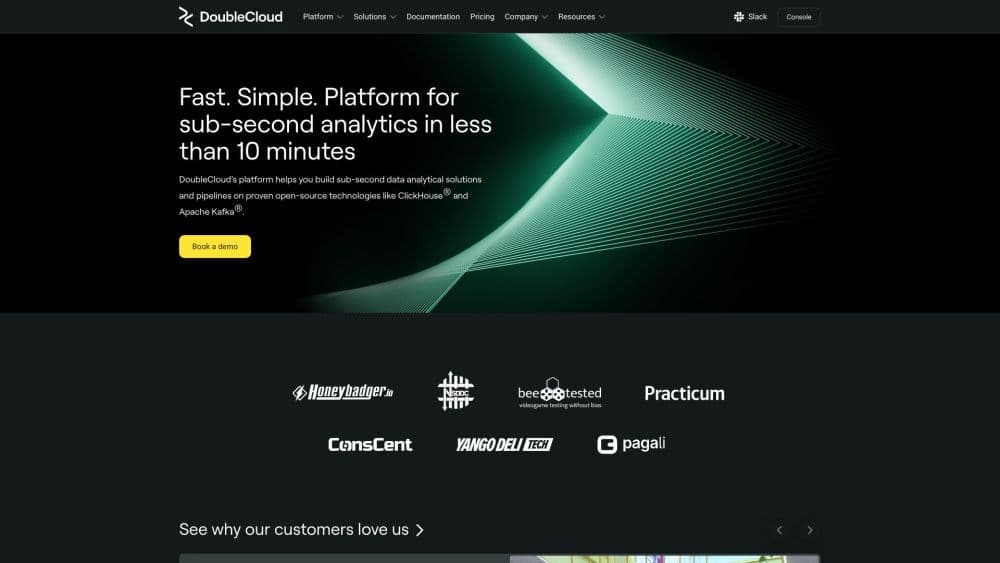
DoubleCloud was a managed analytics platform on open source tools like ClickHouse, Kafka and Airflow. New signups closed October 1, 2024 and service ended March 1, 2025.
About DoubleCloud
What Is DoubleCloud
DoubleCloud was a cloud platform for teams that wanted analytics infrastructure without running the servers themselves. Rather than sell its own database, it packaged well known open source components as managed services and ran them on Amazon Web Services or Google Cloud. ClickHouse handled fast analytical queries, Kafka moved streaming data, Airflow scheduled workflows, and two extra tools filled the gaps in that lineup: a no-code data transfer tool and a free dashboard builder.
The company started with ClickHouse. DoubleCloud described itself as the first managed service for ClickHouse, and it kept adding features on top of the open source version rather than shipping a fork. That mattered for anyone who wanted the performance of ClickHouse without hiring a database team to tune clusters, manage backups and rotate certificates.
Its most important limit today is simple: it's gone. DoubleCloud stopped creating new accounts on October 1, 2024 and its final update asked existing customers to move to another platform by March 1, 2025. The site remains online as an archive, so product pages and docs are still readable, but you can't sign up, launch a cluster or open a support ticket. Teams searching for a managed ClickHouse provider now need to look elsewhere, and most of them land on ClickHouse Cloud or a hyperscaler's managed offering.
A second limit applied while the product was live: the whole appeal rested on managing somebody else's open source code. Migrating away was meant to be easier for that reason, since the data formats and query language were standard, but the platform itself added its own console, API and Terraform provider, so an account was never purely portable.
Getting Started
- Create a DoubleCloud account through the console and pick a cloud provider and region for your resources.
- Create a service cluster, either ClickHouse for analytics, Kafka for streaming or Airflow for scheduling, and set the size and storage options.
- Connect a data source, either inside DoubleCloud Data Transfer or through a native connector, and define which tables or topics you want to sync.
- Build queries or pipelines, then publish the results as charts and dashboards in Data Visualization.
- Scale the cluster up or down from the console or through the API and Terraform provider as traffic changes.
Product Information
A quick look at DoubleCloud's pricing, supported platforms, and performance.
Best for
The users, tasks, and scenarios where this tool fits best.
Users
- Analytics engineers at mid-size companies
- Startups without a dedicated database administrator
- Development teams already committed to open source tooling
Tasks
- Real-time analytics on event data
- Log and trace analysis
- Moving data without writing code
- Streaming ingestion
Scenarios
- Replacing a self-hosted ClickHouse cluster
- Launching customer-facing analytics inside a product
- Cutting warehouse costs after a Snowflake bill got uncomfortable
- Migrating data between clouds during the shutdown
Key features
Managed ClickHouse for Real-Time Queries
The core of the platform was a fully managed ClickHouse service. DoubleCloud provisioned and configured the cluster, set up high availability, ran backups and rotated SSL certificates, then exposed the standard SQL interface. According to the company, ClickHouse runs up to 100x faster than leading relational databases on analytical queries, which is the reason teams reached for it in the first place.
No-Code Data Transfer with Change Data Capture
Data Transfer was a serverless ELT tool for getting data into ClickHouse and back out again. DoubleCloud claimed transfer speeds 9x faster than Airbyte, with a native S3 connector, and said the service scaled to 20 GB/s without dropping records. Connectors covered ClickHouse, MySQL, PostgreSQL, MongoDB, Snowflake, Elasticsearch, Oracle, BigQuery and several ad platforms, and change data capture kept OLTP sources in sync continuously.
Streaming and Orchestration in the Same Console
Managed Kafka and managed Airflow rounded out the stack. Kafka handled high-throughput ingestion for teams that process events rather than daily batches, and Airflow scheduled and monitored the jobs around it. Having all three services under one console meant one billing account, one set of access rules and one place to watch health.
Free Data Visualization
DoubleCloud included a dashboard tool at no extra charge for anyone with an account, and it doubled as the platform's data integration layer for pulling several sources into one chart. It connected to ClickHouse, PostgreSQL, MySQL, MS SQL Server, Prometheus, BigQuery, Snowflake and files, and supported maps, geo layers, cross-source charts and row-level filtering. For teams that had been paying separately for a BI layer, this was often the cheapest part of the deal.
Hybrid Storage and Predictable Billing
ClickHouse hybrid storage pushed colder data to S3-compatible object storage and kept hot data local, which the company said cut storage costs by up to 5X. Cross-availability-zone traffic, ingress, egress and VPC peering were free, and there were no charges for ZooKeeper or ClickHouse Keeper. Pricing stayed usage-based with no termination fees.
Infrastructure as Code and a Public API
Every resource could be managed outside the console. DoubleCloud shipped a public API and a Terraform provider, so clusters, pipelines and transfers could live in version control alongside the rest of the team's infrastructure. That made it viable for companies that don't hand out console access to engineers.
Pros and cons
Pros
- ClickHouse, Kafka, Airflow and visualization ran on one bill, which cut vendor overhead and removed separate contracts for each service.
- Operational work like backups, certificate rotation, patch updates and ZooKeeper management was included, so small teams did less maintenance.
- Standard open source interfaces meant SQL knowledge and existing pipelines carried over, and data could be exported with connectors rather than rewritten.
- Published customer stories reported large speed and cost gains, including one where query speed rose 180x after moving off a previous warehouse.
Cons
- The service is closed. New accounts stopped on October 1, 2024 and remaining customers had to leave by March 1, 2025, so it can't be adopted today.
- The platform depended on AWS and Google Cloud regions, and the more advanced options such as bring-your-own-cloud required direct conversations with sales before pricing was clear.
- Data Visualization was free but narrow. Teams with existing BI tooling got little extra beyond a basic dashboard layer, and complex reporting still needed another tool.
Frequently asked questions
No. DoubleCloud stopped creating new accounts on October 1, 2024, and the company said operations would wind down by March 1, 2025. The website stays online as an archive for reading only.
Related content
Explore related tools, skills, and articles for DoubleCloud.
DoubleCloud Alternatives

Base Code
Base44 (Wix) · Coding · ProductivityBase Code is a shared cloud development environment from Base44. Teammates describe changes to an existing GitHub codebase in chat, preview them live and send them back as pull requests.

Google EmbeddingGemma 2
Google DeepMind · Writing · Image · CodingGoogle EmbeddingGemma 2 is a 740M-parameter open model that turns text, code, images, audio, and video frames into vectors in one 768-dimension space, running on phones and laptops.

GitGlow
GitGlow · Coding · ProductivityGitGlow is a local-first desktop Git client that lets independent developers review their own code and their AI agents' changes in one place before shipping.