

Droidrun
Droidrun GmbH · Other
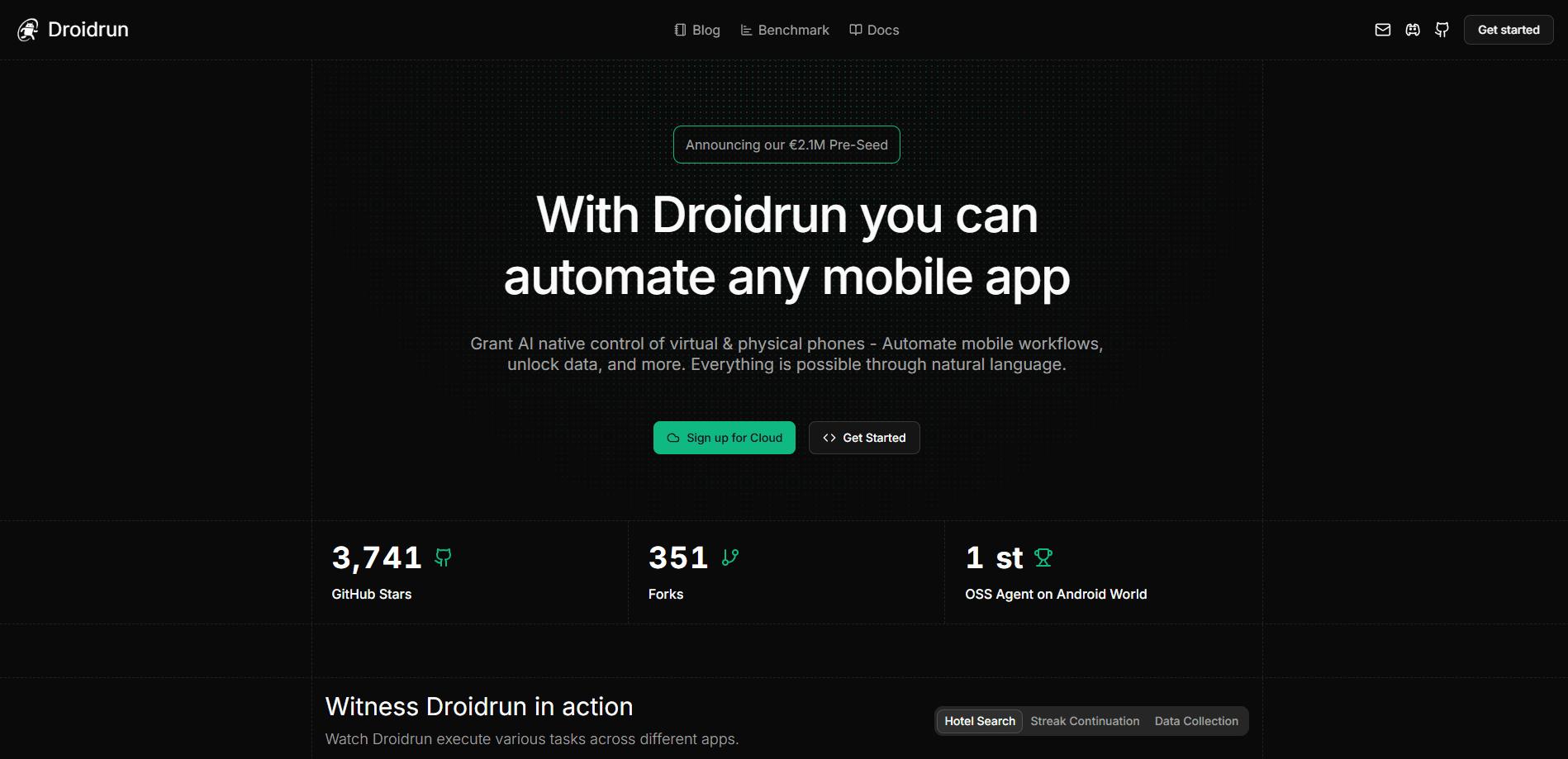
Droidrun is an open-source mobile agent framework that controls Android and iOS devices through natural language commands, with a managed cloud option for running fleets of phones.
About Droidrun
What Is Droidrun
Droidrun is an open-source mobile agent framework for controlling Android and iOS devices with LLM agents. You describe a task in plain language through natural language commands, and the agent reads the screen, then taps, swipes and types its way through any app until the job is done. It ships as a Python package and a command line tool, so you can run it against a phone on your desk or wire it into a bigger automation pipeline.
The project grew out of a simple problem. Traditional mobile automation depends on hardcoded UI selectors that break every time an app updates its layout. Droidrun throws that approach out and hands the decisions to a model, which adapts to whatever the screen shows. The same core powers a hosted service called Mobilerun Cloud, where you rent cloud phones and run agents without keeping a device on your network.
The limit is that it's a developer tool. There's no point-and-click app builder for non-technical users, and you need to be comfortable with a terminal, Python or an API. Local runs also expect a real device or an emulator set up with ADB, and the framework itself doesn't provide the hardware. Getting real value out of it means writing code or leaning on the cloud tier.
Getting Started
- Install the package with
uv tool install mobilerunorpip install mobilerun, using Python 3.11 through 3.13. - Run
mobilerun setupto install the Portal app on an Android device and enable its accessibility service, or use the iOS Portal flow on an iPhone. - Run
mobilerun configureto pick a provider, choose an auth method and select a model. - Send your first task with
mobilerun run "Open settings and turn on dark mode". - Add
--visionfor screenshot analysis or--reasoningfor longer multi-step jobs, then fold the same calls into a Python script or the cloud API.
Product Information
A quick look at Droidrun's pricing, supported platforms, and performance.
Best for
The users, tasks, and scenarios where this tool fits best.
Users
- Developers building mobile automation
- QA teams testing mobile apps
- Teams that need scale without hardware
Tasks
- Automating repetitive in-app chores
- Extracting data from native apps
- Regression testing mobile UI
Scenarios
- A workflow that needs to run around the clock
- Testing an app across many accounts or regions
- Prototyping automation before committing to infrastructure
Key features
Natural language device control
You give the agent a goal in everyday words, and it figures out the taps, swipes and text entry needed to reach it. That removes the selector maintenance that makes traditional mobile scripts brittle, since the model re-reads the screen at each step and adapts to layout changes.
Vision and accessibility trees together
Droidrun combines the accessibility tree with screenshots so the agent can both understand element structure and see what a person would see. Vision mode sends screenshots to the model, and a screenshot-only mode covers apps that expose no useful accessibility data, a common gap in games and canvas-heavy screens.
Reasoning mode for multi-step jobs
A manager agent plans the work and an executor agent carries out each step in turn, checking progress as it goes. Reasoning mode suits booking flows and settings changes that span several apps, while a lighter direct mode handles quick one-shot actions without the planning overhead.
Provider-agnostic model support
The framework works with OpenAI, Anthropic, Gemini, xAI, Ollama, DeepSeek, OpenRouter and any OpenAI-compatible endpoint. You can set a different model per agent, so a stronger model can plan and a cheaper one can execute, which keeps cost down on long tasks.
Custom tools, app cards and structured output
You can extend agents with custom functions, attach app-specific guidance called app cards, and return results as typed data through Pydantic models. This turns a general automation agent into a tool tuned for one app or workflow, and makes the output easy to consume downstream.
Cloud phones and fleet orchestration
Mobilerun Cloud offers hosted Android phones and dedicated iPhones with their own residential IPs, plus receive-only numbers and mailboxes for sign-up and verification steps. You can spin up many phones at once, run the same automation in parallel and manage it all through one API, which is where the framework's local-first design pays off at scale.
Pros and cons
Pros
- Open source under the MIT license, so there's no license fee and you can read or fork the code.
- LLM-agnostic, meaning you're not locked into one vendor and can route tasks between cheap and strong models.
- Strong public benchmark scores, with the team reporting a 100% official score on AndroidWorld and 98.24% mean score on iOSWorld on their task sets.
- Clear path from local prototyping to managed cloud phones, so a project can grow without rewriting the core.
Cons
- It's a developer tool, so non-technical users have no no-code path and must work through a terminal, Python or the API.
- Local runs need a real device or emulator with ADB set up, adding a setup step before the first task.
- The hosted cloud phones and add-ons bill on top of the free framework, so running at scale costs money.
- Python 3.14 isn't supported yet, so you have to stay on 3.11 through 3.13 for now.
Frequently asked questions
Yes, at least for now. The framework targets developers and exposes its features through a CLI and a Python API. The hosted Mobilerun Cloud layer softens this for teams that want managed phones, but there's still no drag-and-drop builder for people who don't write code.
Related content
Explore related tools, skills, and articles for Droidrun.
Droidrun Alternatives
BinkBink
BinkBink · OtherBinkBink is a free online game platform and AI game maker that lets anyone turn a short text description into a playable browser game. You can jump into hundreds of community-made games. Or describe your own idea and play it in seconds, then share it with friends. Want to create your own game? You don't need to code. No engine setup, no download, no hassle.

Audiogen
Audiogen Inc. · OtherAudiogen is an AI music generator built by Audiogen Inc., a small research team that spent about 2.5 years training its own generative music model and designing a web interface around it. Instead of a plain text box, this AI music tool turns the timeline into a beginner-friendly Generative Audio Workstation, or GAW, where inpainting, extending, remixing and stem editing work more like painting on a canvas. The product is still in beta, so access runs through a waitlist or an invite. Paid plans aren't published yet.

Aiml API
AIMLAPI OÜ · OtherAiml API is a unified AI model API that puts more than 1000 models from OpenAI, Google, Anthropic, and others behind one endpoint and one bill. You write code against a single OpenAI-compatible schema, then switch between chat, image, video, and audio models by changing a model string. It suits developers and small teams who want multi-model access without juggling a dozen separate provider accounts, and it removes the usual billing headache that comes with testing several vendors. One key covers it all.