

Dvina
Dvina · Coding · Productivity
Dvina is a private AI platform that pulls your documents, chats, apps, and databases into one connected workspace it calls a living context. Instead of a chatbot that forgets, it keeps every detail and resurfaces what matters when a topic comes back. It works like a secure AI assistant for people and organizations that handle sensitive data and want answers grounded in their own material, not a generic model's guess.
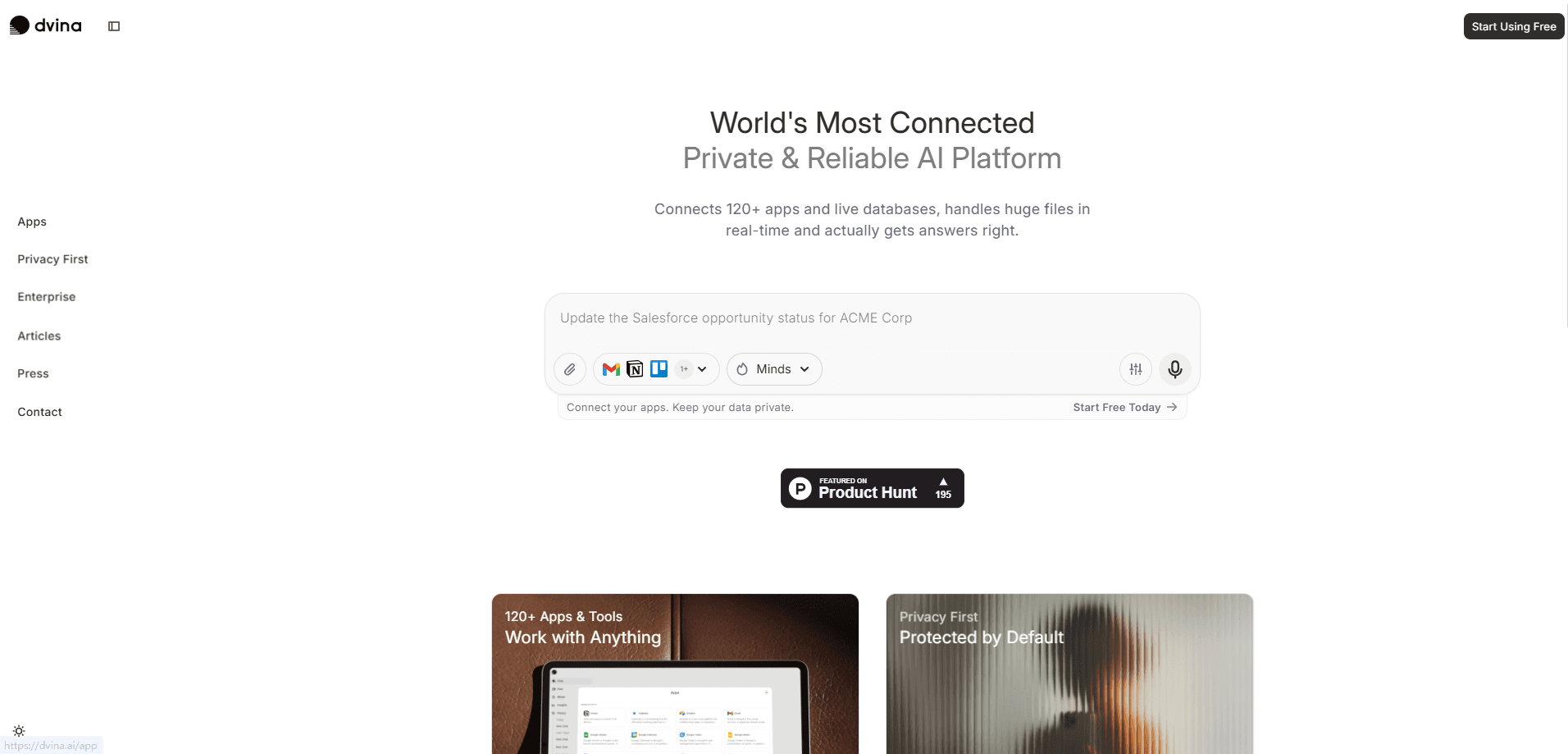
About Dvina
What Is Dvina
Dvina is an integrated AI platform for secure data analysis, automation, and decision-making. You bring in files, connected apps, and database records, and Dvina reads them as one body of context rather than a pile of separate files. The pitch is simple: ask less, know more. You stop re-explaining background every time you start a new conversation.
The problem it targets is fragmented knowledge. Most teams spread their truth across a document editor, a chat tool, a few dashboards, and a database nobody wants to query by hand. Dvina sits on top of all of it, follows what changes inside those apps, and keeps the pieces linked. It's aimed at regulated industries and large organizations, where privacy is a hard requirement that shows up in procurement checklists rather than a nice-to-have you bolt on at the end.
The main limitation is scope. This is a heavy enterprise AI platform, and the free tier caps your daily usage and deep thinking. If you only need a quick writing assistant, it's way more than you want. The interesting parts, like sovereign on-premise deployment for regulated institutions, live behind an enterprise sales conversation. Want the short version? It's built for teams with real data problems.
Getting Started
- Create an account on the Dvina site and pick the Individual plan to start free.
- Connect the apps and data sources you already use, from documents and chats to databases.
- Upload or sync your files. Dvina takes large archives and long threads without asking you to trim them first.
- Ask a question and check the answers against the sources Dvina cites, so you can see where each claim comes from.
- Install the desktop app if you want to code inside Dvina, or upgrade to Plus or Pro for higher usage and team collaboration.
Product Information
A quick look at Dvina's pricing, supported platforms, and performance.
Best for
The users, tasks, and scenarios where this tool fits best.
Users
- Analysts and researchers who need to query large document sets and get answers with sources attached, without exporting everything to a cloud tool.
- Small professional teams that want shared context so decisions carry across people instead of resetting each time someone new joins a thread.
- Regulated organizations and enterprises that need private or on-premise deployment with compliance controls and no model training on their data.
Tasks
- Cross-referencing months of documents, chats, and reports to answer one question without losing the thread.
- Tracking details that matter later, so a fact mentioned in passing surfaces again when the same topic returns.
- Building a document, dashboard, or small working app on top of your data, then feeding that output back into the same context.
Scenarios
- A compliance team reviewing a deep archive of records and needing answers it can trace back to the source.
- A research group sifting scans, charts, and handwritten notes to pull out what's actually there.
- A professional firm where a detail from one conversation has to stay reachable a week or a year later.
Key features
Unified Context Across Apps and Data
Dvina connects to 140+ apps and databases, and it reads what happens inside them rather than treating each one as a silo. A file, a chat message, and a database row all become part of the same context. The result is answers that consider your whole situation instead of one narrow query. If your work is scattered across a dozen tools that never talk to each other, this is the core reason to look at it.
Living, Long-Term Memory
Dvina calls its memory a living one. A small detail can surface in one conversation, come back a week later when the topic returns, and still guide a decision a year on. You don't start from scratch each session, and you don't have to track what you told it and when. For ongoing projects, that continuity is the whole point. Most tools forget. This one doesn't.
Reads Everything You Bring
The platform takes in massive documents, deep archives, and months-long threads without asking you to split or summarize first. It handles scans, charts, diagrams, and handwriting, and answers from what's actually in the material with the source to prove it. Scale doesn't degrade it. A million pages in, the picture stays about as sharp as it started.
Private by Design
Conversations are encrypted, and personal information is detected and shielded automatically. Dvina states plainly that your context is never used to train models. That promise holds on every plan, free included. When you connect sensitive data, the safeguards are the reason it's usable at all in a regulated setting. Read the fine print on what counts as personal data.
Build on Your Own Context
You can create a document, a dashboard, or a working app inside Dvina, and whatever you make joins the context, so the analysis you build today becomes raw material for the question you ask tomorrow. That closes a loop most tools leave open: the output becomes input for the next question. It means your analyses build on each other instead of living in separate files you'd have to re-upload.
Desktop App and Mobile Access
Dvina runs across web, desktop, and mobile, with an Android app available. The desktop app also lets you write code directly, which matters if your work mixes analysis with a bit of building. Having the same context on every device is what makes the always-on memory actually usable day to day.
Pros and cons
Pros
- Answers cite their sources, so you can trace a specific claim back to the exact document it came from, which matters when an audit or a client asks you to prove where something came from.
- It ingests large archives, scans, and handwriting without forcing you to pre-sort, split, or summarize your material before you ask it anything.
- Privacy protections, including no model training on your data, are the same on the free plan as on paid tiers.
- A living memory keeps details reachable over weeks and months, which cuts the re-explaining that eats up time in long projects.
- It connects to 140+ apps and databases, tying the tools you already pay for into one shared body of context instead of adding yet another isolated app to the pile.
Cons
- The free plan limits daily usage, deep thinking, web search, and app access, so heavy users hit the ceiling fast.
- The most sensitive deployments, like on-premise sovereign setup for regulated institutions, sit behind an enterprise sales process with no public price.
- API availability isn't clearly documented, which is a problem if you want to build programmatic workflows on top of it.
- As a newer, broad platform, feature depth per integration can lag behind tools that specialize in a single job.
Frequently asked questions
Dvina is a private AI platform that unifies your documents, apps, chats, and databases into one connected context. It then answers questions, runs analysis, and helps you build on that material while keeping your data private.
Related content
Explore related tools, skills, and articles for Dvina.
Dvina Alternatives
Forefront
Forefront · CodingForefront is a web platform for building with open-source AI. It lets you fine-tune leading open-source language models on your own data, evaluate how they perform, and run them through an API or export them to host yourself. Developers who want the convenience of a closed-source platform but insist on owning their models and data are the target audience here.

Startkit
StartKit.AI · CodingStartkit is a boilerplate for building AI SaaS and AI wrapper products. Think of it as an AI startup boilerplate with the boring parts already wired up: authentication, Stripe and Lemon Squeezy payments, usage limits, transactional email, and an AI API starter that talks to OpenAI, Anthropic, Groq, or Llama. You clone the repo, set your price, and start on the part of your product that people actually pay for. It's Next.js under React and Tailwind, so most of the boilerplate code already feels familiar.
Testim
Tricentis · CodingTestim is an AI-powered test automation platform for building and running end-to-end tests across web, mobile, and Salesforce applications. It leans on machine learning to keep tests stable when an interface changes, so teams spend less time fixing broken selectors. Not bad for an automated testing tool you can start using today. You create tests by recording actions in a browser, then optionally add JavaScript when you need more control. It's a solid pick for busy QA teams.