

easyspecs.ai
EasySpecs (Pier07, Barcelona) · Coding · Productivity
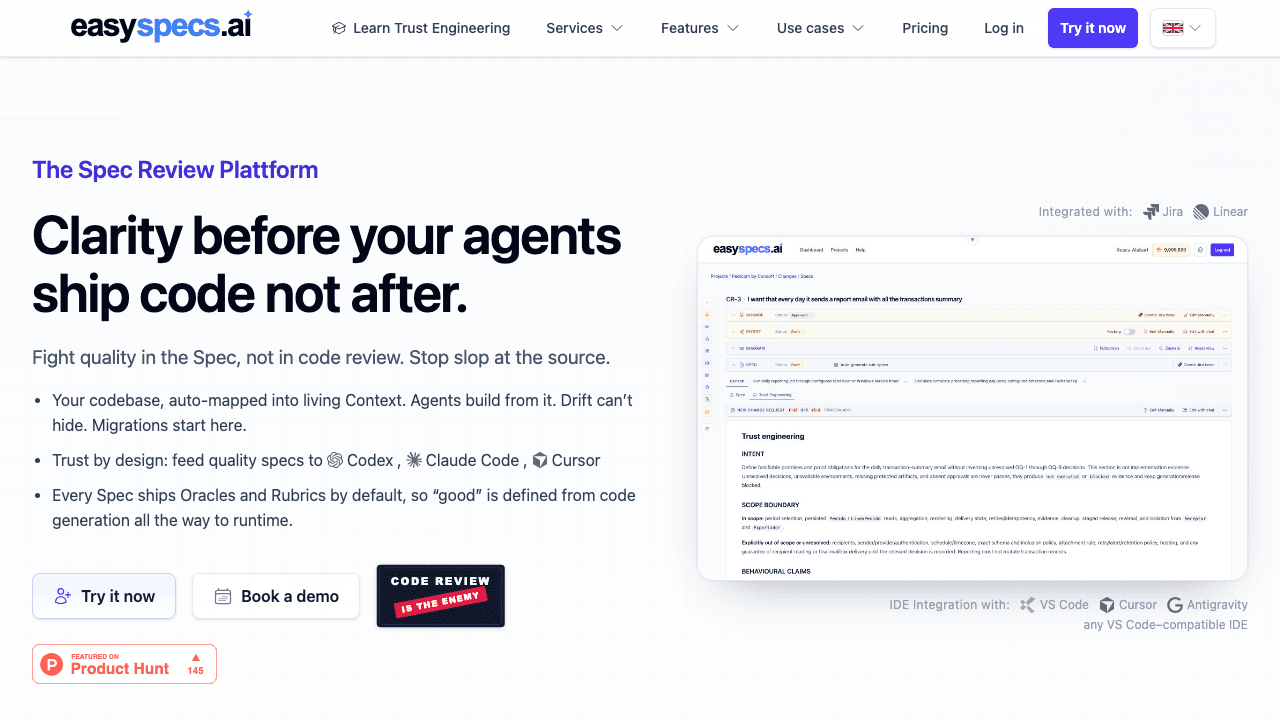
easyspecs.ai is a spec review platform for teams that use AI coding agents. It works as an AI spec writing tool: it reads your Git repository, produces functional documentation of how the app actually behaves, then helps you shape change requests into specs with trust checks attached. Product owners get a place to polish intent, developers get specs they can hand to an agent, and both sides work from the same picture of the codebase.
About easyspecs.ai
What Is easyspecs.ai
easyspecs.ai is a cloud platform built around one idea: AI agents write better code when the spec they start from is grounded in the real codebase. Instead of writing requirements in a separate document and hoping the model guesses right, you connect a repository and let the platform map what the system already does.
The product comes from a small team in Barcelona led by co-creators Xesca Alabart and Carlos Guirao. She comes from product management and requirements engineering, he from software architecture and AI systems. Why does that matter? That split shows up in how the tool divides its work: product-side intent on one hand, code-side evidence on the other.
Two groups use it. Product owners use it to ground a change request in how the app behaves before writing anything. Developers use it to stop babysitting agents on vague asks. Here's the catch: the platform doesn't write or merge your code, so it only pays off if your team already treats specs as the starting point for AI generation. Teams that still work ticket by ticket will find it adds a step without removing one.
Getting Started
- Create an account on the easyspecs.ai website and start the Free Trial, which comes with 3 credits to test on any connected repository.
- Connect a Git repository from GitHub, GitLab, Azure DevOps, or Bitbucket using a read-only personal access token in Settings. The token is used to read your codebase for documentation, not to push commits.
- Generate the functional documentation so the platform has a grounded map of your app's behavior to work from.
- Create a spec for the change you have in mind, drawing on that documentation, and add the validators or evals that sit beside it as the trust check.
- Review and approve the spec, then hand it to your agent or IDE through the MCP integration so generation starts from the spec instead of a guess.
Product Information
A quick look at easyspecs.ai's pricing, supported platforms, and performance.
Best for
The users, tasks, and scenarios where this tool fits best.
Users
- Product owners who need to ground change requests in how the app actually behaves, not in a written story that engineering has to reinterpret.
- Developers running AI coding agents who want specs and validators to start from, so generation begins with clear intent instead of guesswork.
- Small engineering teams that share one repository and want product and engineering looking at the same picture of the system.
Tasks
- Turning an existing codebase into functional documentation that covers what the app really does, so later specs build on facts.
- Writing and refining a spec for an upcoming change, including the intent behind it and the code it touches.
- Attaching validators and evals to a spec so you know how the change will be checked before code is generated.
- Reviewing and approving specs as a team before handing them to an agent.
Scenarios
- A product owner drafts a change request and wants it grounded in the current code before it reaches the sprint.
- A developer connects a repo on the Factory plan and spends monthly credits generating docs and specs across projects.
- A team on Workbench brings its own AI provider keys and runs inference on its own bill while using the platform for spec work.
- An enterprise wants the whole loop inside its own infrastructure, with the platform running on its servers.
Key features
Codebase documentation and mapping
easyspecs.ai reads a connected repository and produces functional documentation of the real system. According to the vendor, this assignment can reach up to 98% LOC coverage, which means specs later start from how the app behaves rather than from an assumption. That's the point. This is the foundation the rest of the platform builds on.
Intent capture before specs
When a change request is fuzzy, the platform helps you craft and clarify what you actually mean and ties it to the current code. Product and engineering end up sharing one picture before any spec is written. It's a small step that saves a lot of back-and-forth later.
Trust by Design specs
This is where the spec-driven development promise gets concrete. Each spec pairs with a trust spec. The main spec says what to build in structured and HTML-rendered views the team can read. The trust spec holds the validators, evals, and checks that sit beside it. You see how the change will be verified before an agent writes a line.
Repository integrations
You can plug in repositories from GitHub, GitLab, Azure DevOps, and Bitbucket using a read-only personal access token. Since the token can't push commits, you're not handing over write access to your code just to get documentation. Big difference.
Bring your own AI
On the Workbench plan you place your own keys for OpenAI, Anthropic, Google, or OpenRouter, and inference runs on your bill. The vendor says it adds no markup on provider rates. Factory and Free Trial instead use EasySpecs-managed keys, with inference covered by your credits.
IDE and MCP integration
Specs feed your AI coding workflow through IDE and MCP integration, so the spec travels with you into the tool where code gets generated. For teams already using MCP to connect agents, this keeps the spec in the loop. Not a separate doc nobody opens.
Credits and plan tiers
Factory includes 15 credits a month you can spend on any connected repository, and you can buy 10 more for €150 when you run out. Workbench doesn't use credits. This gives bigger teams a predictable way to budget spec work across projects.
Pros and cons
Pros
- Grounds specs in actual code behavior, not assumptions about what the app does
- Pairs every spec with validators, so verification is planned before code is written
- Read-only repository access keeps you from handing over commit rights
- Workbench lets you use your own AI keys with no vendor markup
- Clear plan ladder from a free trial up to self-hosted enterprise
Cons
- The paid tiers are priced per repository or in credits, so cost climbs for teams with many repos
- It adds a spec step that only pays off if your team already works spec-first with AI agents
- No public API documentation was available, which limits custom automation for now
Frequently asked questions
It reads your Git repository, produces functional documentation of how the app behaves, and helps you turn change requests into specs with validators attached. The goal is to give AI coding agents a trustworthy starting point instead of a vague prompt.
Related content
Explore related tools, skills, and articles for easyspecs.ai.
easyspecs.ai Alternatives
Forefront
Forefront · CodingForefront is a web platform for building with open-source AI. It lets you fine-tune leading open-source language models on your own data, evaluate how they perform, and run them through an API or export them to host yourself. Developers who want the convenience of a closed-source platform but insist on owning their models and data are the target audience here.

Startkit
StartKit.AI · CodingStartkit is a boilerplate for building AI SaaS and AI wrapper products. Think of it as an AI startup boilerplate with the boring parts already wired up: authentication, Stripe and Lemon Squeezy payments, usage limits, transactional email, and an AI API starter that talks to OpenAI, Anthropic, Groq, or Llama. You clone the repo, set your price, and start on the part of your product that people actually pay for. It's Next.js under React and Tailwind, so most of the boilerplate code already feels familiar.
Testim
Tricentis · CodingTestim is an AI-powered test automation platform for building and running end-to-end tests across web, mobile, and Salesforce applications. It leans on machine learning to keep tests stable when an interface changes, so teams spend less time fixing broken selectors. Not bad for an automated testing tool you can start using today. You create tests by recording actions in a browser, then optionally add JavaScript when you need more control. It's a solid pick for busy QA teams.