

Ebook Maker
EbookMaker.ai · Writing · AI Detection
Ebook Maker (EbookMaker.ai) was an AI ebook generator that turned a title into a full e-book with chapters, images, and an audiobook. It closed to new projects in 2026 and moved users to Ebook GPT.
About Ebook Maker
What Is Ebook Maker
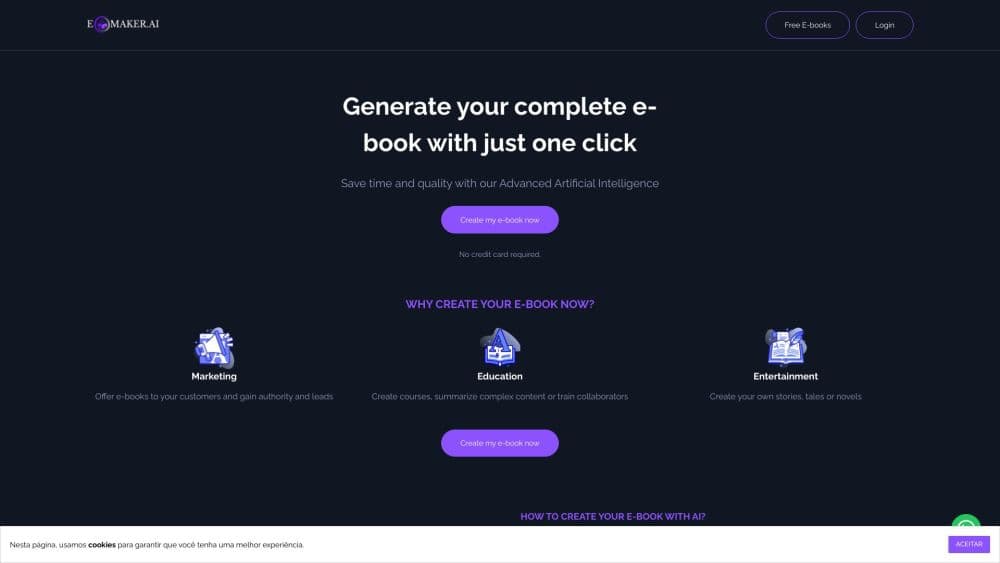
Ebook Maker is a browser-based ebook maker AI that produced complete digital books from a text brief. You typed a title, described what the book should cover, picked a content type, and the tool generated the chapter structure, the prose, and the illustrations. It ran on a credit system rather than a monthly subscription, so you paid for the books you made instead of a calendar month.
The pitch was speed for people who had no design or layout background and wanted a working AI book creator rather than a design suite. Teachers who wanted a workbook, consultants who wanted a lead magnet, and first-time authors who wanted a draft all used the same three-step flow. According to the company, the platform served 899,293 creators across 193 countries before it closed, and it marketed itself as the number one AI tool for e-books.
The limit that matters now is availability. The company ended new creations on ebookmaker.ai and told users that existing work and future projects live on Ebook GPT, the successor platform. If you find an old guide to Ebook Maker, check the date before you sign up anywhere. Accounts from that era are read-only at best.
Getting Started
- Open ebookmaker.ai and create an account with an email address or a Google login. New sign-ups headed for the sunset page as of 2026, where the only working button pointed to Ebook GPT.
- Buy a credit pack if you wanted a paid tier. Two credits cost about $5.99, ten credits about $19.90, and twenty credits about $59.90, and each e-book consumed one credit per six chapters.
- Enter the book basics on the old flow: title, author name, description of the content, language, content type, and chapter count.
- Let the generator build the draft. The AI wrote chapters, added illustrations in a chosen art style, and assembled a cover. The preview showed a partial book before you spent the final credit.
- Edit and export. Paid credits unlocked text editing, image replacement, page controls, an audiobook voice, and downloads as PDF, ePub, and an interactive flipbook.
Product Information
A quick look at Ebook Maker's pricing, supported platforms, and performance.
Best for
The users, tasks, and scenarios where this tool fits best.
Users
- First-time authors
- Teachers and trainers
- Small business owners
Tasks
- Drafting a short nonfiction book
- Producing an audiobook version
- Building a lead magnet
Scenarios
- Launching a first digital product on a small budget
- Turning a workshop outline into a handout
- Testing a book idea before committing
Key features
Title to Full Draft Generation
The core flow asked for one title and one description, then produced the whole book: chapter list, body text, and a closing section. You could accept the AI suggestion for the title or write your own brief. Everything after that was a review pass rather than a writing pass, which is the trade this kind of ebook creation platform makes.
Credit Pricing Tied to Chapter Count
Credits replaced subscriptions. One credit covered a book of up to six chapters, two credits covered seven to twelve, and three credits covered thirteen to eighteen. Editing an existing book did not burn extra credits, so the cost mapped to output size instead of time spent. A ten credit pack at about $19.90 worked out to roughly two mid-size books.
Illustrated Pages with Art Style Control
Generated pages carried images, and the style picker offered photorealistic, gouache, black and white, post-impressionism, abstract, and surrealism. Black and white doubled as a coloring book mode, which parents and teachers used for children's titles. Style applied across the book, so mixing looks meant editing pages one at a time.
Audiobook Generation with Narration
Paid plans unlocked an audiobook build from the same manuscript, with a narrator voice selected by language and gender. The audio came out in a downloadable file rather than streaming only inside the app. For a title priced as a lead magnet, that second format was the main upsell.
PDF, ePub, and Flipbook Exports
One finished project could leave as a PDF for email delivery, an ePub for Kindle and Kobo readers, or a flipbook link that mimicked page turns in the browser. The flipbook also supported a custom background image. Plain word processor output never gets you the flipbook, and that gap is why people picked this tool over a template.
Cover Customization and Page Editing
Paid credits opened the editor: click text to rewrite it, click an image to swap it, add or delete pages, and replace the cover art at a recommended 780 by 780 pixels in JPEG. Inviting an editor by email let a co-author work in the same file. Mobile editing existed but the company warned that the phone preview did not match the final PDF.
Content Types for Different Books
The generator split output by content type: informative, story, children's story, culinary recipes, and poetry, with an extra agent mode for informative books built from uploaded material. Genre shaped both tone and page layout, so a recipe book got ingredient blocks and a children's title got shorter lines.
Pros and cons
Pros
- Fast first draft: a usable chapter structure arrived in minutes from a two-sentence brief.
- Simple cost model: credit packs with no recurring bill, and edits were free after the first generation.
- Multiple output formats from one manuscript: PDF, ePub, audiobook, and a shareable flipbook.
- Editorial control on paid credits: text, images, pages, and cover all editable in the browser without design software.
- Broad language list for generation, with more than sixty options including regional variants.
Cons
- The platform no longer accepts new projects. Any guide that sends you to ebookmaker.ai for a new book leads to a closed checkout, and the successor is a different product with different terms.
- Photo-based custom models needed ten clear photos of one person plus ten credits, and results still needed retouching.
- Chapter ceiling of eighteen per book, which rules out long reference titles and full novels.
- No public API, so there was no way to wire the generator into a newsletter tool or a storefront.
- Mobile editing lagged the desktop editor, and the company advised against Safari for edits.
Frequently asked questions
No. The company ended new creations on ebookmaker.ai and redirected users to Ebook GPT, a separate platform with its own editor, audiobook tools, and sales features. Existing accounts kept access to old books in a limited form, but you cannot generate a new book there. Check the date on any tutorial before following it.
Related content
Explore related tools, skills, and articles for Ebook Maker.
Ebook Maker Alternatives

Emailwritr
Emailwritr · Writing · MarketingEmailwritr is an AI email copywriting tool built for affiliates, course creators, and online businesses that want more revenue from the list they already own. Instead of blank pages or generic chatbot prompts, this AI email writer generates welcome sequences, launch campaigns, cart recovery emails, and promo series from frameworks modeled on well-known direct-response copywriters. You connect your autoresponder, answer a few questions about your offer, and it writes the copy for you.

Swms
Swms AI · Writing · Productivity · BusinessSwms is an AI safety compliance tool that turns a plain description of a job into ready-to-use safety documents. Describe your project, trade, and known hazards, and it writes a safe work method statement, job hazard analysis, safe work procedure, RAMS, or safety data sheet in seconds. It also ships with Oscar, a chat assistant that answers workplace safety questions in any language. Teams in construction, mining, transport, and warehousing use it to cut the paperwork that usually eats into a workday.

Prosp
Prosp · Writing · Voice & Language · MarketingProsp is an AI LinkedIn outreach tool built for agencies and sales teams, and it writes the message and the voice note in your own voice for each prospect so they actually reply. You connect your accounts, find leads, and let the AI draft and send personalized messages at scale, all from one inbox. It's built for people running outbound at volume. That's the whole pitch. Every touchpoint still has to feel human.