

Saara Inc
Saara Inc · Business
EcoReturns by Saara Inc is an AI returns management platform for ecommerce brands, automating RMA, exchanges, refunds, and store credit with policies, fraud checks, and a self-service portal.
About Saara Inc
What Is EcoReturns
EcoReturns is the returns and exchanges module of Saara Inc, an ecommerce software company that also sells shipping and AI-agent products under the same account. The focus here is post-purchase: what happens after a shopper clicks buy and then changes their mind. Saara says more than 1,000 brands use the platform, spanning Shopify, Shopify Plus, Magento, WooCommerce, Amazon, and custom storefronts.
The pitch rests on a single shift. Most returns tools file an RMA and stop. EcoReturns tries to keep the money in the store first, by nudging a shopper toward an exchange or store credit before they reach an outright refund. Saara puts its own customers' numbers at a 20% to 30% cut in return rates and a 25% to 40% share of refund requests converted into exchanges. Treat those as vendor figures rather than independent audits.
The limits are worth knowing up front. This is a tool for merchants, not shoppers, so there's no free consumer app. Setup work concentrates on returns and exchanges automation: policy design, plus mapping your stores and warehouses. And a solo operator selling a dozen items a month gets little from automated routing, since the free Starter plan already covers the small-volume case.
Getting Started
- Install the Shopify returns app from the App Store, or connect WooCommerce, Magento, or a custom storefront through the integration settings.
- Set the rules that decide which orders qualify: return window, item condition, final-sale SKUs, and region. These rules evaluate every request automatically.
- Brand the self-service portal with your logo, colors, and wording, then choose the languages shoppers will see.
- Turn on the automation you want: auto approval, auto rejection, label generation, refunds, and exchange offers.
- Watch the first batch of requests in the dashboard, adjust thresholds, and add warehouse routing once volumes justify it.
Product Information
A quick look at Saara Inc's pricing, supported platforms, and performance.
Best for
The users, tasks, and scenarios where this tool fits best.
Users
- D2C apparel and footwear brands
- Mid-market retailers running several storefronts
- Enterprise operations teams
Tasks
- Turning refund requests into exchanges
- Enforcing return policy without manual review
- Screening suspicious claims
- Keeping shoppers informed
- Reviewing which products cost the most
Scenarios
- Post-holiday return rush
- Cross-border returns
- Multiple warehouses
- Testing before committing
Key features
Self-Service Returns Portal
Shoppers start a return on your own domain rather than being sent to a third-party site. They pick the order, give a reason, choose refund, exchange, or store credit, and print a label when the rules allow it. The portal carries your branding, and Saara supports 90+ languages, so an overseas customer reads the same flow in their own language. Cutting support contact out of the first step is the immediate gain, since most simple returns never need a human.
AI Exchange and Refund Reduction
This is where the AI return prevention claim comes from. When a shopper asks for money back, the AI suggests an exchange that matches what they bought, either a different size or color from the same item or something else in the catalog. Saara also describes smart nudges meant to keep an item instead of returning it. The exchange request happens on your storefront, not an external page, which removes one place where shoppers abandon the process.
Automated Policy and Approval Rules
Rules replace the queue of manual approvals. You define the window, condition requirements, SKU restrictions, and regional exceptions, and the system decides each request the moment it lands. Exchanges, store credit, partial refunds, and full refunds each get their own path. For a team that answers the same policy question fifty times a week, that's where the time goes back.
Fraud Detection and Risk Flags
The return fraud detection engine scores incoming claims against a customer's history and flags repeat returners and suspicious patterns before money leaves your account. Saara reports that users see a 20% drop in return fraud. The flag doesn't block anyone by default, so the decision stays with your team, and the value is in seeing the risk at request time rather than after reimbursement.
Store Credit Wallet
Instead of pushing cash back to a card, the portal can offer store credit with a bonus, and the credit sits in a wallet the shopper can spend later. That keeps revenue inside the business and tends to produce a repeat order. Saara reports that brands lift revenue retention with this route, and the store credit wallet shows up on the Automation plan and above.
Analytics and Return Insights
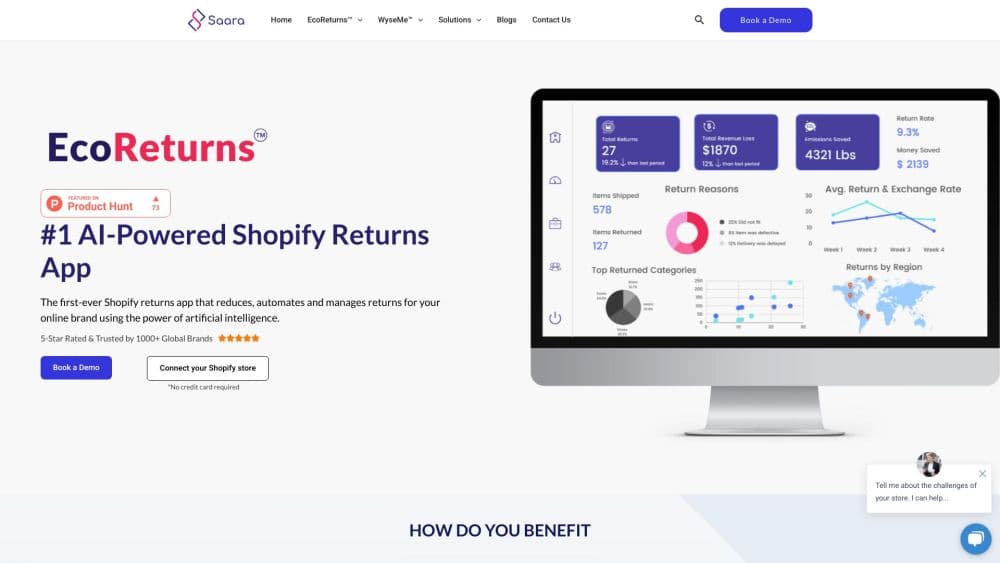
The dashboard breaks down return rate, revenue saved, turnaround time, the most-returned products, and the customers who return most often. Top return reasons get their own view, which is where a merchandising team finds the size chart that keeps failing or the product photo that sets the wrong expectation. Saara positions this as a way to spot the expensive SKUs and customers rather than just count returns.
Warehouse Routing and Reverse Logistics
When you fulfill from several stores or warehouses, the system sends a returned item back to the location that shipped it. Multi-store, multi-warehouse, and multi-currency setups are supported, and routing can follow the original fulfillment record. That avoids one warehouse absorbing all the returns and then reshipping stock to another site.
Integrations and API Access
EcoReturns connects to helpdesk tools such as Zendesk and Gorgias, marketing platforms including Klaviyo, and carrier accounts for label generation. The Automation plan covers more than 100 integrations, and Scale AI adds REST APIs and webhooks for headless storefronts and custom stacks. Saara also publishes an MCP server for teams wiring store data into AI assistants.
Pros and cons
Pros
- The exchange-first flow gives shoppers a reason to stay inside the store, and Saara reports that 25% to 40% of refund requests convert into exchanges.
- Policy rules run automatically at request time, so approval decisions stop depending on who handles the ticket.
- The free Starter plan carries 20 returns a month, which is a real test rather than a demo.
- The self-service portal supports 90+ languages and carries your branding, which matters for cross-border sellers.
- Warehouse-aware routing handles multi-location fulfillment without manual sorting.
Cons
- Pricing scales with volume. Automation includes 100 returns and charges $0.40 for each extra one, so a high-return catalog can outgrow the plan quickly.
- The AI reduction features depend on your catalog data. Sparse product images and size information weaken the exchange suggestions.
- Several capabilities sit behind higher plans. Refund optimizer, multi-warehouse routing, and API access all start at Scale AI, which costs $99 a month.
- The product is built for merchant teams. There's no consumer-facing app, so shoppers only ever see the portal you configure.
Frequently asked questions
EcoReturns handles the returns side of an online store. It gives shoppers a branded portal to request a return, applies your policy rules automatically, and routes the request toward an exchange, store credit, or refund depending on what you allow. Saara sells it alongside EcoShip for shipping and EcoAgents for marketing automation.
Related content
Explore related tools, skills, and articles for Saara Inc.
Saara Inc Alternatives

Knocket
Knocket (Tencent RTC team) · Productivity · Business · ChatbotKnocket is a free live chat and contact page tool that lets visitors message you from your website, app, or a shareable link, with every reply handled from Telegram or one inbox.

shippedit.me
Krawlup · Marketing · Businessshippedit.me now redirects to Krawlup, a web platform that audits SEO, AEO and page speed every week, then hands the fixes to AI coding agents over MCP.

Ayven
Alknoma · Productivity · BusinessAyven is an AI control centre by Alknoma that turns a plain-language goal into a dated plan, hands the work to your people and AI agents, and asks for your approval only when the call is yours.