
Elicit AI
Ought · Business
Elicit is an AI research assistant that searches 138 million academic papers, extracts findings into structured tables, and drafts literature reviews.
About Elicit AI
What Is Elicit
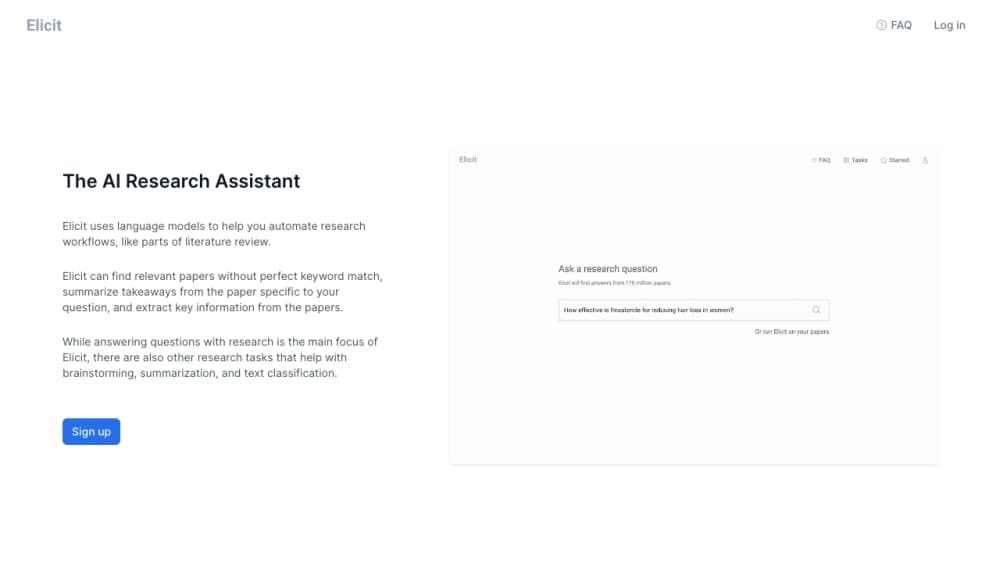
Elicit is an AI research assistant built for the literature side of research rather than open-ended chat. You describe a question the way you would explain it to a colleague, and Elicit searches a library of more than 138 million academic papers, pulls the relevant ones, and reads them for you. Instead of returning a list of links, it fills in a table of the papers, their methods, their sample sizes, and what each one found, so you can compare studies side by side.
The tool is aimed at people who conduct or consume research: graduate students assembling a literature review, clinicians checking what trials say about a treatment, analysts who need a defensible evidence base, and teams running systematic reviews. Its core value is speed on the tedious parts. Screening hundreds of abstracts, logging findings into a spreadsheet, and tracking whether studies agree are tasks that can eat weeks. Elicit automates those steps and leaves the judgment calls to you.
Two things are worth setting expectations on. Elicit summarizes and organizes studies, but it does not replace reading the papers your argument actually rests on. And the strongest workflow, systematic review automation, leans on the paid plans, so the free tier works best as a first taste rather than a full production setup. Elicit is developed by Ought, a public benefit corporation based in Oakland, California.
Getting Started
- Go to elicit.com and create an account with an email address or a Google login.
- Type a research question in plain language, for example "does intermittent fasting improve insulin sensitivity."
- Let Elicit search the literature, then review the suggested papers and remove the ones that do not fit.
- Run an extraction so Elicit pulls the key data, such as study design, sample size, and outcomes, into a sortable table.
- Export the table to CSV, or turn the set of papers into a structured research report you can share.
Product Information
A quick look at Elicit AI's pricing, supported platforms, and performance.
Best for
The users, tasks, and scenarios where this tool fits best.
Users
- Graduate students and early-career researchers
- Clinicians and evidence reviewers
- Research teams and systematic reviewers
Tasks
- Mapping what the literature says
- Extracting data from many papers
- Screening a large result set
- Drafting a literature review
Scenarios
- Starting a thesis or dissertation
- Building a systematic review
- Checking a claim before you cite it
Key features
Search Across 138 Million Papers
Elicit is an academic paper search AI that runs your plain-language question against a library of more than 138 million papers and returns the most relevant studies rather than a raw list of links. You can refine the set by removing papers that do not fit, and the results stay tied to their sources so a claim is always traceable.
Data Extraction Into Tables
The defining feature is turning papers into a table, so you can extract data from papers at scale. You decide which columns matter, such as population, method, sample size, or outcome, and Elicit reads each paper and fills in the cells. The result is a comparison grid you can sort and export, a form of research automation that is far faster than logging findings by hand.
Systematic Review Workflows
Elicit works as systematic review software for the screening and extraction steps, including structured study selection and a log of decisions. This is the use case behind the higher paid tiers, and it fits teams that need a repeatable, documented process rather than a one-off search.
Research Reports
Beyond a single answer, Elicit can generate a structured report that gathers the relevant papers, summarizes their findings, and lays out the evidence around your question. It gives you a draft to edit and build on, which shortens the distance between a research question and a first write-up.
Paper Chat and PDF Upload
You can open a single paper and ask questions about it in plain language, or upload your own PDFs so they sit alongside the indexed literature. Paper chat helps you interrogate one study's methods or conclusions without reading end to end first, and PDF upload brings your private documents into the same workflow.
Citation Export
Extracted tables and selected papers export to formats like CSV and BibTeX, so results drop straight into a reference manager or a spreadsheet. Keeping citations attached to the data means the path from finding a paper to citing it stays short.
Pros and cons
Pros
- As an AI literature review tool, Elicit turns a week of abstract reading into an afternoon by searching 138 million papers and extracting findings into tables.
- Every result links back to a real paper, so claims stay checkable rather than generated.
- The extraction table is genuinely useful, producing a comparison grid you can sort, edit, and export.
- Systematic review workflows give teams a documented, repeatable process instead of an ad hoc search.
Cons
- Elicit summarizes and organizes studies; it does not replace reading the papers your argument depends on.
- The strongest features, such as systematic review automation, sit behind the paid plans, so the free tier is a limited taste.
- Coverage leans toward English-language and open-access science, so some fields and non-English work can be under-represented.
- There is no public API, so teams cannot wire Elicit into their own products or automated pipelines.
Frequently asked questions
Elicit is an AI research assistant for the literature side of research. It searches academic papers, extracts their findings into tables, and helps draft literature reviews and systematic reviews. You ask a question in plain language and get relevant studies with their data, rather than a plain list of links.
Related content
Explore related tools, skills, and articles for Elicit AI.
Elicit AI Alternatives

Knocket
Knocket (Tencent RTC team) · Productivity · Business · ChatbotKnocket is a free live chat and contact page tool that lets visitors message you from your website, app, or a shareable link, with every reply handled from Telegram or one inbox.

shippedit.me
Krawlup · Marketing · Businessshippedit.me now redirects to Krawlup, a web platform that audits SEO, AEO and page speed every week, then hands the fixes to AI coding agents over MCP.

Ayven
Alknoma · Productivity · BusinessAyven is an AI control centre by Alknoma that turns a plain-language goal into a dated plan, hands the work to your people and AI agents, and asks for your approval only when the call is yours.