

EloquentAI
Eloquent AI · Other · Prompts
Eloquent AI is an enterprise AI agent platform that deploys autonomous Operators to run banking and insurance operations, updating systems without APIs or prompting.
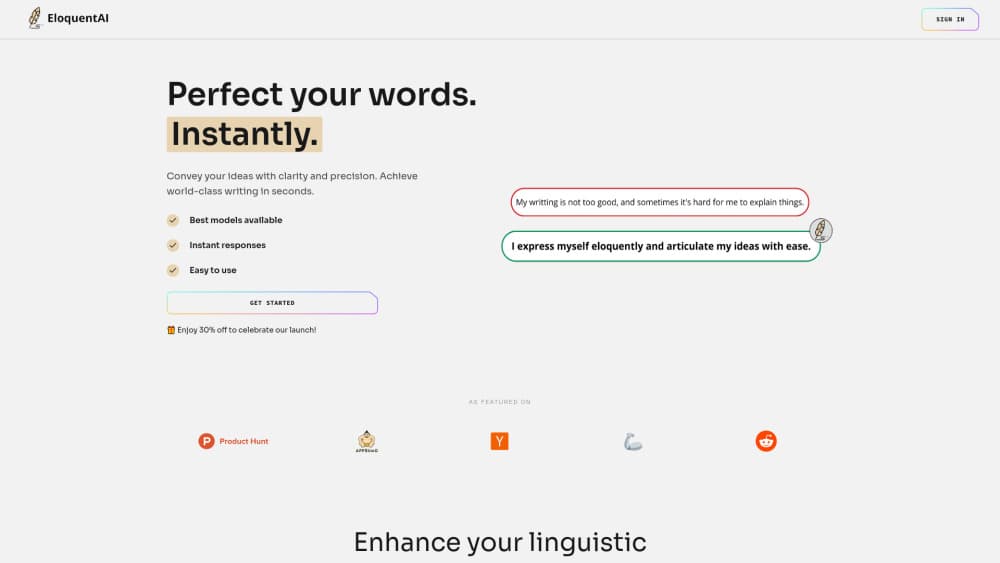
About EloquentAI
What Is Eloquent AI
Eloquent AI is an enterprise platform that builds autonomous AI Operators for regulated industries, mostly financial services. Instead of a chatbot that only answers questions, an Operator watches how your team already works and then does the work itself. It can update a CRM, process a refund, unblock an account, or adjust a loan repayment. The company says no engineering, no APIs, and no prompt writing are needed to get there.
The pitch is aimed at banks, insurers, and fintechs that lose money on repetitive service work. Its flagship agent, Fixer, handles customer service across chat, email, and voice, and Eloquent claims it resolves up to 96% of customer issues on its own. A second agent, Closer, works sales leads by answering questions and booking meetings. Underneath both sits an Evals Framework that scores decisions for accuracy and regulatory fit, plus a dedicated model called Oratio Fin for auditable decision-making.
The limits matter. This is not a self-serve tool you sign up for and use today. Pricing is not published, deployment starts with a demo request, and private or on-premises setups are aimed at large teams with compliance departments. If you run a small support desk, the onboarding and enterprise focus will feel heavy.
Getting Started
- Request a demo through the Eloquent AI site and describe which operations you want to automate.
- Let the team map your existing systems and standard operating procedures so the Operator can learn how work moves through them.
- Configure guardrails and routing rules so the agent escalates to a human when a case falls outside policy.
- Run pre-launch simulations, where the Evals Framework tests decisions against your rules before anything reaches customers.
- Go live across your chosen channels and monitor interactions through the real-time dashboard and audit trail.
Product Information
A quick look at EloquentAI's pricing, supported platforms, and performance.
Best for
The users, tasks, and scenarios where this tool fits best.
Users
- Bank and credit union operations teams
- Insurance service and claims teams
- Fintech support and collections teams
- Enterprise AI and CX leaders
Tasks
- Resolving customer service tickets end to end
- Running KYC and AML checks
- Adjusting loan repayments and reissuing policies
- Qualifying inbound sales leads
Scenarios
- A support inbox that floods every month end
- A collections backlog
- A policy renewal cycle
- A peak season spike
Key features
Autonomous Operators that act across your tools
An Eloquent Operator works inside the software you already run, from CRMs to payment systems, the same way a human agent would. It doesn't wait for an API integration or an IT project. The company says you can connect a tool like Intercom or Zendesk to real actions in days rather than months, which is the difference between a support bot and something that actually closes a case. That matters most for teams with an integration backlog they can't clear.
The Fixer service agent
Fixer is the flagship agent for customer service, built to resolve issues rather than hand them off. Eloquent says it independently solves up to 96% of customer problems, and it updates CRMs, processes refunds, and manages returns under enterprise-grade security. A self-healing engine reruns simulations before launch and adjusts as it runs, so the agent isn't a fixed script you have to babysit. The gap the product targets is real: many support agents handle only a slice of cases and pass the rest to a person.
The Closer sales agent
Closer turns inbound inquiries into qualified opportunities. It engages prospects across channels, answers product questions, works through objections, and books meetings in real time. For SaaS and financial products where a fast reply decides whether a lead converts, an agent that never drops a thread changes the math. It runs on the same Operator stack, so sales and service can share one deployment.
The Evals Framework and Oratio Fin
Every decision can be scored before a customer sees it. Eloquent's Evals Framework tests the agent's output for accuracy and regulatory alignment, while Oratio Fin, a dedicated model, is built for decisions you can audit. In industries where a wrong answer carries legal weight, a scoring layer between the model and the customer is the feature that lets compliance say yes. It's also what separates an enterprise deployment from a general-purpose chatbot.
Multi-channel, multi-language conversations
One Operator covers text chat, email, and voice, and conversations keep their context as a customer moves between them. If someone starts in chat and follows up by email, the agent knows the history. It works across languages too, which matters for banks and insurers serving customers in several markets from one support organization. The goal is a single consistent experience rather than a different bot per channel.
Guardrails, monitoring, and data control
Bespoke guardrails keep the agent on topic and inside your policies, and real-time monitoring lets a team watch live interactions. Every action leaves an audit trail, so decisions can be reviewed later. Eloquent states that your data stays yours and is never used to train its models, with encryption for personal data in transit and at rest and customizable redaction. For regulated buyers, the control over deployment, including private cloud and on-premises options, is often the deciding factor.
Pros and cons
Pros
- Acts inside existing tools: no API work or integration project to get an Operator running.
- High autonomy target: Eloquent reports up to 96% autonomous resolution of customer issues.
- Compliance built in: the Evals Framework and Oratio Fin are aimed at auditable, regulated decisions.
- One agent across channels: chat, email, and voice share context and stay consistent.
- Data control: private cloud and on-premises deployment with encryption and redaction.
Cons
- No public pricing: you must request a demo to learn cost, so budgeting is hard up front.
- Not self-serve: setup requires mapping your systems and standard procedures with the vendor's team.
- Enterprise focus: smaller support desks will find the guided rollout heavier than they need.
- Limited public detail on limits: independent test results and usage caps are not published.
Frequently asked questions
Eloquent AI automates customer-facing operations for financial services. Its autonomous Operators handle support tickets, update core systems, run KYC and AML checks, adjust loan repayments, and manage policy renewals without needing APIs or prompt writing.
Related content
Explore related tools, skills, and articles for EloquentAI.
EloquentAI Alternatives

Odyssey 3
Odyssey · OtherOdyssey-3 is Odyssey's foundation world model. It simulates physics in real time, turns a prompt into an interactive environment, and adapts to robots, cars and games.

JarvisCore
Prescott Data · Coding · Productivity · OtherJarvisCore is an open source Python runtime where AI agents work as equal peers on an agent mesh, claim tasks from a shared ledger, and reach external services through a zero-trust broker.
Clef
Cloudflare · Business · OtherClef is Cloudflare's open-source decision model for Workers AI. It returns calibrated probabilities for typed questions, not generated text, so agents can classify, route, and act fast.