
EnergeticAI
EnergeticAI open-source project · Coding
EnergeticAI is an open-source distribution of TensorFlow.js built for serverless functions, so Node.js apps can run an embeddings model or text classifier with cold starts near 50 ms.
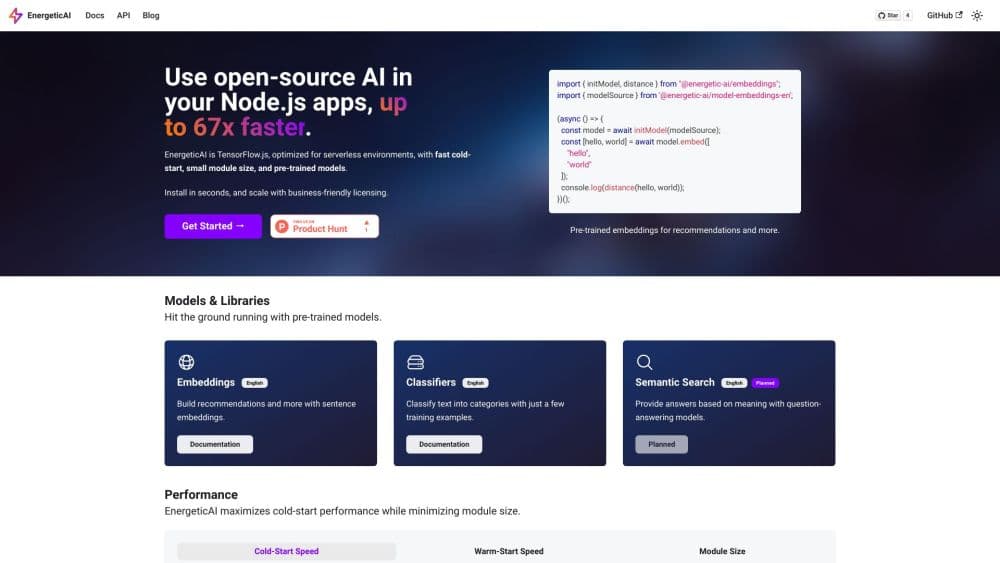
About EnergeticAI
What Is EnergeticAI
EnergeticAI is a slimmed-down build of TensorFlow.js packaged for serverless functions such as AWS Lambda, Vercel Functions, and Netlify Functions. It solves a concrete deployment problem. Stock TensorFlow.js ships 146 MB to 513 MB uncompressed, which often breaks bundle limits before your code ever runs, and its model weights download on first use, which pushes cold starts past two seconds.
The project keeps the parts you need for inference and drops the rest. Module size lands around 3 MB, cold start inference sits near 50 ms in the project's own benchmark, and the core package works as a drop-in replacement for @tensorflow/tfjs-core. That means existing code and models usually run without rewrites.
The limits matter just as much. Pre-trained models cover English embeddings and text classification only, semantic search is still marked as planned, and everything runs on WebAssembly with no GPU path. It also lives on npm at version 0.2.0, published in June 2023, so treat it as a stable but quiet project rather than an actively expanding platform.
Getting Started
- Install Node 18 or newer, then pull the core package and the model library you want:
npm install @energetic-ai/core @energetic-ai/embeddings @energetic-ai/model-embeddings-en. - Import
initModelfrom the model library and the matching model source, then load the weights once per function instance. - Call
model.embed()on an array of strings to get vectors, or use the classifiers package to train on a handful of labeled examples. - Compare vectors with the built-in
distancehelper, then wire the score into your ranking, filtering, or routing logic. - Deploy to your serverless host and check the bundle size, since that limit is the main reason people switch to EnergeticAI in the first place.
Product Information
A quick look at EnergeticAI's pricing, supported platforms, and performance.
Best for
The users, tasks, and scenarios where this tool fits best.
Users
- Node.js developers deploying to serverless platforms
- Indie developers and small teams
- Teams with strict data rules
- Backend engineers adding a first AI feature
Tasks
- Building product recommendations from sentence embeddings
- Sorting support tickets or form submissions into categories with a text classifier trained on a few dozen labeled examples.
- Grouping similar feedback, reviews, or duplicate listings by comparing embedding distance instead of writing keyword rules.
- Adding a lightweight semantic search layer over a few hundred documents, as long as you accept that the built-in semantic search models are still listed as planned.
Scenarios
- Deploying on a free or low tier with a hard bundle cap, where a 3 MB module is the difference between shipping and not shipping.
- Running inference on text you can't send to an external API, such as internal tickets, health notes, or customer records under contract.
- Prototyping an AI feature on a laptop and pushing the same code to production without rewriting the model layer around a vendor SDK.
Key features
Serverless First Packaging
The whole project is organized around the constraints of function platforms. Module size drops to roughly 3 MB, which fits inside typical Lambda and edge bundle limits that stock TensorFlow.js blows past. Model weights are bundled rather than downloaded on first call, so a cold container doesn't wait on a network fetch before answering.
Cold Start Speed
The site reports up to 67x faster inference than TensorFlow.js in serverless functions, measured by initializing the model and embedding a five sentence paragraph on an M1 Max MacBook Pro. Real numbers vary by host and payload size. The direction holds either way: tens of milliseconds instead of seconds, which is what decides whether a request times out.
Pre-Trained Embeddings Model
The embeddings package turns strings into vectors you can compare, cluster, or rank. An English model ships as a separate weights package, so you install only the language you need. It's the fastest path to recommendations and similarity search without training anything yourself.
Few-Shot Text Classifier
The classifiers package trains on a small set of labeled examples at runtime, which suits routing and tagging jobs where you have 20 or 50 examples rather than a labeled dataset. You keep the labels in your repo and retrain on deploy, so behavior stays versioned with your code.
Drop-In TensorFlow.js Compatibility
The core module mirrors @tensorflow/tfjs-core, so existing imports and model code usually keep working. You can test EnergeticAI on one endpoint before committing the whole service, which lowers the cost of trying it.
WebAssembly Backend
Inference runs through WebAssembly, which is fast enough for short inputs and available on every Node host without native build steps. There's no GPU acceleration, so large batches and long documents take noticeably longer than they would on a CUDA box.
Pros and cons
Pros
- Cuts bundle size from hundreds of megabytes to about 3 MB, which is often the only way to deploy a model on a serverless plan.
- Cold starts land near 50 ms in the project benchmark, so a user request doesn't stall while the model loads.
- Apache 2.0 license with pre-trained models picked for similar terms, which keeps commercial use simple.
- No per-call fees and no data leaving your function, a real difference from hosted embedding APIs.
- The core package drops into existing TensorFlow.js code, so migration is usually a package swap.
Cons
- Pre-trained models are English only, so multilingual products need their own weights and testing.
- No GPU support means big batches run slower, and a long document set can take seconds per request on a small function.
- The model catalog is thin: embeddings and classifiers ship today, while semantic search is still marked planned.
- npm shows version 0.2.0 from June 2023, so you're adopting a project with a slow release cadence and should pin versions and read the source when something breaks.
Frequently asked questions
It runs open-source AI models inside serverless functions. Typical uses are product recommendations, text classification, duplicate detection, and similarity search in Node.js backends that can't ship a full machine learning stack.
Related content
Explore related tools, skills, and articles for EnergeticAI.
EnergeticAI Alternatives

Base Code
Base44 (Wix) · Coding · ProductivityBase Code is a shared cloud development environment from Base44. Teammates describe changes to an existing GitHub codebase in chat, preview them live and send them back as pull requests.

Google EmbeddingGemma 2
Google DeepMind · Writing · Image · CodingGoogle EmbeddingGemma 2 is a 740M-parameter open model that turns text, code, images, audio, and video frames into vectors in one 768-dimension space, running on phones and laptops.

GitGlow
GitGlow · Coding · ProductivityGitGlow is a local-first desktop Git client that lets independent developers review their own code and their AI agents' changes in one place before shipping.