

Epigram
Sandeep Panda · AI Detection
Epigram is a free, open-source AI news app that compresses long articles into short summaries and a personalized feed, so busy readers catch up in minutes.
About Epigram
What Is Epigram
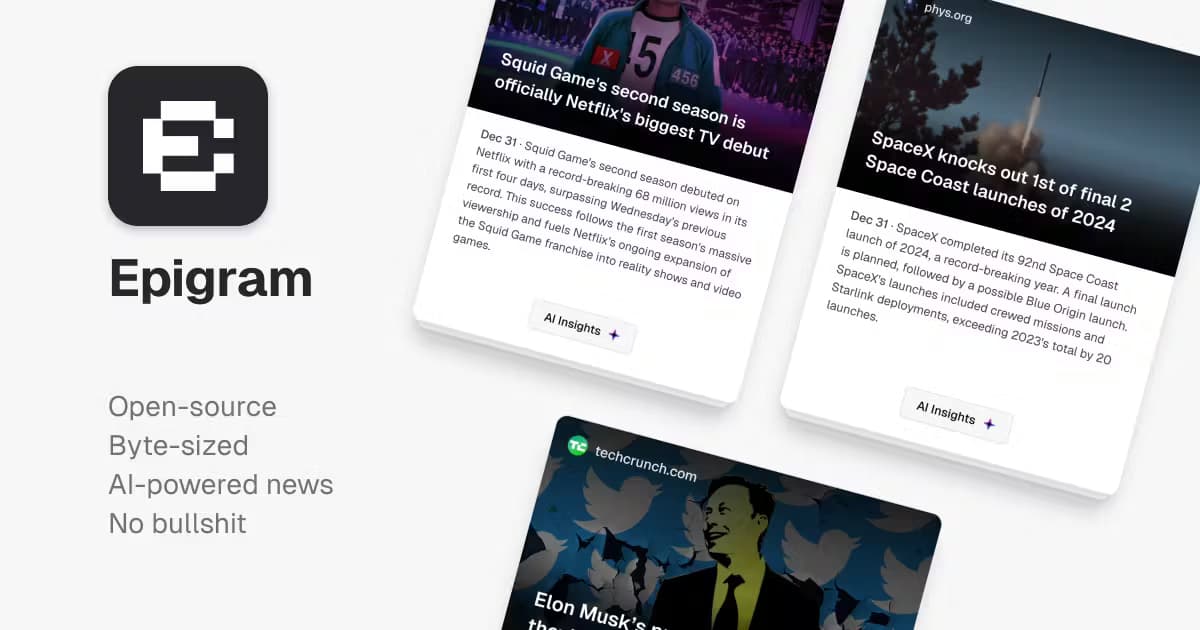
Epigram is a news reader built as an AI news summarizer. Instead of sending you another feed of full-length articles, it pulls stories from a set of news sources, condenses each one into a short brief, and sorts them into a feed shaped by the topics you follow. The whole project is open source and free to use.
It fits readers who want the gist of the day without opening ten tabs. A student following tech and politics, a commuter skimming headlines between stops, or anyone tired of long reads all fall into the same group: people who value speed over exhaustive coverage.
The catch is depth and control. Summaries lose nuance, so a breaking story with contested details reads thin until you open the original. The app also depends on AI models for every summary, which means occasional errors slip through, and self-hosting it asks for real setup work with API keys for news and model providers.
Getting Started
- Open Epigram in a browser and add it to your home screen if you want app-like access on mobile.
- Pick the topics and interests that should fill your feed.
- Browse the AI-generated summaries in the feed, tapping any card to read the short brief.
- Open a full article when a topic deserves the deeper read.
- Use the AI deep dive on a story to pull a longer analysis before deciding what to think.
Product Information
A quick look at Epigram's pricing, supported platforms, and performance.
Best for
The users, tasks, and scenarios where this tool fits best.
Users
- Busy professionals
- Students and researchers
- Self-hosters and developers
Tasks
- Daily news catch-up
- Topic tracking
- Deep reading on demand
Scenarios
- Morning routine on a commute
- Following a fast-moving story
- Trying an AI news tool before paying
Key features
AI-powered news summaries
Every story gets condensed into AI-powered news summaries, so a reader can move through several topics without opening full articles. The summarizer works on the source text itself, which keeps the brief tied to the original reporting rather than a reworded opinion piece. The value is speed: you learn what happened in a sentence or two, then decide whether the source is worth your time.
Personalized news feed
Epigram builds the feed from the preferences and interests you set, mixing topics into one stream rather than a fixed category list. That means the first screen shows what you care about, not whatever ranks highest sitewide.
AI deep dive
When a summary is too thin, the deep dive pulls a longer analysis of a single article. It suits the moment when a topic matters enough to want context, but not enough to read three separate pieces.
Trusted sources
Stories come from established news providers rather than random aggregation, which gives the summaries a traceable origin. You can still reach the original article when you want to verify a claim or read the full account.
Responsive, installable web app
Epigram runs in the browser and adapts to phone, tablet, and desktop, and Safari users can add it to the home screen for a native-like feel. There's no app store download to manage.
Open-source codebase
The project ships under the AGPL-3.0 license, so developers can read the code, run their own copy, and contribute changes. That transparency is rare among AI news apps, which usually keep their models and pipelines closed.
Pros and cons
Pros
- Free to use with no paid tier, so there's no cost barrier to trying it.
- Open-source code that developers can self-host and modify.
- AI summaries cut reading time on routine news.
- Feed personalization keeps the stream focused on chosen topics.
- Works on any device through the browser, with home-screen install on Safari.
Cons
- Summaries trade nuance for speed, so contested or technical stories can read incomplete until you open the original.
- AI-generated briefs can carry occasional factual errors that a careful reader has to catch.
- Self-hosting needs API keys for the news and model providers, which adds setup effort and ongoing cost for developers.
Frequently asked questions
Epigram is a news app that summarizes articles with AI and arranges them into a personalized feed. It's for staying current on chosen topics without reading every full story.
Related content
Explore related tools, skills, and articles for Epigram.
Epigram Alternatives
Isgen AI
Isgen · AI DetectionIsgen AI is a web-based AI detector that scores text for machine authorship and shows you which sentences and phrases push the number up. It's built for teachers, editors, students, and writers. Their question is simple: did this draft come from ChatGPT, GPT-5, Claude, Gemini, DeepSeek, or another model? You paste or upload content, run a scan, and get a Human, AI, and Mixed breakdown in seconds. There's also a companion editor that scores text while you write it.
Humanizeai Tools
Humanizeai Tools · Writing · AI DetectionHumanizeai Tools is a web-based AI humanizer that rewrites machine-generated text so it sounds like a person wrote it, which is the whole point of the category it belongs to. Paste a draft from ChatGPT, Claude, or Gemini, run it through the tool, and it swaps out the phrases and sentence patterns that AI detectors flag. If your goal is to make AI text sound human before you publish it, this is the kind of tool built for exactly that. It suits students, bloggers, and marketers who need copy that reads naturally and clears tools like GPTZero, Copyleaks, and Winston AI after a single pass.

Hidemyai
Hidemyai · Writing · AI DetectionHidemyai is an AI content humanizer. It rewrites text from ChatGPT, Jasper, and similar tools so the result reads like a person wrote it. You paste your draft, pick a document type and tone, and the service returns a version meant to bypass AI detectors such as Originality.ai, Turnitin, and ZeroGPT. It targets writers, marketers, and students who lean on AI drafts but can't ship copy that sounds robotic. The promise is simple: make AI content undetectable.