

DistillerSR
Evidence Partners · Business
DistillerSR is Evidence Partners' AI-assisted platform for systematic and literature reviews, handling screening, data extraction, and audit-ready reporting in one workspace.
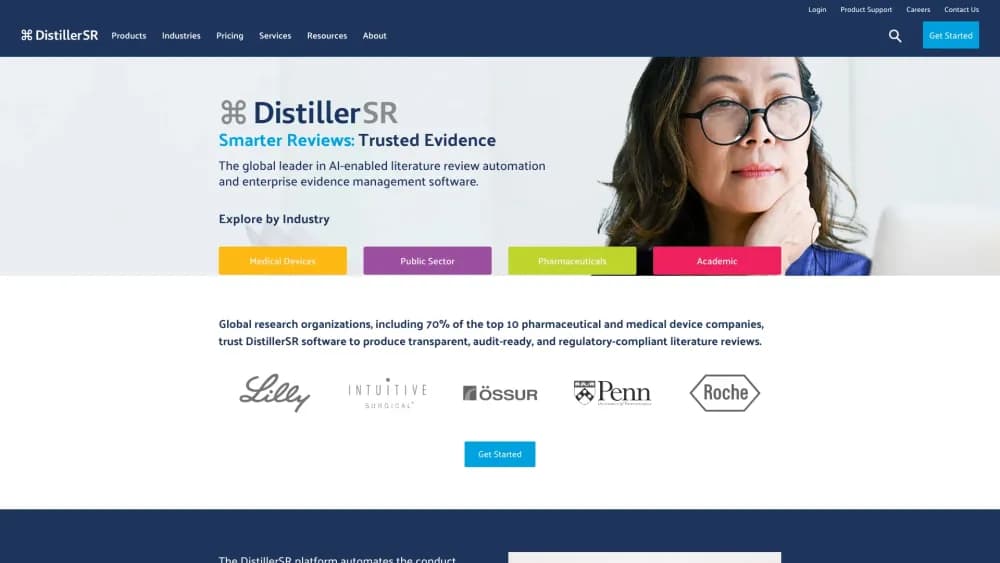
About DistillerSR
What Is DistillerSR
DistillerSR is a web-based literature review software platform for running systematic reviews end to end. Reviewers import references from a library search, screen titles and abstracts, pull data into structured forms, and export the results. The software was built for the systematic review workflow first, so dual screening, conflict resolution, exclusion reasons, and risk of bias assessment all exist as first-class features rather than workarounds.
The platform is a piece of evidence management infrastructure, and the buyer is usually not an individual. Pharmaceutical companies, medical device makers, public health bodies, and research groups use it to keep evidence consistent across projects, and the platform carries SOC 2 Type II certification along with design work toward FDA 21 CFR Part 11 and EU Annex 11 requirements. Small labs can use it too, but the value depends on how many reviews you run and how much regulatory scrutiny those reviews face.
Two things to know before signing up. Pricing isn't published. You request a quote and the number depends on reviewers, modules, and support level, so there's no self-serve checkout to compare against. The other limit is scope: DistillerSR organizes and documents the review, but the search itself happens in PubMed, Embase, or whatever database you use, and the statistical synthesis at the end belongs to separate tools.
Getting Started
- Request a demo or quote from the Evidence Partners site. The pricing page is a contact form rather than a price list, and implementation usually includes a call with their team.
- Configure a project with your protocol: set up screening levels, forms, and workflow stages, or start from one of the built-in templates for systematic reviews, rapid reviews, or CER programs.
- Import references from your database search, or set up recurring imports from RightFind, PubMed, or Embase so living reviews stay current.
- Screen in levels. Reviewers work in parallel, conflicts route to a third reviewer, and exclusion reasons are captured while the decision is made.
- Extract data into AI-enabled forms, run reports such as the PRISMA flow diagram, and export your dataset to a BI tool, a statistics package, or your regulatory submission.
Product Information
A quick look at DistillerSR's pricing, supported platforms, and performance.
Best for
The users, tasks, and scenarios where this tool fits best.
Users
- Medical device and pharma teams
- Academic researchers and students
- Guideline and HTA groups
Tasks
- Running a systematic review from search to PRISMA diagram
- Title and abstract screening at volume
- Extracting data from full texts and tables
- Building a CER or post-market surveillance program
Scenarios
- Facing a regulatory submission deadline
- Maintaining a living review
- Several teams extracting from the same papers
Key features
Smart Screening With Generative AI
Smart Screening reads titles and abstracts and makes inclusion decisions, either by suggesting a call for a reviewer to confirm or by running fully automated on a defined slice of the queue. It plugs into existing forms rather than demanding a new setup, and an independent AI can check its decisions. Evidence Partners points to a Lilly case where AI-assisted title and abstract screening cut review time by 67%, with an accuracy figure of 90% for systematic and targeted reviews. That's the vendor's own result, and the human-in-the-loop mode exists for exactly that reason.
Smart Evidence Extraction
Smart Evidence Extraction, or SEE, pulls data from text and tables at scale. It supports two modes: a human-in-the-loop path where a reviewer confirms each field for regulatory work, and a fully automated path for faster throughput. Anyone who has spent a week copying outcomes from PDF tables into a spreadsheet will recognize the time this addresses.
Audit Trail and Regulatory Readiness
Every decision in the platform is logged with the reviewer and the time. Version control applies to projects and forms, and the platform is designed around SOC 2 Type II, FDA 21 CFR Part 11, and EU Annex 11. For a CER program, that means the provenance of each data point can be shown on demand. For everyone else, it means a review can be defended after the fact without hunting through old emails.
Configurable Workflows and Templates
Projects are built from configurable stages, forms, and filters. You set the protocol once, then standardize it across products or review types by replicating the template. Built-in form libraries cover standard data extraction and risk of bias assessment, including the Cochrane Risk of Bias tool. Filters route references to reviewers based on the answer to a screening question, so nobody sifts through a queue meant for someone else.
CuratorCR Evidence Reuse
CuratorCR is a separate module that turns past extraction work into a searchable repository. When a reference has already been reviewed elsewhere in the organization, the platform says so, shows the data, and identifies who collected it and at which stage. Reviewers validate and reuse it, which removes the most common form of duplicated work in multi-team evidence programs.
Integrations, API, and Reporting
References can be imported automatically from corporate library systems and databases, and full texts are available through RightFind or by pulling from PMC. The API connects DistillerSR to BI dashboards, safety systems such as Oracle Argus, and external data sources, so extracted evidence flows into analysis without manual exports. Standard reporting covers PRISMA flow diagrams and activity reports, and reports can be scheduled and emailed to stakeholders.
Pros and cons
Pros
- The workflow was designed for systematic reviews, so dual screening, conflict resolution, and exclusion tracking don't need to be built on top of a generic tool.
- Audit trails, version control, and the compliance posture behind them make the output easier to defend in a regulatory submission.
- AI screening and extraction can meaningfully cut the hours spent on large reference sets, with a human-in-the-loop mode when the review needs it.
- CuratorCR stops teams from extracting the same paper twice, which is where a lot of hidden cost sits in larger evidence programs.
- The API and library integrations mean evidence can move into Power BI, safety systems, or a statistics package without manual re-keying.
Cons
- There's no public price and no self-serve plan, so an individual researcher can't compare costs without contacting sales first.
- Implementation takes configuration work. The templates help, but a first project isn't a ten-minute setup.
- The platform handles review management, not statistical synthesis or the database search itself. You still need other tools for the analysis and for search strategy.
- Small teams may not use enough of the feature set to justify enterprise pricing, especially with CuratorCR sold as a separate module.
Frequently asked questions
DistillerSR manages literature reviews from screening through data extraction and reporting. Teams import references from a database search, screen them in parallel, capture data in structured forms, and export results with an audit trail. It supports systematic reviews, rapid reviews, living reviews, clinical evaluation reports, and post-market surveillance.
Related content
Explore related tools, skills, and articles for DistillerSR.
DistillerSR Alternatives

Knocket
Knocket (Tencent RTC team) · Productivity · Business · ChatbotKnocket is a free live chat and contact page tool that lets visitors message you from your website, app, or a shareable link, with every reply handled from Telegram or one inbox.

shippedit.me
Krawlup · Marketing · Businessshippedit.me now redirects to Krawlup, a web platform that audits SEO, AEO and page speed every week, then hands the fixes to AI coding agents over MCP.

Ayven
Alknoma · Productivity · BusinessAyven is an AI control centre by Alknoma that turns a plain-language goal into a dated plan, hands the work to your people and AI agents, and asks for your approval only when the call is yours.