

Expertise AI
Expertise AI · Voice & Language
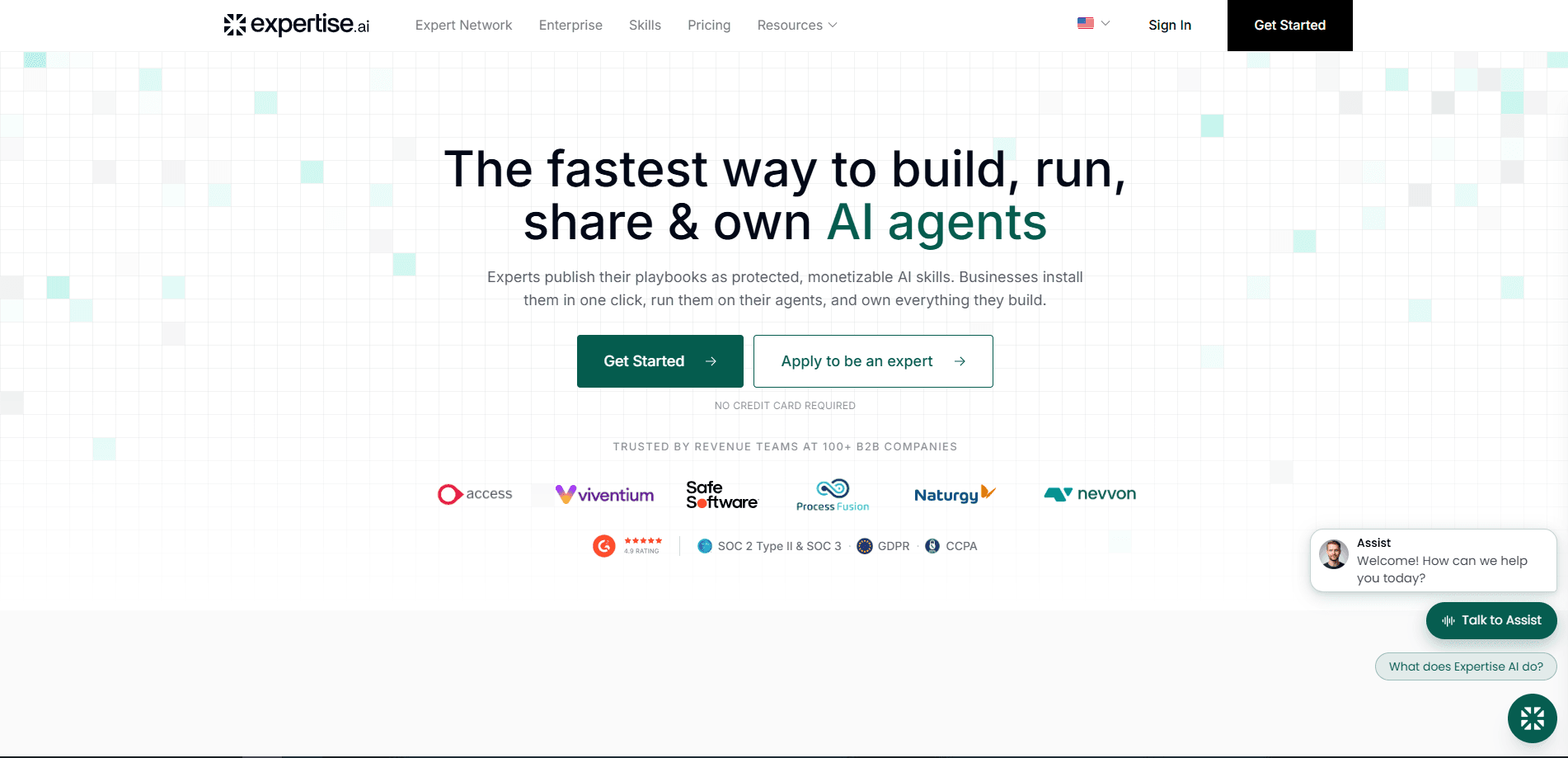
Expertise AI is an enterprise AI agent platform that turns website visitors and customer questions into booked meetings and resolved tickets. Teams deploy enterprise AI agents for sales, customer support, and internal workflows on one shared system. The pitch is simple. One platform, with the integrations, controls, and data-residency options large companies need before they put AI into production.
About Expertise AI
What Is Expertise AI
Expertise AI lets a company build, run, and share AI agents without stitching together a dozen separate tools. A sales agent can greet a visitor on the website, answer product questions, qualify intent, and run AI meeting booking that flows into the CRM. An AI customer support agent handles chat, voice, and phone requests while keeping the help desk updated. Both run on the same integrations and governance layer. No separate stacks. No duplicated setup.
The platform is built for enterprises, not hobby projects. It carries SOC 2 Type II and SOC 3 compliance, follows GDPR rules, and gives you a choice of where your data lives, whether that's Canada, the US, or Europe. You can also pick which underlying model powers your agents, including open-weight options, and run on dedicated infrastructure or a VPS if your security team requires it. That's a lot of control. Most competitors lock you in.
The catch is that Expertise AI doesn't sell a cheap self-serve plan. Pricing runs through a demo and a sales conversation, and the tiers point at teams scaling across multiple departments. If you're a solo builder wanting to spin up an agent in five minutes for free, this isn't that product. It's aimed at organizations that need controls and a deployment partner more than a low entry price. That's a narrow audience, on purpose.
Getting Started
- Book a demo with the Expertise AI team to map your first workflow, such as website visitor qualification or support deflection.
- Choose your deployment model, including region and infrastructure, and connect the systems your team already uses, like the CRM or help desk.
- Design the agent's flows, guardrails, and handoff rules with the team's help, then test against real scenarios.
- Launch the agent on your website or support channels and keep tuning it after it goes live.
Product Information
A quick look at Expertise AI's pricing, supported platforms, and performance.
Best for
The users, tasks, and scenarios where this tool fits best.
Users
- Enterprise sales teams
- Customer support leaders
- IT and security teams
Tasks
- Turning website traffic into pipeline
- Resolving support conversations
- Automating repeatable internal work
Scenarios
- A regulated bank or insurer that needs human control and audited workflows on every customer-facing agent.
- A high-volume retail or telecom support desk that wants to cut contact volume without adding headcount.
- An enterprise rolling AI out across several departments that wants one platform instead of separate tools per team.
Key features
Sales Agents for Website Engagement
Expertise AI's sales agents meet buyers while they're still on the site. They answer questions, spot buying intent, book the next step, and pass the right context into your sales systems. That AI meeting booking step matters. A visitor can move from a question to a scheduled meeting without a round trip through a contact form.
Support Agents Across Chat, Voice, and Phone
The support side handles requests over chat, voice, and phone, and keeps your help desk and teams updated as it resolves them. This is where the AI customer support agent earns its keep. It's the same platform and controls doing both sales and support work, so you aren't running two disconnected AI systems.
Unlimited Usage on Production Plans
Higher tiers drop per-interaction metering and let you run high-volume sales and support workflows without watching every conversation. The pitch is more predictable deployment economics as usage grows, which matters once an agent is handling thousands of interactions a month. Nobody likes a meter running.
Private Infrastructure and Model Choice
You can run agents on dedicated infrastructure or a VPS and choose among models, including open-weight options, based on your performance, privacy, and cost needs. For teams with strict architecture requirements, this flexibility is often the deciding factor over a locked-in SaaS tool. Not every vendor allows it.
Data Residency and Enterprise Security
Deployments can be hosted in Canada, the US, or Europe to meet regional and regulatory rules. The platform carries SOC 2 Type II and SOC 3 compliance and follows GDPR, with encryption applied to your data throughout. For a bank or an insurer, that turns this into a SOC 2 AI platform their review board might approve.
Hands-On Deployment and Tuning
Expertise AI works alongside your team to design workflows, connect integrations, test real scenarios, and set guardrails. Tuning continues after launch, which is a real difference from self-serve tools where you're alone once you click deploy. That support isn't cheap, but it's there.
Industry-Tuned Workflows
The platform ships patterns for insurance, banking, retail, manufacturing, airlines, logistics, utilities, and telecommunications. Each one covers the specific questions and handoffs that a given industry actually faces in daily customer conversations, so you start closer to a working agent instead of a blank page. Less blank-page work.
Pros and cons
Pros
- Runs sales and support agents on one platform with shared integrations and controls, so you avoid managing separate tools.
- Strong compliance footing with SOC 2 Type II, SOC 3, and GDPR, plus data residency in Canada, the US, and Europe.
- Model choice and private infrastructure let security-conscious teams meet internal architecture rules.
- Unlimited usage on higher tiers removes per-conversation cost anxiety as volume climbs.
- Hands-on deployment help reduces the risk of a stalled rollout.
- Website chat AI and support agents share one governance layer, so policy changes apply everywhere at once.
Cons
- No free plan and no public pricing, so you can't evaluate cost or try it solo, and everything starts with a sales demo.
- Geared to enterprises with volume and IT resources, which makes it heavy for small teams or solo builders.
- The value depends on integrating your CRM and help desk, so setup effort is real and not a five-minute task.
Frequently asked questions
It's an enterprise AI agent platform for sales and customer experience. Agents engage website visitors, qualify them, book meetings, and handle support requests over chat, voice, and phone while keeping your systems updated. Think website chat AI that does more than answer, it moves a buyer toward a decision.
Related content
Explore related tools, skills, and articles for Expertise AI.
Expertise AI Alternatives

Foley
Hanamori Labs, LLC · Voice & Language · Productivity · AI AssistantFoley is a voice to-do list that turns a spoken sentence into a filed task, complete with project, date and time, then helps you plan the day around what is already there.

HireKey
HireKey · Voice & Language · Productivity · LeaningHireKey is an AI job search copilot built by a former tech recruiter. It checks role fit, tailors resumes, runs interview practice and tracks every application.

Fluence
Yay Software (Yannick Huchard) · Writing · Voice & Language · ProductivityFluence is an Android app that reads PDFs, EPUBs, Word files and web articles aloud, follows each sentence as it speaks, and answers questions about the text on the phone itself.