

EyeBreathalyzer
HazyEyes (NeuroAgent AI, Inc.) · AI Detection
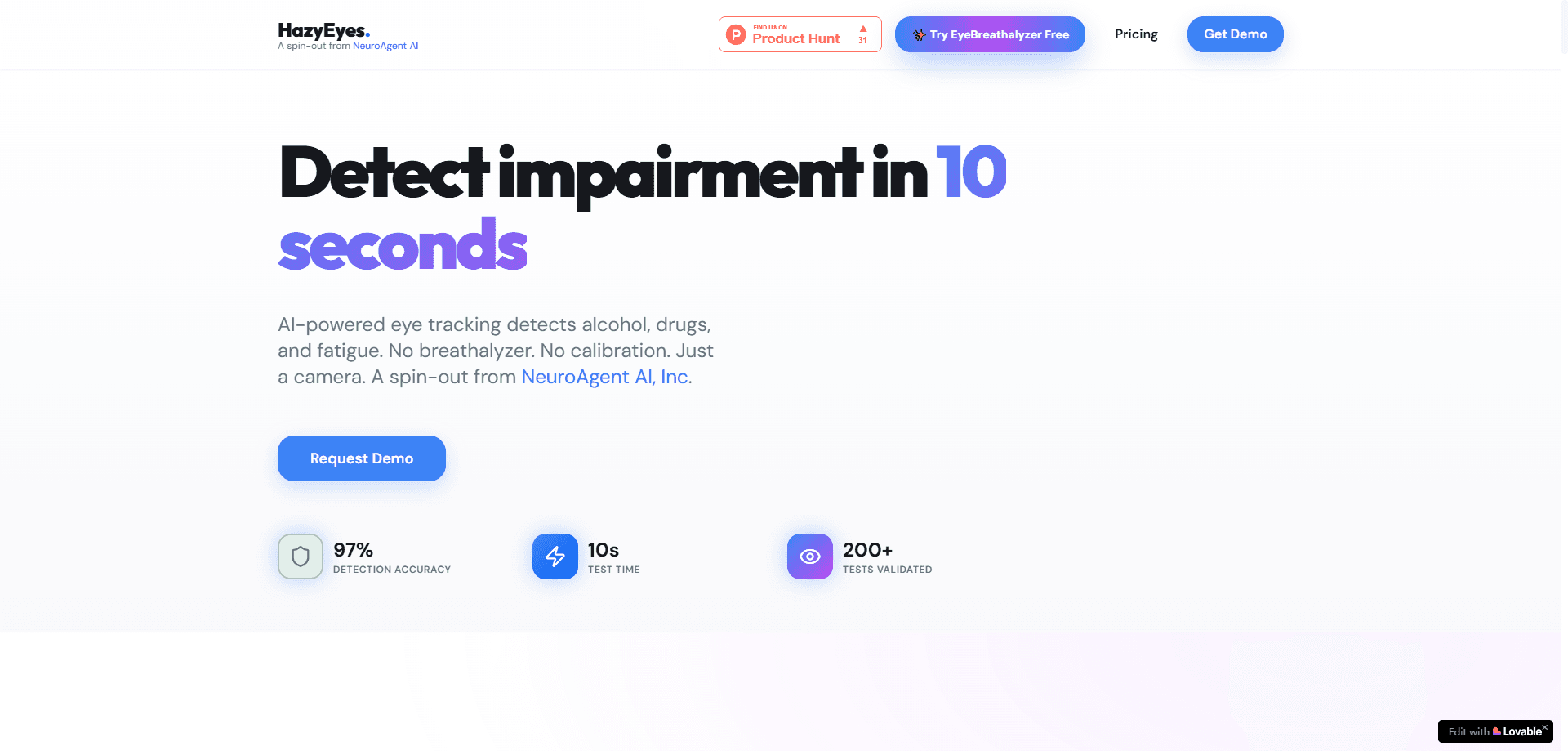
EyeBreathalyzer is an AI impairment detection system from HazyEyes that reads eye movement through a standard camera to flag alcohol, drug, and fatigue impairment in roughly 10 seconds. There's no breathalyzer, no physical contact, and no calibration step. Agencies, campuses, and employers use it to run fast, consistent sobriety checks and store tamper-proof evidence that holds up in court.
About EyeBreathalyzer
What Is EyeBreathalyzer
EyeBreathalyzer is software, not a handheld device. It asks a person to follow a moving target on a screen for 10 to 15 seconds, then analyzes the captured eye tracking data with a neural network trained to spot impairment. That's the whole test. No breath, no contact, no calibration. Its AI impairment detection leans on subtle changes in saccades (fast eye jumps), pursuit movements, and pupil dynamics that track with alcohol, drugs, and fatigue.
The product is a spin-out of NeuroAgent AI, Inc. Its pitch is aimed at public safety teams, universities, and workplaces that currently rely on breathalyzers and field sobriety tests. Those older tools only catch alcohol and depend on officer judgment, which makes them slow and easy to challenge.
The main limitation is scope and rollout. It needs a decent camera and a quiet moment to run, and it's sold to organizations rather than to individual consumers. There's no self-serve signup, and pricing isn't published. If you want a quick personal check at home, this isn't built for that.
Getting Started
- Contact HazyEyes through the official site to request a demo or deployment quote for your agency, campus, or company.
- Choose the deployment unit and schedule onboarding, which the vendor runs in phases over the first few months.
- Set up the camera-equipped device or kiosk where tests will be administered.
- Run a test: the subject follows the on-screen target for 10 to 15 seconds.
- Review the pass or flag result and the stored documentation, then move it into your existing case workflow.
Product Information
A quick look at EyeBreathalyzer's pricing, supported platforms, and performance.
Best for
The users, tasks, and scenarios where this tool fits best.
Users
- Public safety and police departments
- University and campus security teams
- Employers in safety-sensitive industries
Tasks
- Roadside or event sobriety screening
- Fatigue checks before high-risk shifts
- Evidence documentation
Scenarios
- Checkpoints and campus entry points where many people need to be screened quickly and without contact.
- Post-incident assessment where you want a repeatable, tamper-proof reading to support a report.
- High-volume event security where breathalyzer lines would slow everyone down.
Key features
Camera-Only Eye Tracking Test
Everything runs off a camera that's already on hand. The subject follows a moving target for 10 to 15 seconds and the system captures the eye movement it needs, so there's no device to buy, sterilize, or replace. Nothing to touch. That non-contact design also sidesteps the contamination concerns that come with shared mouthpieces.
Multi-Impairment Detection
Breathalyzers catch alcohol and nothing else. EyeBreathalyzer looks for alcohol, drug impairment detection, and fatigue in one test, which matters as drug-impaired driving keeps rising. The vendor cites 91% detection accuracy and says the approach has been validated across 200+ tests.
Neural Network Movement Analysis
The system reads three signals: saccades, pursuit movements, and pupil dynamics. A proprietary neural network compares those patterns against known impairment signatures and returns a confidence score. Subtle changes that a human eye would miss are the whole point. That's the pitch, anyway.
No Calibration or Maintenance
Traditional breathalyzers need regular calibration and annual maintenance, and out-of-calibration units get challenged in court. EyeBreathalyzer claims zero calibration and zero maintenance cost, which is where much of its 66% cost-savings figure comes from.
Court-Ready Evidence Storage
Each test produces tamper-proof digital documentation automatically. For agencies, that's the difference between a reading an officer has to defend from memory and a stored, objective record that travels with the case.
Fast Throughput
The vendor puts test duration at about 9 seconds versus 1 to 4 minutes for a typical breathalyzer, roughly an 8x speed gain. At a checkpoint or campus gate, that speed is what keeps lines moving. Minutes saved per person add up fast.
Deployment Program
Rollout is staged, starting with a single unit in months 1 to 3, followed by training and broader onboarding. Buyers get guided setup rather than a box they configure alone.
Real-Time Confidence Readout
Results come back immediately with a confidence percentage, not just a pass or fail. If the reading is borderline, staff can see that before deciding what to do next.
Pros and cons
Pros
- No hardware purchase or calibration, since it runs on existing cameras.
- Detects alcohol, drugs, and fatigue instead of alcohol only.
- Around 10 seconds per test, so it moves crowds much faster than a breathalyzer.
- Non-contact testing avoids shared mouthpieces and contamination risk.
- Automatic tamper-proof records support legal and compliance use.
Cons
- No published pricing, so you can't estimate cost without contacting sales.
- Sold to organizations only, with no individual or consumer option.
- Accuracy claims come from the vendor and haven't been independently verified by third parties in the material we could find.
- Needs a camera and a calm moment to run, which can be awkward in a noisy field setting.
Frequently asked questions
It's used to detect impairment from alcohol, drugs, and fatigue by analyzing how someone's eyes move. Agencies, campuses, and employers use it as a non-invasive sobriety test that skips the breathalyzer and the field sobriety check.
Related content
Explore related tools, skills, and articles for EyeBreathalyzer.
EyeBreathalyzer Alternatives
Isgen AI
Isgen · AI DetectionIsgen AI is a web-based AI detector that scores text for machine authorship and shows you which sentences and phrases push the number up. It's built for teachers, editors, students, and writers. Their question is simple: did this draft come from ChatGPT, GPT-5, Claude, Gemini, DeepSeek, or another model? You paste or upload content, run a scan, and get a Human, AI, and Mixed breakdown in seconds. There's also a companion editor that scores text while you write it.
Humanizeai Tools
Humanizeai Tools · Writing · AI DetectionHumanizeai Tools is a web-based AI humanizer that rewrites machine-generated text so it sounds like a person wrote it, which is the whole point of the category it belongs to. Paste a draft from ChatGPT, Claude, or Gemini, run it through the tool, and it swaps out the phrases and sentence patterns that AI detectors flag. If your goal is to make AI text sound human before you publish it, this is the kind of tool built for exactly that. It suits students, bloggers, and marketers who need copy that reads naturally and clears tools like GPTZero, Copyleaks, and Winston AI after a single pass.

Hidemyai
Hidemyai · Writing · AI DetectionHidemyai is an AI content humanizer. It rewrites text from ChatGPT, Jasper, and similar tools so the result reads like a person wrote it. You paste your draft, pick a document type and tone, and the service returns a version meant to bypass AI detectors such as Originality.ai, Turnitin, and ZeroGPT. It targets writers, marketers, and students who lean on AI drafts but can't ship copy that sounds robotic. The promise is simple: make AI content undetectable.