

Fabi.ai
Fabi.ai · Coding · Business
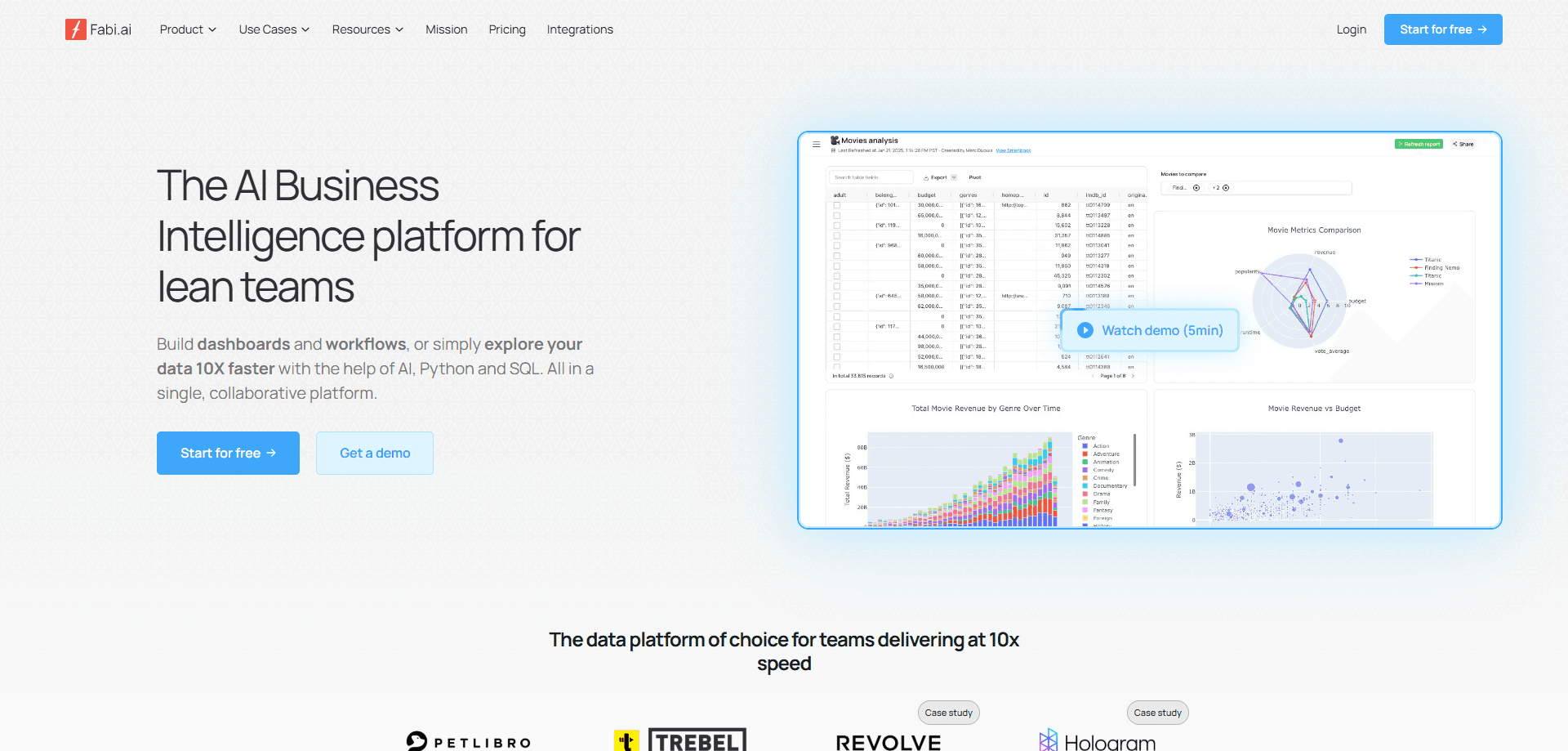
Fabi.ai is an AI-native business intelligence platform that connects to your data and answers questions, builds dashboards and runs scheduled reports in plain English.
About Fabi.ai
What Is Fabi.ai
Fabi.ai is an AI data analysis platform built for teams that need answers from their product and revenue data without waiting on a data engineer. It connects to warehouses, spreadsheets and SaaS apps, then puts an AI analyst agent on top of everything you connect. You ask a question in normal language, and it writes the SQL or Python, runs it and shows the result.
The core problem it solves is speed. Ad hoc questions, one-off dashboards and recurring reports usually bounce between five tools and three people. Fabi.ai keeps that work in one place, so the person who has the question can often answer it. It isn't a replacement for a full BI stack, and heavy data modeling still needs someone who knows what they're doing.
Fabi.ai announced it is joining Omni, the data platform company, so the roadmap now moves under a larger organization. Current features and pricing still run independently.
Getting Started
- Sign up on the Fabi.ai website and open a workspace.
- Connect a data source, such as Snowflake, BigQuery, PostgreSQL or a Google Sheet.
- Describe what you want in the Analyst Agent chat, or draft a question in a Smartbook.
- Turn the answer into a dashboard or a scheduled workflow and share it with your team.
Product Information
A quick look at Fabi.ai's pricing, supported platforms, and performance.
Best for
The users, tasks, and scenarios where this tool fits best.
Users
- Data teams drowning in ad hoc requests
- Product and growth managers
- Marketing and finance analysts
Tasks
- Ad hoc data questions
- Dashboard building
- Scheduled reporting
- Notebook analysis
Scenarios
- Daily retention or revenue checks
- Early product research
- Executive reporting
Key features
AI Analyst Agent
The Analyst Agent answers questions about your data and can query it, write code and build charts. It validates its own work with custom tools and shows the underlying queries so you can check the result. You can deploy it in Slack, ChatGPT, Claude or anywhere else through the MCP server.
Analyst Agent MCP Server
Fabi.ai ships an MCP server that drops the AI analyst into the chat tool your team already uses. The server creates threads, submits questions and saves Smartbooks programmatically. You connect it with a token or OAuth, and it's the fastest path to a text-to-SQL assistant that knows your business.
Smartbooks (AI notebooks)
Smartbooks are reactive notebooks that combine SQL, Python and no-code cells. They track dependencies across cells, so variable state issues that plague classic notebooks mostly go away. You can add filters and inputs and share the whole thing with your team in a couple of clicks.
Dashboards and Data Apps
You describe the dashboard you want and Fabi.ai generates it, then you edit charts and layout by hand. Interactive elements and AI-assisted explanations let anyone on the team explore the data. The result stays connected to your sources, so it updates as the data changes.
Automated Workflows
Workflows pull, clean and deliver data without manual steps. You can push reports to Google Sheets, Slides, Slack and email, set AI-powered alerts for critical changes, and build lightweight pipelines in minutes instead of waiting on engineering.
Broad Data Connectivity
Fabi.ai connects to warehouses like Snowflake, BigQuery, Redshift, Databricks and DuckDB, plus SaaS apps, ad platforms and CRMs. You can merge sources in memory, so a spreadsheet and a warehouse table can answer one question together.
Governance and Access Control
You control what data each agent and user can reach. Field and table access is configurable, results stay traceable to their source queries, and the platform is SOC 2 compliant with GDPR and CCPA readiness. That matters when finance and marketing share one workspace.
Pros and cons
Pros
- Mixes SQL, Python and no-code in one place, so technical and non-technical users work in the same tool.
- The Analyst Agent shows its underlying queries, which makes every answer easy to verify.
- Connects to a wide range of warehouses, spreadsheets, CRMs and ad platforms out of the box.
- Scheduled workflows push insights to Slack, email and Google Sheets where people already work.
- Granular access control and compliance features suit teams with sensitive revenue data.
Cons
- Pricing for paid tiers isn't listed publicly, so you have to contact sales to get a quote.
- A free plan exists, but the heavier warehouse and workflow features sit behind the paid tiers.
- The reactive notebook model has a learning curve for people used to classic Jupyter notebooks.
- Accuracy depends on the context and semantics you provide, so a careless setup gives weaker answers.
Frequently asked questions
Fabi.ai handles data analysis work like ad hoc questions, dashboards and scheduled reports. It connects to your sources and lets a team ask questions in plain English instead of writing queries from scratch.
Related content
Explore related tools, skills, and articles for Fabi.ai.
Fabi.ai Alternatives

Base Code
Base44 (Wix) · Coding · ProductivityBase Code is a shared cloud development environment from Base44. Teammates describe changes to an existing GitHub codebase in chat, preview them live and send them back as pull requests.

Google EmbeddingGemma 2
Google DeepMind · Writing · Image · CodingGoogle EmbeddingGemma 2 is a 740M-parameter open model that turns text, code, images, audio, and video frames into vectors in one 768-dimension space, running on phones and laptops.

GitGlow
GitGlow · Coding · ProductivityGitGlow is a local-first desktop Git client that lets independent developers review their own code and their AI agents' changes in one place before shipping.