

fast.ai
fast.ai (now part of Answer.AI) · Leaning
fast.ai is a non-profit education platform that teaches deep learning to people who already know how to code, regardless of their math background. It offers free courses like Practical Deep Learning for Coders, an open-source Python library called fastai that sits on top of PyTorch, a free online book, and a busy community forum. The organization joined Answer.AI in late 2024 and now also runs a paid cohort course, How To Solve It With Code.
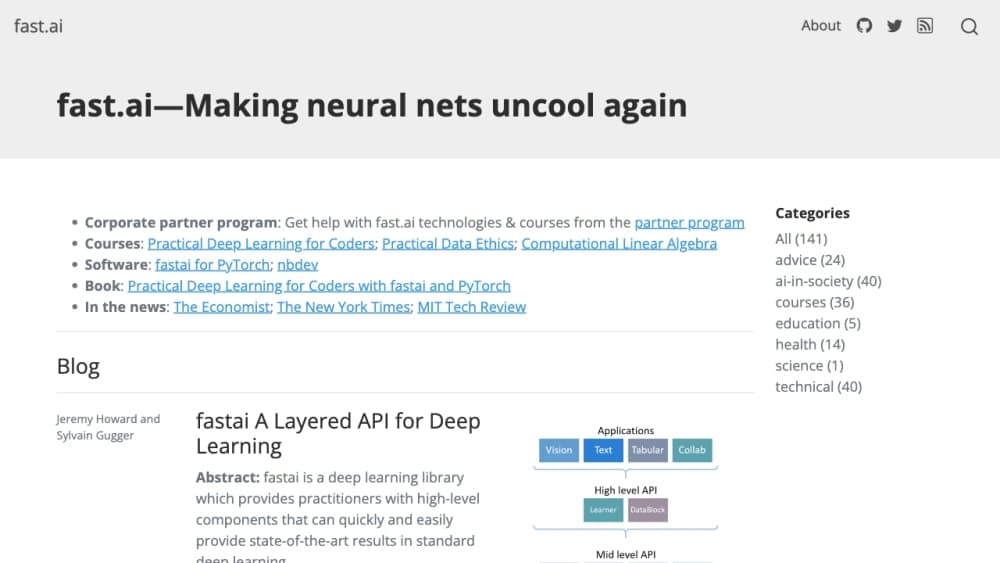
About fast.ai
What Is fast.ai
fast.ai started in October 2016 as a bet that deep learning shouldn't be reserved for people with PhDs. Co-founders Jeremy Howard and Rachel Thomas built the whole project around one claim: anyone with about a year of Python experience and high school math can train useful models. Sound too good to be true? Their course pages put it bluntly. You don't need a big dataset, a research budget, or a GPU cluster.
The teaching style is what sets it apart. Instead of opening with algebra, fast.ai shows you a working model in lesson one, then works backward to explain the machinery underneath. That inverted approach, sometimes called top-down learning, is why the videos have racked up more than six million views and why alumni now work at places like Google Brain, OpenAI, and Tesla, according to the course site.
The main limitation is that this isn't a no-code platform. Everything runs in Python, usually inside a Jupyter Notebook, and you'll be typing real code from the first session. If you want a drag-and-drop AI tool, fast.ai is the wrong door. No way around it. It's also a moving target: the organization shifted its focus after joining Answer.AI, and the newer cohort-based course costs money while the classic courses stay free.
Getting Started
- Go to course.fast.ai and start with lesson 1 of Practical Deep Learning for Coders. Each of the 9 lessons runs about 90 minutes.
- Pick a free notebook environment. The course recommends Kaggle Notebooks or Paperspace Gradient and walks you through setup, so you don't need your own GPU.
- Work through the lessons alongside the free online book, which mirrors every chapter as an interactive Jupyter Notebook.
- Build and deploy a small model on your own data by the end of lesson 2, then post it in the Show Your Work thread on the forum.
- If you want the newer, mentor-led path, check solve.it.com for How To Solve It With Code, a 10-lesson course covering coding puzzles, web apps, writing, and APIs.
Product Information
A quick look at fast.ai's pricing, supported platforms, and performance.
Best for
The users, tasks, and scenarios where this tool fits best.
Users
- Developers picking up deep learning for the first time
- Self-taught learners who bounced off theory-first courses
- Data scientists and analysts who want machine learning skills that transfer to computer vision, NLP, and tabular work
- Career changers testing the field before committing money
Tasks
- Training an image classifier on your own photos
- Building a text classifier or sentiment model with Hugging Face Transformers
- Turning a trained model into a shareable web app
- Working with tabular data like spreadsheets and CSVs
Scenarios
- Learning on a laptop or a free cloud notebook with no GPU
- Studying around a full-time job
- Getting unstuck at odd hours
Key features
Free Practical Deep Learning Course
Practical Deep Learning for Coders is the entry point, and it stays free. That's the deal. The 2022 edition recorded at the University of Queensland packs 9 lessons of about 90 minutes each, covering computer vision, NLP, tabular analysis, and collaborative filtering. You learn PyTorch, fastai, Hugging Face Transformers, and Gradio along the way, all on free cloud notebooks. The prerequisite bar is deliberately low. Some coding experience, no university math. That's it. It's a solid place to learn deep learning without paying tuition.
The fastai Library
fastai is a Python library that wraps PyTorch in higher-level building blocks. It handles the repetitive parts of a training pipeline, like data loading, augmentation, and learning rate schedules, so you can get strong results without writing hundreds of lines of setup code. The library is layered by design, which means you can call one function for a standard task or drop down to raw PyTorch when you need custom control. It's open source and free to use in your own projects. No license fees, no strings.
Part 2: Foundations to Stable Diffusion
The advanced course picks up where part 1 ends and rebuilds the machinery from scratch, including a full training loop and stochastic gradient descent. The 2023 edition added more than 30 hours of video, spanning topics like diffusion models and the techniques behind Stable Diffusion. This is where the course stops hiding complexity, and it's aimed at people who finished part 1 and want to understand why things work, not just how to call them. Expect a grind.
Free Book and Interactive Notebooks
Deep Learning for Coders with fastai and PyTorch is the companion text, and every chapter is readable free online. Each chapter also exists as a runnable Jupyter Notebook, so you can edit the code and see what changes instead of reading passive examples. That matters more than it sounds. The book drew praise from Google's research director Peter Norvig, who called it one of the best sources for a programmer to become proficient in deep learning.
Community Forum and Testimonials
forums.fast.ai is the support layer that keeps the whole thing usable. Years of threads cover everything from CUDA errors to project feedback, and the community runs a Show Your Work section where students post their models. That's where you find out whether someone else already hit your problem. The course site collects alumni stories too, including people who placed in machine learning competitions or landed roles at major labs after finishing.
The Solve It With Code Course
Since joining Answer.AI, fast.ai has been building a different kind of course. How To Solve It With Code teaches a method the team calls Dialog Engineering, where you work with an AI partner in small steps instead of generating a whole codebase at once. Small moves, better code. The 10-lesson program stretches beyond coding into writing, reading papers, web APIs, and system administration. It's a paid, cohort-based experience with a live Discord, and it's the clearest signal of where the organization is heading.
Pros and cons
Pros
- Every classic course, the book, and the fastai library are free. That's rare for deep learning material at this level.
- The top-down teaching method gets you training real models in the first lesson instead of after weeks of theory.
- Free cloud notebooks mean you don't need an expensive GPU to follow along.
- The fastai library is genuinely usable in production work, not just as a teaching prop.
- An active forum means most beginner questions already have answers.
Cons
- You need to code. There's no visual builder, so non-programmers will struggle from lesson 1.
- The core courses date to 2022 and 2023, so some tooling references lag behind current library versions.
- The newer How To Solve It With Code course costs $500 and signups close between cohorts, so the mentor-led track isn't always available.
- Course material focuses on training your own models, which is less relevant if you only plan to call a hosted AI API.
- Video-heavy lessons demand serious time. Part 1 alone runs about 13 hours before you factor in practice.
Frequently asked questions
Yes. The Practical Deep Learning for Coders courses, part 2, the online book, and the fastai library are all free. The newer Solve It With Code cohort course is paid, listing at $500, and includes 30 days of platform access before a $10/month subscription kicks in. It's a reasonable way for deep learning for beginners to start without spending anything.
Related content
Explore related tools, skills, and articles for fast.ai.
fast.ai Alternatives

Kaggle AI
Google · Coding · LeaningKaggle AI is a community platform where people build, test, and compare machine learning models against shared data. It combines data science competitions, tens of thousands of public datasets, and free cloud notebooks with GPU and TPU access, so anyone with a browser can train a model without buying hardware. Google owns the platform, and joining costs nothing.

Bunch
Bunch AI · Leaning · BusinessBunch is an AI leadership coaching app that turns a few spare minutes a day into real management practice. It hands you one short, personalized tip each day, tracks how you respond, and lets you compare notes with peers inside private groups. The pitch is simple: you lead better by practicing a little, often, instead of sitting through a weekend seminar. Think of it as a leadership training app you actually open.

AI Mock Interview
SQLPad · Coding · LeaningAI Mock Interview is a practice tool built into SQLPad that simulates real job interviews and gives you instant feedback on both what you say and how you say it. You pick a role template or upload a job description, answer questions out loud in real time, and then review a transcript with notes on structure, clarity, and grammar. It's aimed at data professionals prepping for SQL, Python, data engineering, machine learning, and system design roles, and it works entirely in the browser. No install needed.