

Finden
Finden · Coding
Finden is an AI services firm that co-creates and co-distributes AI products with enterprise teams. It fits finance, travel, and retail businesses that need a working product, not a demo.
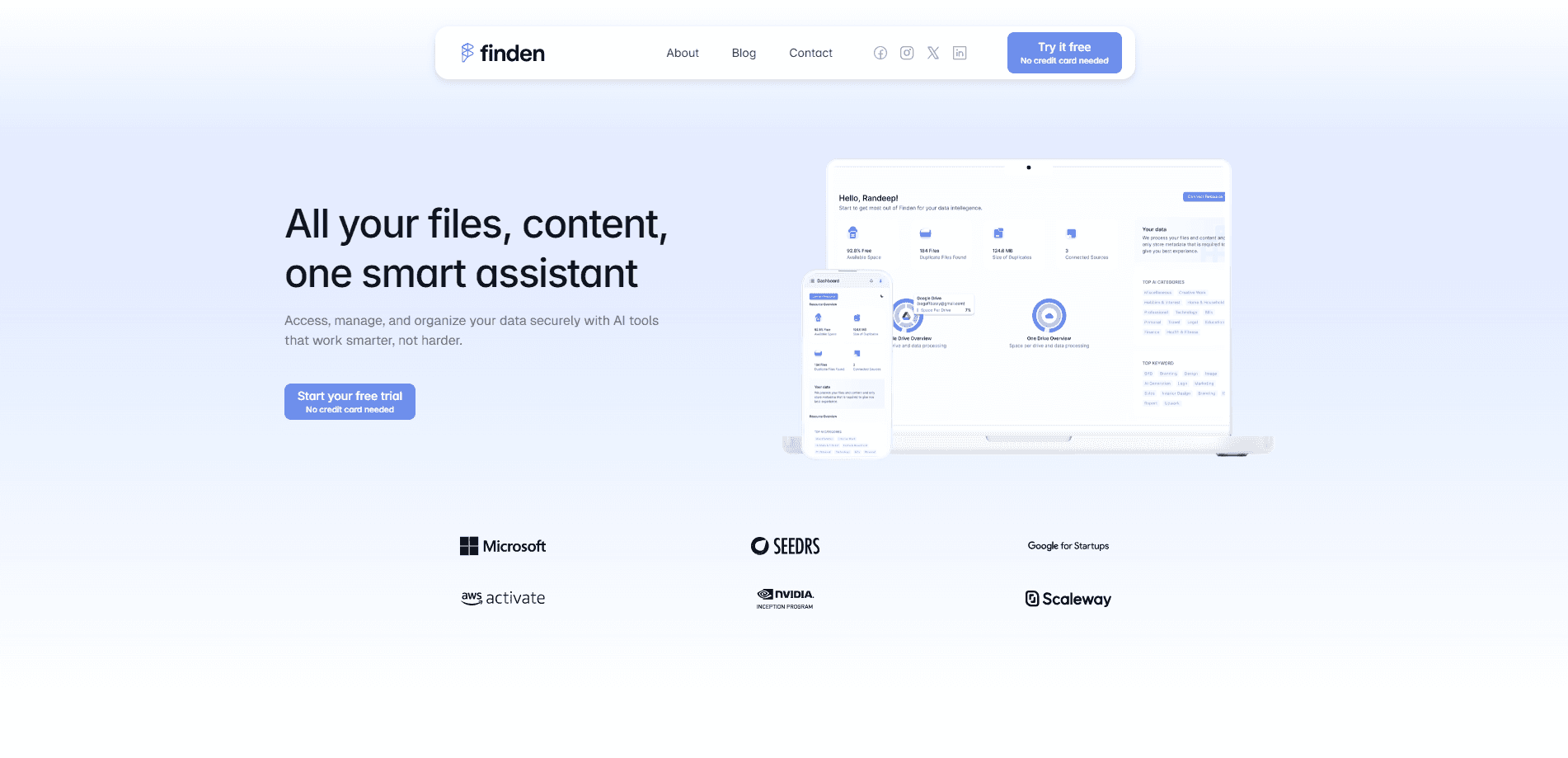
About Finden
What Is Finden
Finden is an AI services agency, not a downloadable app. Think of it as AI consulting for enterprises that want software built and shipped. It embeds a mixed team of strategists, data engineers, AI engineers, designers, and growth specialists inside a client's organization to turn an AI idea into something that runs in production. The pitch centers on outcomes: the firm says it bills on results rather than seats.
The work splits into five capabilities. AI strategy and advisory helps leadership pick which workflows actually shift unit economics. AI product co-creation builds on the Finden Platform and aims to land a first usable version within a quarter. Modern data and insights handles the pipelines, lineage, and knowledge graphs that make AI output trustworthy in an audit. Design engineering builds the dashboards and copilot interfaces people actually use. Co-distribution covers go-to-market, search visibility, and agent-powered growth.
The main thing to understand is who this is for. There's no self-serve signup, no free plan, and no public pricing. Finden takes on a small number of engagements each quarter and asks prospects to describe their problem in two paragraphs, then responds within 48 hours. That makes it a poor fit for individuals or small teams wanting to try AI tools on their own. It's built for organizations with a real budget and a workflow worth rebuilding.
Getting Started
- Reach out through the contact form on finden.me and describe your workflow or problem in about two paragraphs.
- Expect a reply within 48 hours outlining how the team would approach the work.
- Agree on the engagement scope, which typically starts with a six-week AI exploration sprint or an eight-to-twelve week path from idea to MVP.
- Work alongside the embedded squad, which builds on the Finden Platform and your existing stack.
- Move to production hardening, then to a co-distribution retainer if you want help with adoption after launch.
Product Information
A quick look at Finden's pricing, supported platforms, and performance.
Best for
The users, tasks, and scenarios where this tool fits best.
Users
- Enterprise leadership teams exploring AI
- Product and engineering leaders with an idea to ship
- Data and operations teams in regulated industries
Tasks
- Deciding where AI changes the unit economics
- Building a first production version of an AI product
- Setting up the data plumbing AI depends on
- Designing dashboards and copilot interfaces
- Planning go-to-market and distribution
Scenarios
- A bank wants one operator dashboard over scattered accounting and ops data, with automated summaries and live insights.
- A travel company needs an end-to-end booking platform built for its agents rather than bought off the shelf.
- An enterprise with abandoned AI proofs-of-concept wants help getting past the pilot stage into production.
- A telecom or retail group needs a voice or chat assistant deployed across a regulated environment.
Key features
AI Product Co-Creation
Finden builds working software end to end, pairing its own team with the client's. The stated timeline runs from idea to MVP in eight to twelve weeks, with production hardening adding about four weeks. The difference from a standard dev shop is the AI-native focus. The squad builds on the Finden Platform and a stack that spans Anthropic Claude, OpenAI GPT, Google Gemini, Microsoft Azure, and LangGraph, so model choice follows the task rather than a single vendor.
Co-Distribution and Growth Systems
Shipping a product is only half the job, and Finden treats distribution as a discipline rather than an afterthought. The team designs go-to-market strategy, builds SEO and generative engine optimization foundations, and runs agent-powered content and outbound growth automation. The argument rests on a hard number: the firm cites research that only about one in three AI products reaching launch achieve meaningful adoption.
AI Strategy and Advisory
Before any build, Finden helps leadership find the workflows where AI actually changes the economics. It offers a six-week AI exploration sprint, an operating-model design that runs four to eight weeks, and an ongoing board-level roadmap. This is aimed at cutting through the noise and picking platforms and tools per bet, then deciding where to start.
Modern Data and Insights
AI output is only as trustworthy as the data behind it, and this service covers the plumbing: the modern data stack plus its ongoing operation, knowledge graph design per domain, and an insights-as-a-service retainer. The stated goal is making outputs hold up in an audit, which matters most in finance and healthcare where every number may need a trail.
Design Engineering
The interface is where model output turns into a decision, and Finden designs the dashboards, copilots, and agent UIs that sit on top. It covers product and UX design per surface, front-end engineering per surface, and design systems per brand. Teams that already have models but a clunky UI tend to hire this work separately.
Cross-Industry Delivery Record
Finden points to products in production across finance, travel, EdTech, healthcare, the creator economy, and DevOps. Named work includes finden.me itself, an operator dashboard for financial data, Kubegraf, an AI SRE for Kubernetes, and Costar Travel, a booking platform. The record is a track record rather than a feature, but it's the firm's main proof that it ships.
Pros and cons
Pros
- Outcome-based billing means the price is tied to results rather than headcount or hours, which suits teams wary of open-ended retainers.
- The embedded squad model keeps strategists, engineers, and designers on one team instead of shipping work across separate vendors.
- Model-agnostic building across Claude, GPT, Gemini, Azure, and LangGraph avoids lock-in to a single AI provider.
- Co-distribution covers the adoption problem most AI builds ignore, with SEO, AI search, and growth automation bundled in.
Cons
- There's no public pricing and no free or self-serve tier, so you can't evaluate cost or try the work without a sales conversation.
- Engagements are limited each quarter, meaning availability depends on the firm's capacity and smaller budgets may not qualify.
- A minimum six-week sprint sets a high floor, so it's out of reach for individuals or teams testing a small idea.
- You hand internal workflows and data to an outside team, which is a real hurdle for organizations with strict data controls.
Frequently asked questions
Finden is an AI-native services firm that co-creates and co-distributes AI products with enterprise teams. It runs five capabilities: AI strategy and advisory, AI product co-creation, modern data and insights, design engineering, and co-distribution. Rather than selling software you install, it embeds its people inside your organization to build and launch something that runs in production.
Related content
Explore related tools, skills, and articles for Finden.
Finden Alternatives

Base Code
Base44 (Wix) · Coding · ProductivityBase Code is a shared cloud development environment from Base44. Teammates describe changes to an existing GitHub codebase in chat, preview them live and send them back as pull requests.

Google EmbeddingGemma 2
Google DeepMind · Writing · Image · CodingGoogle EmbeddingGemma 2 is a 740M-parameter open model that turns text, code, images, audio, and video frames into vectors in one 768-dimension space, running on phones and laptops.

GitGlow
GitGlow · Coding · ProductivityGitGlow is a local-first desktop Git client that lets independent developers review their own code and their AI agents' changes in one place before shipping.