

FineTuner
FineTuner · Other · Chatbot
FineTuner is a no-code platform that trains a custom GPT or Claude model on your own content, such as PDFs, websites, and videos, then hands you a ready-to-use API.
About FineTuner
What Is FineTuner
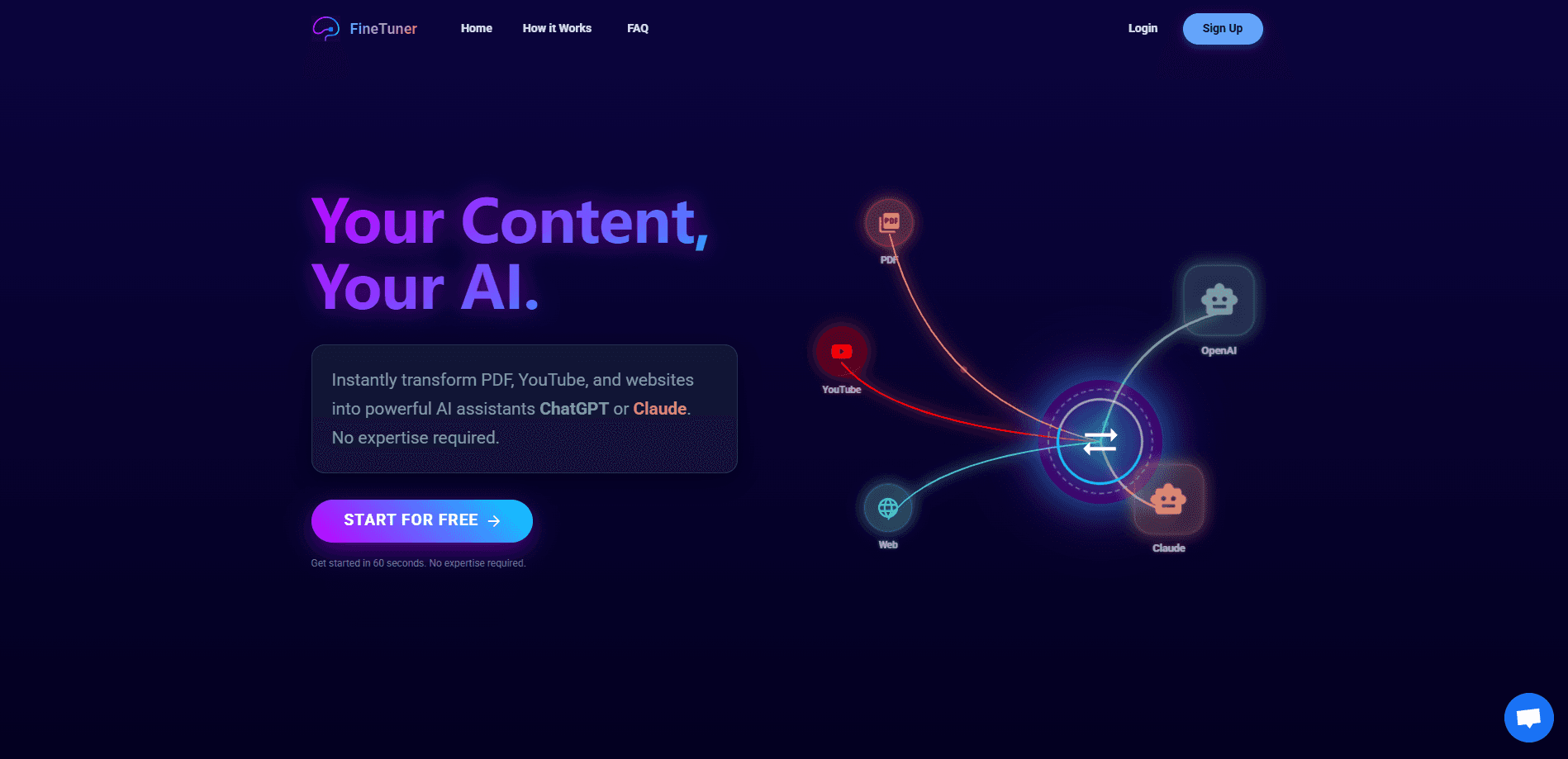
FineTuner is a web platform for people who want a language model that talks about their own material, not the open internet. You point it at the sources you already have (PDFs, a website, YouTube videos) and it builds a training dataset, runs a fine-tuning job on a GPT or Claude model, and returns an assistant you can call through an API. The whole point is to skip the setup that usually surrounds a fine-tuning project.
Fine-tuning means taking a pre-trained model and training it further on your data so it picks up your tone, your facts, and your way of answering. Doing that by hand means writing JSON, wiring a pipeline, and babysitting a training run. FineTuner pitches the opposite: upload your content, click, and get a model back in minutes rather than days. The maker says the platform handles the full chain, from scraping and cleaning the data to training, validation, and a served endpoint.
The trade-offs are worth knowing before you commit. FineTuner sits on top of models from other providers, so you inherit their limits on training data size and cost, and the quality of the result depends on how good your source content is. The project launched in 2025 and, as of late 2026, its original website (finetuner.io) no longer serves the product, which means the live service may no longer be available. Check current status before you plan around it.
Getting Started
- Create an account on finetuner.io and sign in to the dashboard.
- Add the content you want the model to learn from, including PDFs, website links, or YouTube videos.
- Let the platform generate a training dataset from those sources and clean it up.
- Pick a base model, such as a GPT or Claude checkpoint, and start the fine-tuning job.
- Take the finished model's API endpoint and plug it into your app or chatbot.
Product Information
A quick look at FineTuner's pricing, supported platforms, and performance.
Best for
The users, tasks, and scenarios where this tool fits best.
Users
- Solo builders and indie makers
- Content creators with a large back catalog
- Support and success teams
- Small businesses without ML staff
Tasks
- Fine-tuning GPT models
- Fine-tuning Claude models
- Building a training dataset
- Deploying a model behind an API
- Cloning a writing voice
Scenarios
- A blogger turning years of articles into a Q and A assistant
- A startup shipping a branded support bot
- A creator testing a personal clone
- A developer prototyping an AI feature
Key features
No-code AI fine-tuning
The core promise is that you never touch training code. You work through a guided flow instead of writing JSON or wiring a training loop, which puts model customization within reach of people who are not machine learning engineers. The steps you would normally fight through, such as formatting a dataset correctly, are handled for you.
Multi-source content ingestion
FineTuner pulls from the material you already have. PDFs, websites, and YouTube videos are all listed as inputs, so you don't have to rewrite your knowledge base before training. The platform scrapes those sources, which saves the manual copying that makes a first fine-tuning project drag on.
Automatic dataset generation and cleaning
A training set decides how good the final model is, and building one by hand is the part most people get wrong. FineTuner lets you train AI on your own data by generating a high-quality dataset from your content and cleaning it before training starts. That covers the messy middle between raw files and a usable fine-tuning job.
GPT and Claude model support
You choose which base model to fine-tune rather than being locked to one vendor. GPT and Claude checkpoints are both offered, so you can match the model to the writing style or capability you want. The result is a model that keeps the base model's strengths while picking up your content.
Ready-to-use API deployment
When training finishes, you get an AI model API endpoint for the custom model. That endpoint is what turns a fine-tuned checkpoint into something an app can call, so you skip building a serving layer yourself. It is the difference between a model that sits in a dashboard and one you can ship.
End-to-end training pipeline
The platform covers scraping, cleaning, training, validation, and deployment as one flow. Handling those stages together is what lets the product promise minutes rather than days, since you're not switching between separate tools for each step. It also means fewer places for a beginner to get stuck.
Pros and cons
Pros
- Removes the training code and dataset formatting that blocks most beginners, so a non-technical user can customize a model.
- Accepts PDFs, websites, and YouTube videos directly, which fits content creators who already have a library.
- Produces an API endpoint, so the finished model is usable in an app without extra deployment work.
- Supports both GPT and Claude, giving you a choice of base model rather than a single vendor.
Cons
- The original website no longer serves the product, so you should confirm whether the service is still running before relying on it.
- Fine-tuning inherits the limits of the underlying GPT or Claude models, including caps on training data size and added cost.
- Output quality tracks your source content, so thin or inconsistent source material produces a weak model.
- Because it sits on top of other providers, pricing and availability can change when those providers update their fine-tuning rules.
Frequently asked questions
It is a no-code platform for fine-tuning language models. You feed it your own content, it builds a training dataset and trains a GPT or Claude model on it, then gives you an API endpoint for the custom assistant.
Related content
Explore related tools, skills, and articles for FineTuner.
FineTuner Alternatives

Odyssey 3
Odyssey · OtherOdyssey-3 is Odyssey's foundation world model. It simulates physics in real time, turns a prompt into an interactive environment, and adapts to robots, cars and games.

JarvisCore
Prescott Data · Coding · Productivity · OtherJarvisCore is an open source Python runtime where AI agents work as equal peers on an agent mesh, claim tasks from a shared ledger, and reach external services through a zero-trust broker.
Clef
Cloudflare · Business · OtherClef is Cloudflare's open-source decision model for Workers AI. It returns calibrated probabilities for typed questions, not generated text, so agents can classify, route, and act fast.